In any industrial or chemical process, the goal of mixing is to achieve a uniform distribution of different substances. The most common scenarios involve combining solids with solids, solids with liquids, liquids with gases, or liquids with other liquids—which can be either miscible (able to mix) or immiscible (unable to mix). The success of any mixing operation depends entirely on generating enough energy to overcome the specific physical forces that resist blending.
The core challenge of mixing is not simply combining components, but applying the right type and amount of energy—typically through turbulence—to dominate the unique opposing forces inherent in each scenario, such as gravity, surface tension, or buoyancy.
The Core Principle: Turbulence vs. Resistance
Effective mixing is a battle between the energy you introduce and the natural tendencies of the materials you are combining.
The Role of Turbulence
The primary mechanism for mixing is turbulence, often described as chaotic fluid motion characterized by eddies and currents. These eddies act as vehicles, transporting particles or molecules from one area of the vessel to another, breaking down clumps and promoting a uniform distribution.
The Opposing Forces
Every mixing scenario has a unique set of forces that resist this distribution. The mixer's job is to generate turbulence strong enough to overpower these specific forces.
A Breakdown of Common Mixing Scenarios
Each scenario presents a distinct physical challenge that dictates the mixing strategy and equipment required.
Solid-to-Solid Dispersion
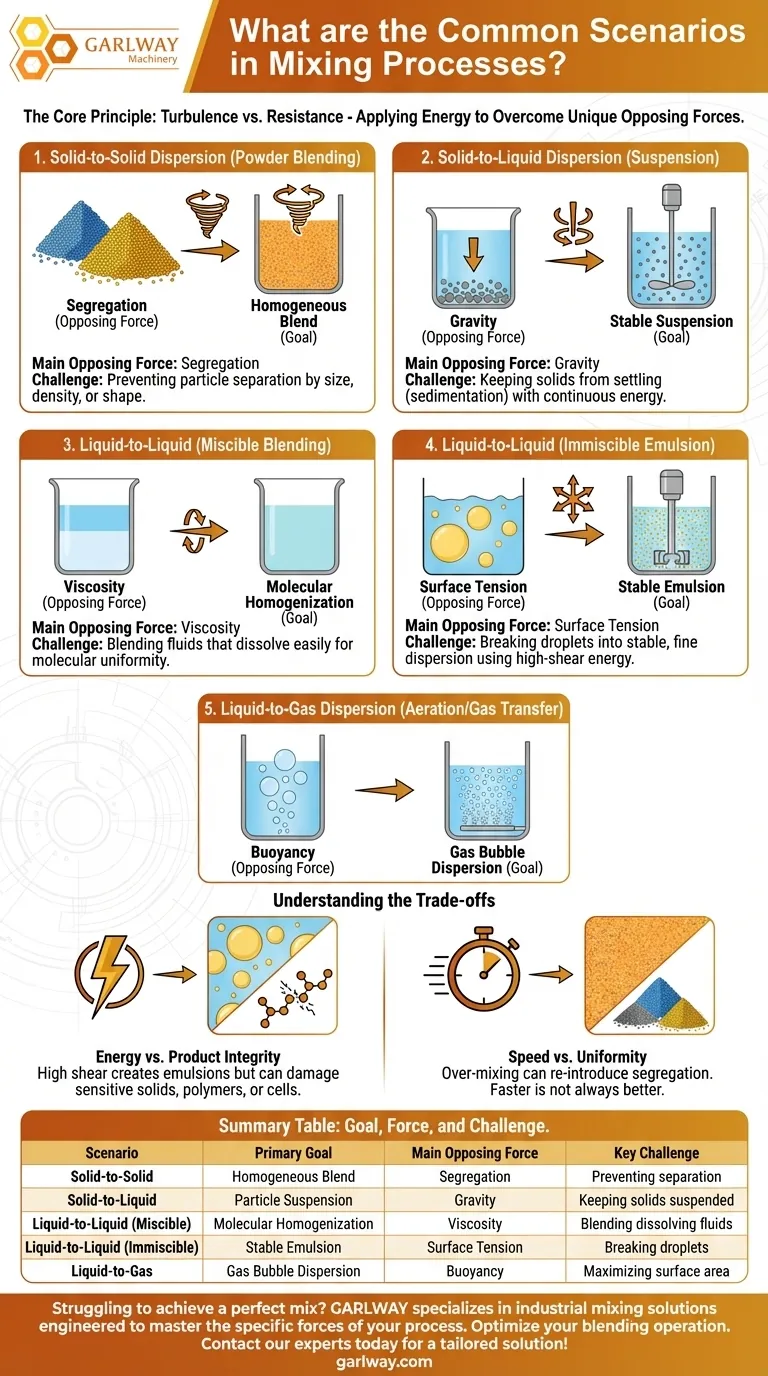
The goal here is to create a homogenous blend of two or more dry powders or granular materials. The main opposing force is segregation, where particles separate due to differences in size, density, or shape.
Solid-to-Liquid Dispersion (Suspension)
This involves suspending solid particles within a liquid without them dissolving. The primary challenge is overcoming gravity, which causes denser particles to settle to the bottom (sedimentation). This requires continuous energy to keep the particles lifted and distributed.
Liquid-to-Liquid (Miscible)
This is the process of blending two or more liquids that readily dissolve in each other, like alcohol and water. This is often the simplest scenario, as the main resistance is simply the fluid's viscosity. The goal is to achieve homogeneity at a molecular level.
Liquid-to-Liquid (Immiscible Emulsion)
Here, the goal is to disperse droplets of one liquid into another that it does not naturally mix with, like oil and vinegar. The dominant opposing force is surface tension, which causes the droplets to coalesce and separate. Creating a stable emulsion requires high-shear energy to break these droplets into smaller, more stable sizes.
Liquid-to-Gas Dispersion
This process involves dispersing gas bubbles into a liquid, such as in carbonation or bioreactors. The key challenge is buoyancy, as the gas bubbles naturally want to rise to the surface and escape. The objective is to create very small bubbles and keep them in the liquid long enough to maximize the surface area for mass transfer.
Understanding the Trade-offs
Selecting a mixing method involves balancing competing factors. An ideal solution for one scenario can be destructive in another.
Energy vs. Product Integrity
High-energy, high-shear mixing is essential for creating stable emulsions. However, this same energy can damage or destroy sensitive solids, long-chain polymers, or delicate biological cells.
Speed vs. Uniformity
A faster or more violent mix does not always lead to a better outcome. For example, over-mixing solid powders can actually re-introduce segregation as finer particles vibrate and settle beneath larger ones.
Equipment vs. Application
The physical scenario dictates the equipment. A simple propeller agitator that works perfectly for miscible liquids is completely ineffective for creating a fine-droplet emulsion, which requires a specialized high-shear rotor-stator mixer.
Making the Right Choice for Your Goal
Your mixing strategy must be directly aligned with the specific forces you are trying to overcome.
- If your primary focus is creating a stable suspension (solid-in-liquid): Your main challenge is counteracting gravity, which typically requires continuous, low-shear agitation to keep particles suspended.
- If your primary focus is blending miscible liquids: Your goal is simple homogenization, where overcoming viscosity differences with basic turbulence is sufficient.
- If your primary focus is creating an emulsion (immiscible liquids): You must apply high-shear energy to overcome surface tension and break down droplets into a stable dispersion.
- If your primary focus is gas dispersion (liquid-and-gas): Your objective is maximizing the gas-liquid surface area by creating and maintaining small bubbles against their natural buoyancy.
Ultimately, designing an effective mixing process begins with correctly identifying the fundamental physical forces you need to master.
Summary Table:
| Mixing Scenario | Primary Goal | Main Opposing Force | Key Challenge |
|---|---|---|---|
| Solid-to-Solid | Homogeneous powder blend | Segregation | Preventing particle separation by size/density |
| Solid-to-Liquid | Particle suspension | Gravity | Keeping solids from settling (sedimentation) |
| Liquid-to-Liquid (Miscible) | Molecular homogenization | Viscosity | Blending fluids that dissolve easily |
| Liquid-to-Liquid (Immiscible) | Stable emulsion | Surface Tension | Breaking droplets for a stable mixture |
| Liquid-to-Gas | Gas bubble dispersion | Buoyancy | Maximizing surface area and preventing bubble escape |
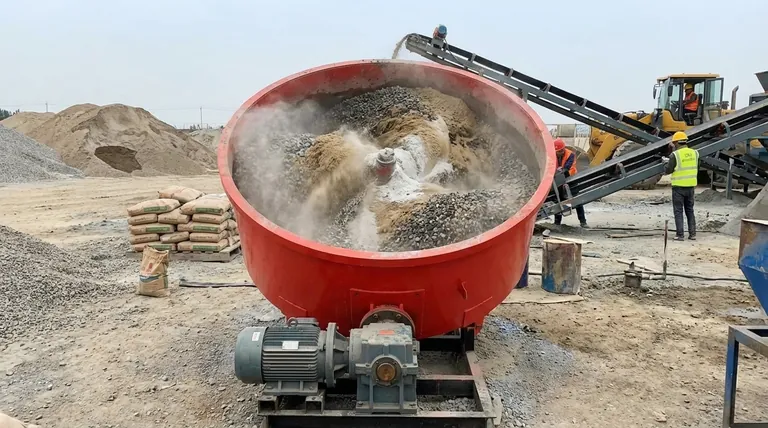
Struggling to achieve a perfect mix in your construction materials? GARLWAY specializes in industrial mixing solutions for construction companies and contractors. Our robust concrete mixers and batching plants are engineered to master the specific forces of your mixing process—ensuring uniform, high-quality results every time. Let's optimize your blending operation. Contact our experts today for a tailored solution!
Visual Guide