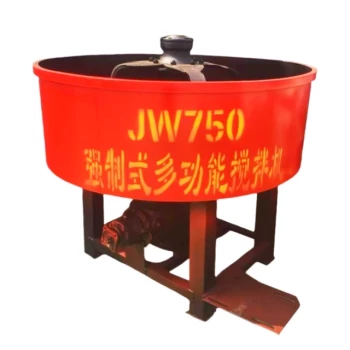
In short, the key characteristics of a mobile concrete plant are its portability, reliability, and cost-effectiveness for on-site production. These plants are specifically engineered to be moved between various locations, offering a flexible solution for temporary projects or sites with physical constraints like height restrictions.
The defining characteristic of a mobile concrete plant is its ability to deliver reliable, on-demand concrete production directly at the job site. This trades the massive scale of a stationary plant for unparalleled flexibility and logistical efficiency.
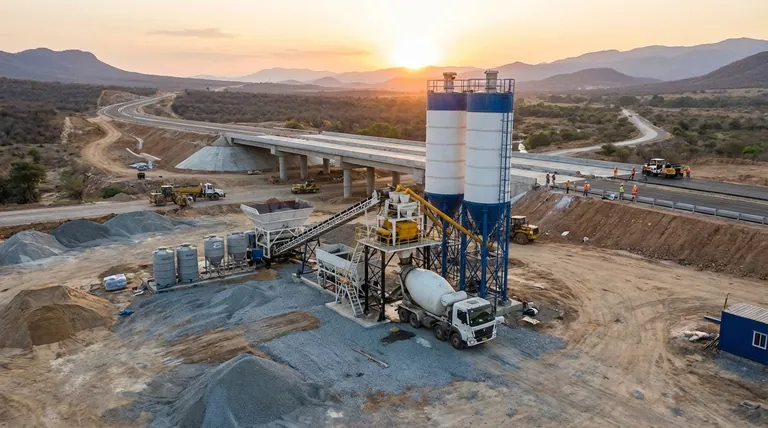
Core Attributes of Mobile Concrete Plants
A mobile concrete plant, also known as a portable batch plant, is a self-contained unit designed for easy transport and rapid setup. Understanding its core attributes is key to deploying it effectively.
Designed for Portability
The primary advantage is its mobility. These plants are built on a chassis, allowing them to be towed from one project to the next with relative ease.
This eliminates the significant logistical challenge and cost of transporting wet concrete over long distances from a central, stationary plant.
Productive and Reliable Operation
While smaller than their stationary counterparts, mobile plants are engineered for consistent and reliable production.
They can produce various types of concrete, from standard plastic concrete to thicker mixes, meeting the demands of most medium-sized construction and engineering projects.
Cost-Effective for Specific Scenarios
The cost-effectiveness comes from reducing transportation expenses and eliminating the need for a permanent foundation.
For companies managing multiple, non-continuous projects, a mobile plant is a capital asset that can be deployed wherever it is needed most.
Adaptable to Site Constraints
Mobile plants are an ideal solution for job sites with limitations. This includes remote locations, urban areas with tight space, or projects with specific height restrictions that would preclude a traditional, towering stationary plant.
Understanding the Trade-offs
Choosing a mobile plant involves recognizing its specific role. It is not a universal replacement for all concrete production methods.
Production Volume
Mobile plants are best suited for lower to medium production requirements. They are perfect for providing a dedicated supply to a specific project.
Stationary plants, in contrast, are built for massive, continuous output, often supplying concrete to dozens of projects simultaneously from a central location.
Project Duration
These plants are optimized for temporary projects. Their strength lies in being able to set up, produce the required concrete for a job, and then move on.
For very long-term, high-volume projects lasting years, the initial setup cost of a larger stationary plant may be more economical over the project's lifecycle.
Making the Right Choice for Your Project
Your decision should be driven entirely by the logistical and production demands of your work.
- If your primary focus is a series of temporary or remote job sites: The mobility and on-demand production of a mobile plant make it the most efficient and logical choice.
- If your primary focus is a single, massive infrastructure project: A high-capacity stationary plant may provide a better economy of scale over the long term.
- If your primary focus is operating in space-constrained environments: The smaller footprint and adaptability of a mobile plant are a distinct operational advantage.
By aligning the equipment's core characteristics with your project's goals, you ensure maximum efficiency and cost-effectiveness.
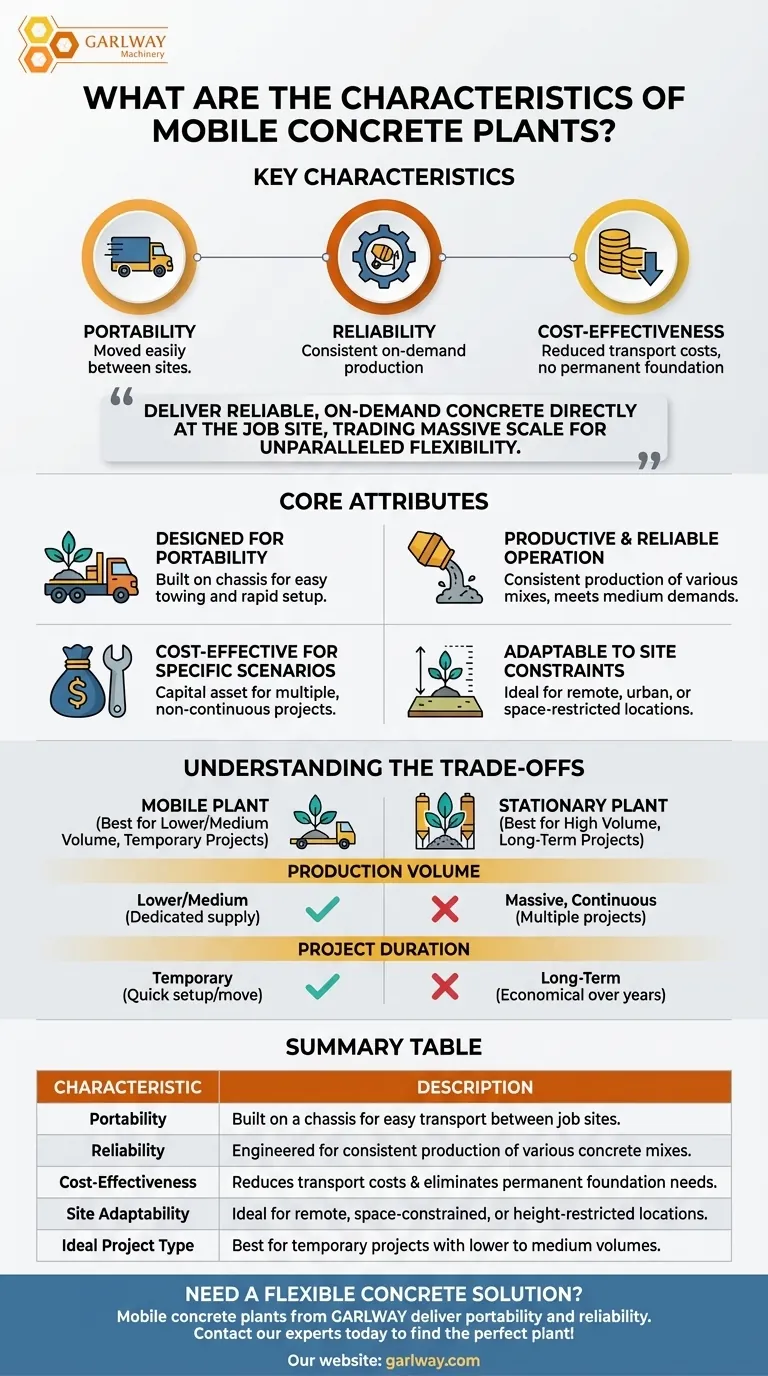
Summary Table:
| Characteristic | Description |
|---|---|
| Portability | Built on a chassis for easy transport between job sites. |
| Reliability | Engineered for consistent production of various concrete mixes. |
| Cost-Effectiveness | Reduces transport costs and eliminates the need for a permanent foundation. |
| Site Adaptability | Ideal for remote, space-constrained, or height-restricted locations. |
| Ideal Project Type | Best for temporary projects with lower to medium production volumes. |
Need a flexible concrete solution for your next project?
Mobile concrete plants from GARLWAY deliver the portability and reliability your construction company or contracting business needs. We specialize in providing high-quality construction machinery, including mobile batching plants, to help you produce concrete on-demand, reduce logistical costs, and conquer challenging job sites.
Let us help you maximize on-site efficiency. Contact our experts today to discuss your project requirements and find the perfect mobile concrete plant for your needs!
Visual Guide
Related Products
- HZS35 Small Cement Concrete Mixing Batch Plant
- JW1000 Mobile Cement Mixer Concrete Mixer Truck and Batching Plant
- Belle Cement Mixer JS2000 Volumetric Concrete Mixer for Harbor Freight
- Commercial Electric Concrete Mixer Machine HZS 50 Small Batch Plant for Sale
- JZC400 Mobile Small Concrete Mixer Cement Mixer Machine
People Also Ask
- Why buy concrete batch plant parts only from the manufacturer? Protect Your Investment and Maximize Uptime
- Why is proper maintenance important for a concrete batch mix plant? Maximize Uptime & Profitability
- What is the advantage of a mobile concrete batching plant? Achieve On-Site Production & Total Control
- What are the advantages and disadvantages of concrete batching plants? Maximize Quality & Efficiency
- What are the two methods of material charging in a concrete mixing station? Single vs. Multiple Charging Explained