
High shear mixers are engineered to solve the most challenging mixing tasks by applying intense mechanical energy where standard agitators fail. Their primary capabilities include creating stable emulsions, producing uniform homogenizations, dispersing solids into liquids, reducing particle size, and disintegrating materials. They achieve this by using a high-speed rotor that generates substantial shear forces, making them ideal for processing immiscible liquids or substances with varying viscosities.
The core function of a high shear mixer is not simply to blend ingredients, but to fundamentally alter the physical properties of a mixture by breaking down particles and droplets to a microscopic level, ensuring uniformity and stability that cannot be achieved by simple stirring.
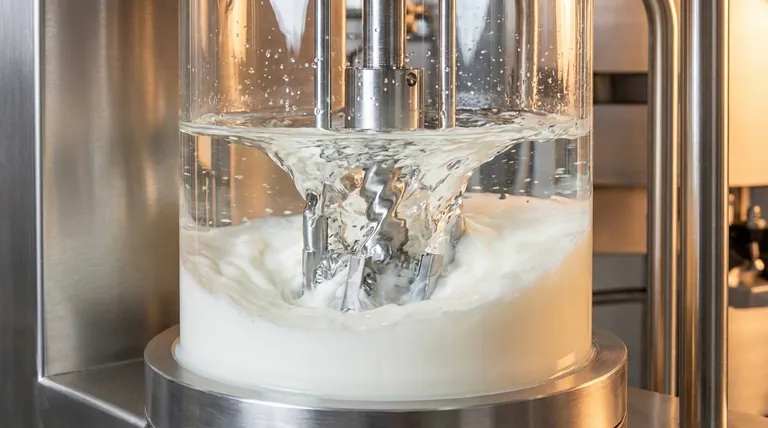
How High Shear Mixers Generate Force
At the heart of a high shear mixer's capability is its unique mechanism for applying focused, intense energy into a fluid. This process is far more dynamic than simple agitation.
The Rotor and Stator Principle
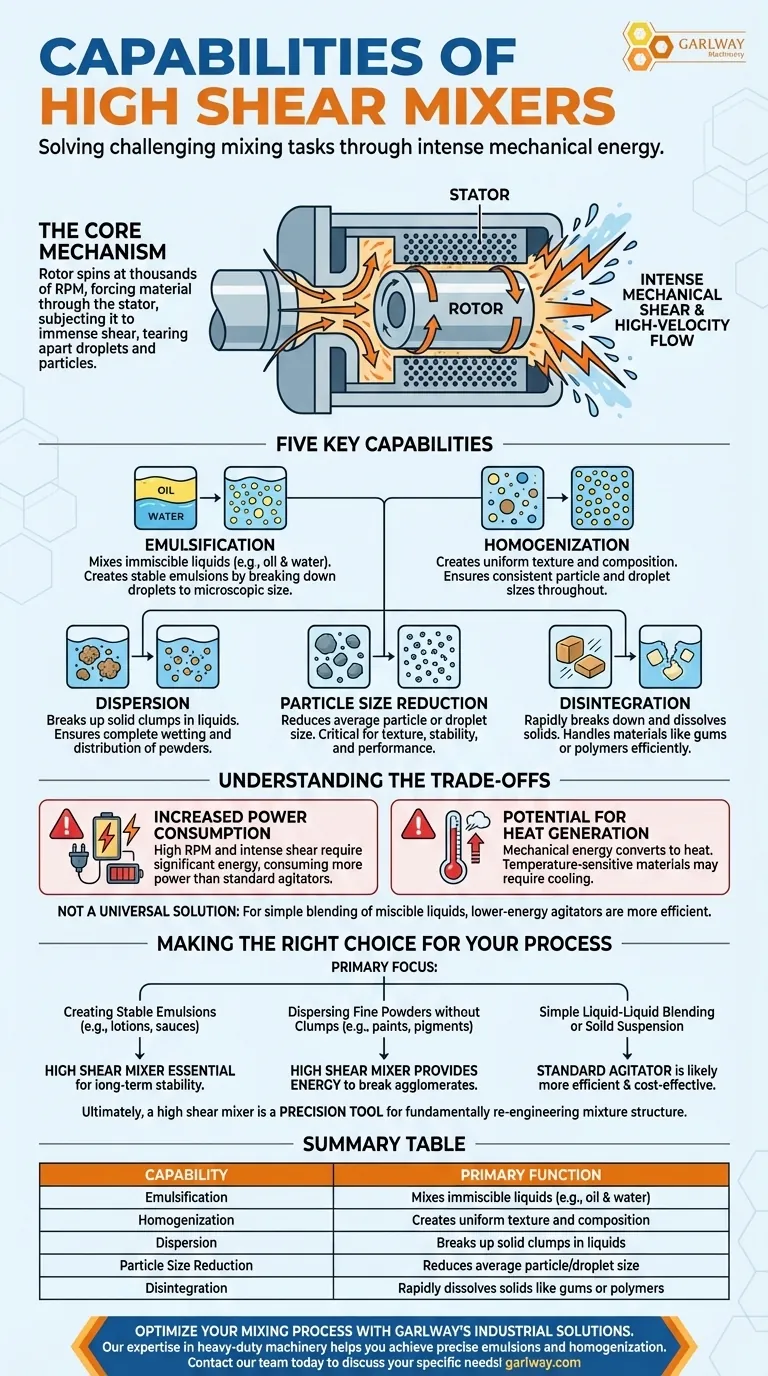
A high shear mixer consists of a high-speed rotating component, the rotor, nested within a stationary component, the stator. Both parts have slots, holes, or teeth.
Creating Intense Mechanical Shear
The rotor spins at thousands of revolutions per minute (RPM), pulling materials in and expelling them radially at high velocity through the openings in the stator.
As the material is forced through the narrow clearance between the fast-moving rotor and the stationary stator, it is subjected to immense mechanical shear, effectively tearing apart droplets and particles.
The Impact of High-Velocity Flow
This high-velocity expulsion also generates intense hydraulic shear and turbulence within the vessel, which rapidly circulates the entire batch and ensures all material passes through the high-shear zone repeatedly.
A Closer Look at Core Capabilities
Each capability of a high shear mixer is a direct result of its ability to apply this intense, localized energy.
Emulsification
This is the process of mixing two liquids that normally do not mix, like oil and water. The mixer's high shear force breaks down droplets of the dispersed phase to such a small size that they can remain uniformly suspended within the continuous phase, creating a stable emulsion.
Homogenization
Homogenization aims to create a mixture with a uniform, consistent texture and composition. The mixer ensures that all components, whether liquid or solid, are evenly distributed and that droplet or particle sizes are consistent throughout the batch.
Dispersion
When adding solid powders to a liquid, they often form clumps or agglomerates. High shear force breaks these clumps apart, ensuring each solid particle is fully wetted by and distributed within the liquid base.
Particle Size Reduction
The intense mechanical forces are strong enough to physically break down or tear apart solid particles or liquid droplets. This reduces the average particle size in the mixture, which can be critical for product texture, stability, and performance.
Disintegration
High shear mixers can rapidly break down and dissolve larger solid materials within a liquid. This includes solids like gums, polymers, or other materials that would take an exceptionally long time to dissolve with simple agitation.
Understanding the Trade-offs
While powerful, a high shear mixer is a specialized tool with specific operational considerations. It is not always the right choice for every application.
Increased Power Consumption
Generating thousands of RPMs and intense shear requires a significant amount of energy. Consequently, high shear mixers consume substantially more power than standard, low-speed agitators.
Potential for Heat Generation
The intense mechanical energy applied to the product is largely converted into heat. For temperature-sensitive materials, this may require the use of a jacketed vessel or a post-mixing cooling process.
Not a Universal Solution
For simple tasks like blending two miscible liquids of similar viscosity, a high shear mixer is often unnecessary. A less energy-intensive propeller or turbine mixer would be more efficient for such applications.
Making the Right Choice for Your Process
Selecting the correct mixing technology depends entirely on the final product characteristics you need to achieve.
- If your primary focus is creating stable emulsions (e.g., lotions, sauces): The intense droplet size reduction from a high shear mixer is essential for long-term product stability.
- If your primary focus is dispersing fine powders without clumps (e.g., paints, pigments): A high shear mixer provides the energy required to break apart agglomerates and ensure uniform distribution.
- If your primary focus is simple liquid-liquid blending or solid suspension: A standard, lower-energy agitator is likely a more efficient and cost-effective choice.
Ultimately, a high shear mixer is a precision tool for fundamentally re-engineering the physical structure of your mixture.
Summary Table:
| Capability | Primary Function |
|---|---|
| Emulsification | Mixes immiscible liquids (e.g., oil & water) |
| Homogenization | Creates uniform texture and composition |
| Dispersion | Breaks up solid clumps in liquids |
| Particle Size Reduction | Reduces average particle/droplet size |
| Disintegration | Rapidly dissolves solids like gums or polymers |
Optimize your mixing process with GARLWAY's industrial solutions. Our expertise in heavy-duty machinery, including robust mixers, can help you achieve the precise emulsions and homogenization your projects demand. Whether you're a contractor or a large construction firm, we provide reliable equipment built for performance. Contact our team today to discuss your specific needs!
Visual Guide
Related Products
- Commercial Electric Concrete Mixer Machine HZS 50 Small Batch Plant for Sale
- HZS90 Large Multiquip Concrete Mixers for Construction
- HZS25 Best Cement Mixer for Quick Mix Concrete at Bunnings
- Belle Mixer Drum Self Loading Mortar Mixers JS3000
- JDY350 Electric Hydraulic Mortar Mud Concrete Mixer
People Also Ask
- What are the types of concrete mixers used in batching plants? Choose the Right Mixer for Your Project
- What is the core component of a concrete batching plant? The Mixer Unit Defines Your Concrete Quality
- Why is proper maintenance important for a concrete batch mix plant? Maximize Uptime & Profitability
- Why buy concrete batch plant parts only from the manufacturer? Protect Your Investment and Maximize Uptime
- What are the two main types of concrete batch mixers? Choose the Right Mixer for Your Project


