The primary benefits of a tilting drum mixer are its speed, precision, and ability to handle challenging materials. It allows for the rapid discharge of concrete by tilting the entire drum, provides precise pouring control to reduce waste, and is exceptionally effective for mixing low-workability concrete or mixes containing large aggregates.
Tilting drum mixers are defined by their discharge mechanism. Instead of reversing rotation, the entire drum tilts downward, using gravity for a swift and complete emptying of the contents. This core design makes it uniquely suited for high-speed operations and difficult concrete specifications.
The Core Mechanism: How Tilting Drives Efficiency
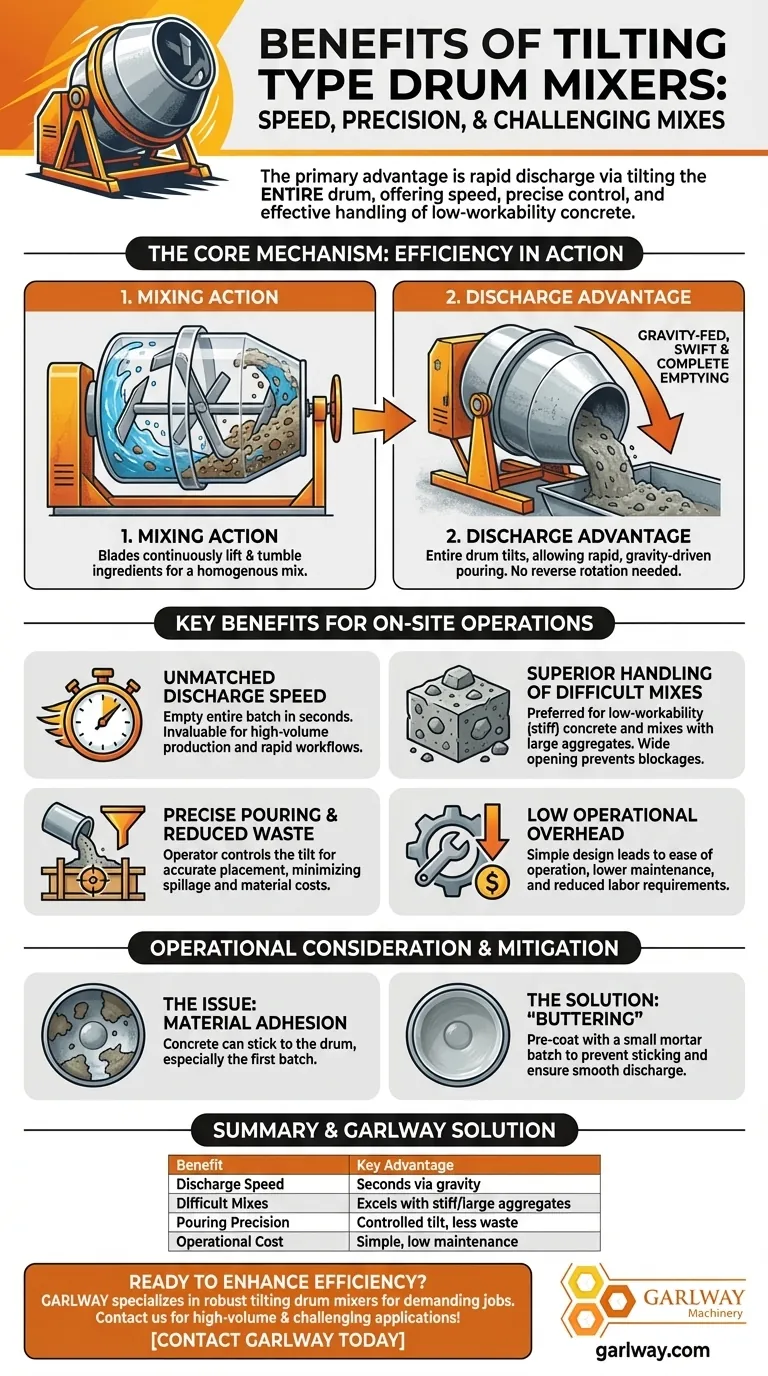
The effectiveness of a tilting drum mixer comes from its straightforward yet powerful design. The process is divided into two simple phases: mixing and discharging.
The Mixing Action
Inside the drum, strategically positioned blades continuously lift and tumble the ingredients. This action ensures that cement, aggregates, and water are thoroughly combined into a uniform, homogenous mixture.
The Discharge Advantage
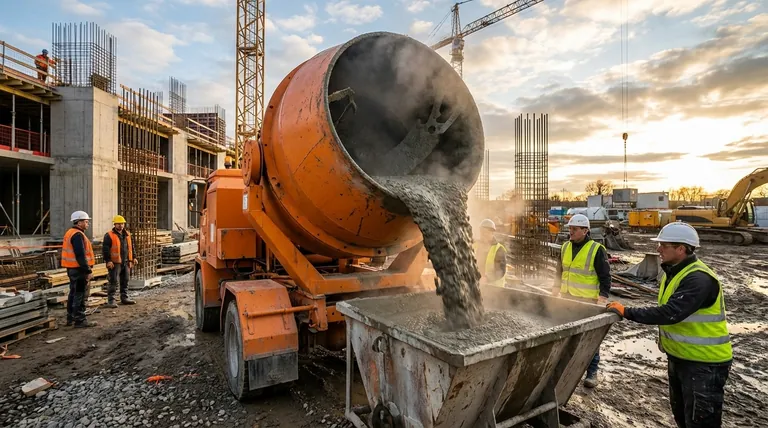
Once mixing is complete, the entire drum pivots and tilts downwards. This action allows the mixed concrete to pour out quickly and completely, driven by gravity. This is fundamentally faster than non-tilting mixers that must reverse their rotation to slowly push the material out.
Key Benefits for On-Site Operations
The design of a tilting drum mixer translates directly into practical advantages that improve workflow and accommodate specific project demands.
Unmatched Discharge Speed
The ability to empty the entire batch in seconds is the most significant benefit. For projects requiring high-volume production and a rapid workflow, this quick turnaround time is invaluable.
Superior Handling of Difficult Mixes
Tilting drum mixers excel where others struggle. They are the preferred choice for low-workability (stiff) concrete and mixes containing large aggregates because the wide opening and gravity-assisted pour prevent the material from getting stuck during discharge.
Precise Pouring and Reduced Waste
The tilting motion gives the operator significant control over the pour. This precision is especially useful for directing concrete into forms or wheelbarrows at lower levels, minimizing spillage and reducing material waste.
Low Operational Overhead
Like other drum mixers, tilting models are known for their operational simplicity. They are easy to operate, require less labor, and generally have the lowest maintenance and operating costs compared to other mixer types.
Understanding the Trade-offs
While highly effective, tilting drum mixers are not without their operational considerations. Understanding these helps ensure optimal performance.
The Issue of Material Adhesion
A common issue is that some of the concrete mix can stick to the bottom surfaces of the drum, especially during the first batch of the day.
The "Buttering" Mitigation
This problem is typically solved by "buttering" the mixer. Before mixing the first official batch, a small amount of cement mortar is mixed and discharged to coat the drum's interior. This pre-coating prevents the main concrete batch from sticking.
Factors Affecting Performance
The overall mixing efficiency is not guaranteed by the type alone. It is a result of optimal design, including the specific shape of the drum, the angle of the blades, and the maximum tilt angle.
Making the Right Choice for Your Project
Selecting a tilting drum mixer depends on the specific demands of your job site and the type of concrete you need to produce.
- If your primary focus is speed and high-volume production: The rapid, gravity-fed discharge of a tilting drum mixer will significantly improve your cycle times.
- If your primary focus is working with stiff or large aggregate concrete: This mixer type is specifically designed to handle these challenging mixes without blockages.
- If your primary focus is precision and minimizing waste: The controlled pour from a tilting drum gives you the ability to place concrete exactly where it's needed.
Ultimately, choosing a tilting drum mixer empowers you to tackle demanding concrete jobs with speed and reliability.
Summary Table:
| Benefit | Key Advantage |
|---|---|
| Discharge Speed | Entire batch empties in seconds via gravity, improving cycle times. |
| Handles Difficult Mixes | Excels with low-workability concrete and large aggregates. |
| Pouring Precision | Controlled tilting motion minimizes spillage and material waste. |
| Operational Cost | Simple operation leads to low maintenance and labor requirements. |
Ready to enhance your project's efficiency with a reliable tilting drum mixer? GARLWAY specializes in providing robust construction machinery, including concrete mixers, for contractors and construction companies worldwide. Our equipment is designed to handle demanding jobs with speed and precision, helping you save time and reduce material costs. Contact GARLWAY today to find the perfect mixer for your high-volume or challenging concrete applications!
Visual Guide
Related Products
- Concrete Cement Mixer Machine Drum Mixer for Construction
- Belle Mixer Drum Self Loading Mortar Mixers JS3000
- Portable Cement Mixer with Lift Concrete Machine
- Skid Steer Self Loading Concrete Mixers for Construction
- Shaft Mixer Machine for Cement and Regular Concrete Mixing
People Also Ask
- What are the key advantages of using drum mixers in concrete mixing? Boost Volume & Efficiency on Your Site
- What are the key components that maintain concrete mix consistency in the drum? Ensure Uniform Quality from Plant to Site
- How do cement mixers enhance safety on construction sites? Reduce Strain, Hazards, and Accidents
- When was the first concrete mixer developed and by whom? Discover the 1900 Breakthrough
- What is the average lifespan of a concrete mixer? Maximize Your Equipment's Lifespan & ROI