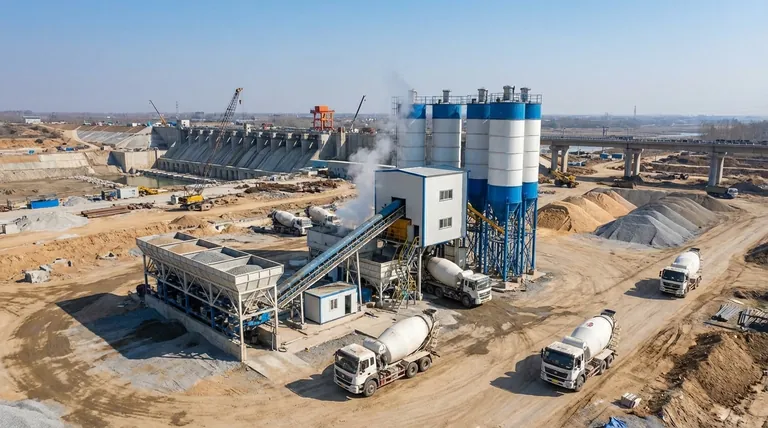
The primary advantages of a stationary concrete plant are high-volume output, superior quality control, and operational stability. Engineered for long-term projects and centralized production, these facilities deliver consistently high-specification concrete with remarkable efficiency, making them the backbone of major construction and infrastructure development.
A stationary concrete plant is an investment in production certainty. While it lacks mobility, it provides unparalleled control over the quality, consistency, and volume of concrete required for demanding, large-scale applications.
Unpacking the Core Performance Advantages
Stationary plants are designed from the ground up for one purpose: to produce vast quantities of high-grade concrete from a fixed location. This singular focus translates into several key performance benefits.
Superior Concrete Quality and Consistency
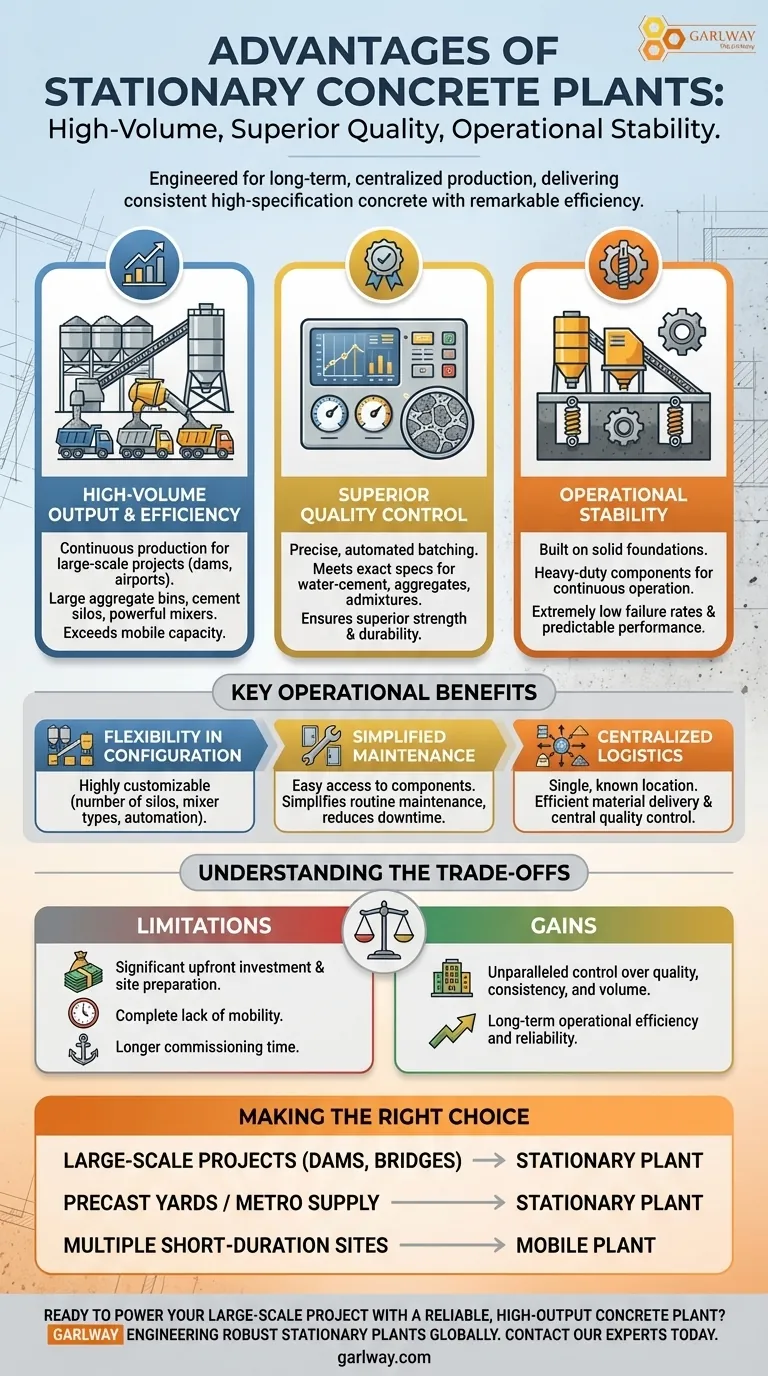
The fixed, robust nature of a stationary plant allows for highly precise and automated batching systems. This ensures every batch meets exact specifications for water-cement ratio, aggregate grading, and admixture dosage, leading to superior final strength and durability.
High-Volume Output and Efficiency
These plants are built for scale. With large aggregate bins, cement silos, and powerful mixers, they can produce a continuous and significant volume of concrete, far exceeding the capacity of mobile alternatives. This high output is critical for projects with tight schedules like dams, airports, or major roadworks.
Unmatched Stability and Reliability
Stationary plants are built on solid foundations with heavy-duty components designed for continuous operation. This inherent stability minimizes vibrations and mechanical stress, leading to extremely low failure rates and predictable, reliable performance over the life of a project.
Key Operational Benefits
Beyond raw output, the design of a stationary plant provides significant advantages in day-to-day operations and long-term use.
Flexibility in Configuration
Unlike standardized mobile units, stationary plants can be highly customized. Owners can specify the number and size of silos, types of mixers, and level of automation to perfectly match the needs of a specific market or long-term project.
Simplified Maintenance
With more space and a permanent layout, components are easily accessible for inspection, cleaning, and repair. This straightforward access simplifies routine maintenance, reduces downtime, and extends the operational life of the plant.
Centralized Logistics
Operating from a single, known location simplifies the management of raw materials. Bulk deliveries of cement, sand, and aggregates can be scheduled efficiently, and quality control can be managed centrally, ensuring all inputs meet project standards.
Understanding the Trade-offs
To maintain an objective view, it's crucial to understand what you give up by choosing a stationary plant. The benefits of stability and scale come with clear limitations.
Significant Upfront Investment
A stationary plant requires a dedicated site, extensive foundation work, and a longer, more complex installation process. This results in a much higher initial capital expenditure compared to mobile plants.
Complete Lack of Mobility
The most obvious trade-off is its immobility. The plant is a permanent or semi-permanent structure, making it entirely unsuitable for projects that are short-term or spread across multiple, geographically dispersed locations.
Longer Commissioning Time
From site preparation to final calibration, getting a stationary plant operational is a multi-week or multi-month process. This lead time must be factored into the overall project schedule.
Making the Right Choice for Your Project
Selecting the right type of concrete plant depends entirely on your project's goals and constraints.
- If your primary focus is a single, large-scale project like a dam, bridge, or major commercial building: A stationary plant offers the essential high-volume output and stringent quality control.
- If your primary focus is supplying concrete to a precast yard or a specific metropolitan area: The centralized production and reliability of a stationary plant are ideal for this business model.
- If your primary focus is supporting multiple, short-duration job sites like residential foundations or road repairs: The immobility is a deal-breaker; a mobile plant is the correct technical solution.
Ultimately, a stationary concrete plant provides a powerful, centralized hub for production that prioritizes quality and scale above all else.
Summary Table:
| Advantage | Key Benefit |
|---|---|
| Quality & Consistency | Precise, automated batching for superior strength and durability. |
| High-Volume Output | Continuous production for large-scale projects like dams and airports. |
| Stability & Reliability | Heavy-duty design for low failure rates and predictable performance. |
| Operational Flexibility | Customizable configuration to match specific project or market needs. |
| Simplified Maintenance | Easy access to components for reduced downtime and longer life. |
Ready to power your large-scale construction project with a reliable, high-output concrete plant?
GARLWAY specializes in engineering robust stationary concrete batching plants for construction companies and contractors globally. Our solutions are designed to deliver the quality, volume, and operational stability your major projects demand.
Contact our experts today to discuss how a GARLWAY stationary plant can be the backbone of your success.
Visual Guide
Related Products
- HZS90 Large Multiquip Concrete Mixers for Construction
- HZS35 Small Cement Concrete Mixing Batch Plant
- HZS180 Ready Mix Concrete Plant for Foundations with Sand and Cement
- Commercial Electric Concrete Mixer Machine HZS 50 Small Batch Plant for Sale
- HZS75 Concrete Batching Plant Cement Mixer Price Concrete Mixer Bunnings Mixing Plant
People Also Ask
- What are the types of concrete mixers used in batching plants? Choose the Right Mixer for Your Project
- What is the core component of a concrete batching plant? The Mixer Unit Defines Your Concrete Quality
- What are the different power sources for concrete mixers? Choose the Right Power for Your Project
- What are the main types of concrete mixers? A Guide to Batch, Continuous & More
- What are the main types of concrete mixers mentioned? Find the Perfect Mixer for Your Project