The primary advantages of a static mixer are its ability to enable continuous material flow, achieve rapid mixing of steady fluid streams, and provide precise, repeatable control over the mixing process. Because it has no moving parts, it offers a simple, low-maintenance, and energy-efficient solution for specific industrial applications.
A static mixer's core advantage stems from its elegant simplicity. By eliminating moving components, it transforms the fluid's own flow energy into a highly efficient and predictable mixing force, making it an exceptionally reliable choice for continuous processing lines.
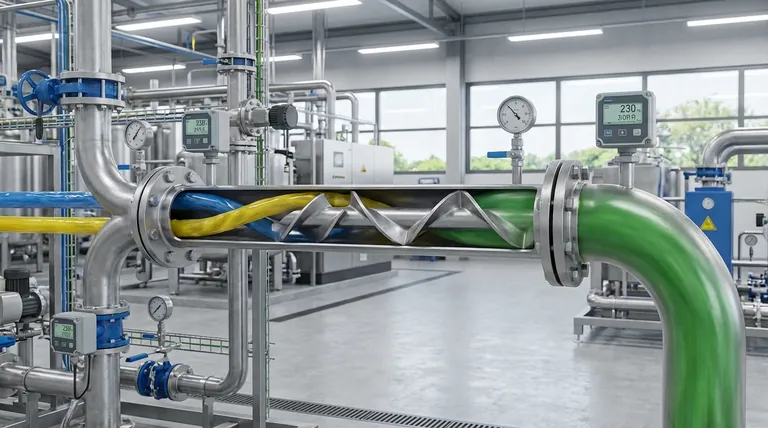
How Static Mixers Achieve High Performance
A static mixer is not a machine in the traditional sense; it is a carefully engineered obstacle course for fluid. Its design is the key to its effectiveness.
The Principle of No Moving Parts
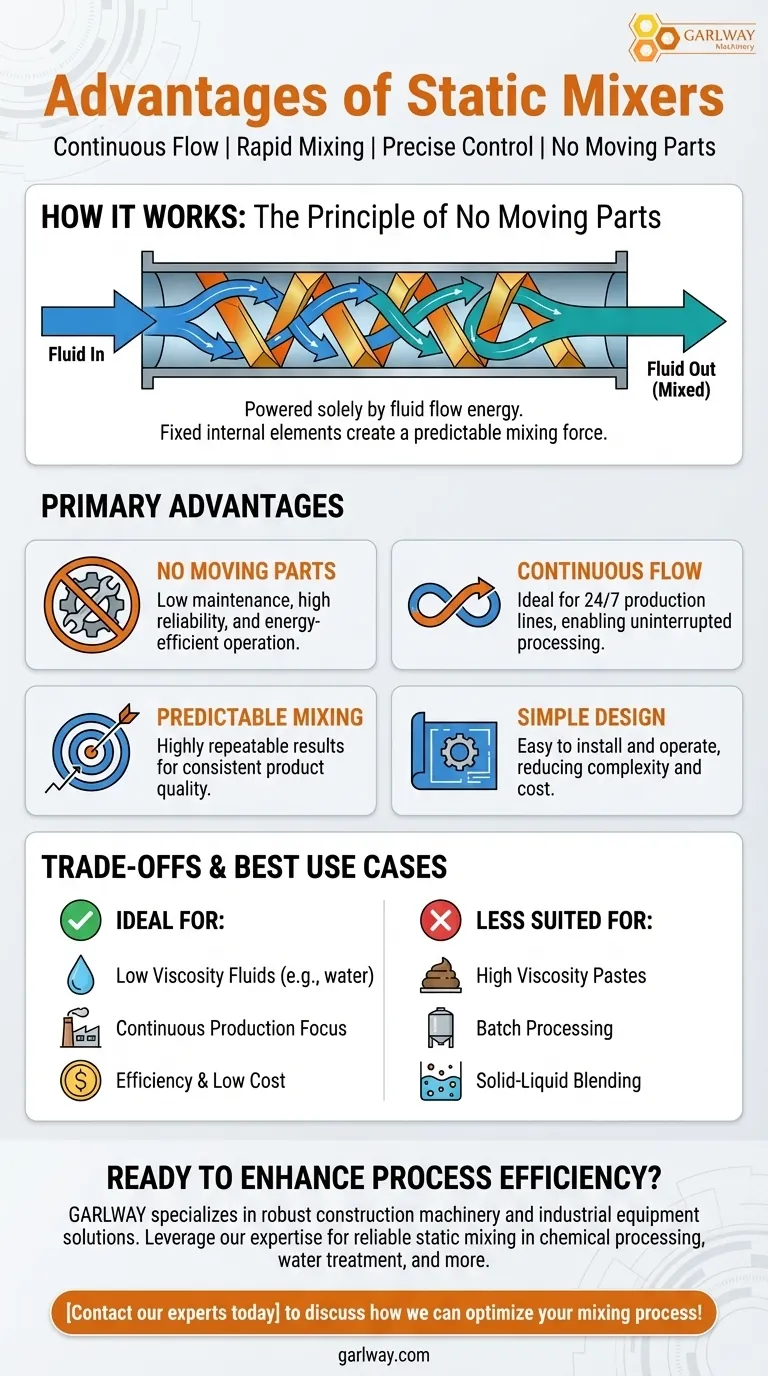
The device consists of a housing pipe containing a series of fixed, geometric elements or baffles. These elements, often ribbon-shaped and made of metal alloys or plastic, repeatedly split, stretch, and redirect the fluid streams as they pass through.
This entire mixing action is passive. It is powered solely by the energy of the fluid being pumped through the unit.
Designed for Continuous, Uninterrupted Flow
Unlike dynamic mixers that process materials in batches, static mixers are designed to be placed directly into a pipeline. This makes them ideal for production lines that require continuous, uninterrupted operation.
Materials enter one end, are thoroughly mixed by the time they exit the other, and the process can run indefinitely without stopping.
Rapid and Predictable Mixing
The fixed geometry of the internal blades ensures the mixing result is highly predictable and repeatable. The degree of mixing is a direct function of the fluid's properties and flow rate, allowing for precise control.
This makes them invaluable in industries like chemical, pharmaceutical, and water treatment where consistent product quality is paramount.
Understanding the Trade-offs and Limitations
While highly effective, the static mixer is a specialized tool. Its advantages are most pronounced when used within its intended operational parameters.
Ideal for Low Viscosity Fluids
Static mixers excel at blending low-viscosity liquids, such as water-like fluids, or for injecting a gas into a liquid. They are generally less effective for high-viscosity pastes or for blending solids into liquids.
Not Suited for Batch Processing
Their inline, continuous nature makes them an unsuitable choice for processes that require discrete, contained batches. A traditional tank with a dynamic agitator is the correct tool for that task.
Performance Depends on Flow Rate
Because the mixer has no motor, the mixing energy is entirely dependent on the pump pushing the fluid through it. A significant change in flow rate will directly impact the mixing performance, and a certain amount of pressure drop across the unit is unavoidable.
Making the Right Choice for Your Process
Selecting the correct mixing technology requires a clear understanding of your primary operational goal.
- If your primary focus is continuous production and efficiency: A static mixer is an excellent choice for its reliability, low energy use, and minimal maintenance needs in a 24/7 pipeline.
- If your primary focus is versatility for batch production: A dynamic mixer in a tank provides the flexibility needed to handle various materials, viscosities, and batch sizes.
- If your primary focus is minimizing operational costs: The static mixer's lack of a motor and moving parts translates directly into lower energy bills and reduced maintenance downtime.
Ultimately, choosing a static mixer is a decision for process simplicity and unwavering consistency in the right application.
Summary Table:
| Advantage | Key Benefit |
|---|---|
| No Moving Parts | Low maintenance, high reliability, and energy-efficient operation. |
| Continuous Flow | Ideal for 24/7 production lines, enabling uninterrupted processing. |
| Predictable Mixing | Highly repeatable results for consistent product quality. |
| Simple Design | Easy to install and operate, reducing complexity and cost. |
Ready to enhance your process efficiency with reliable static mixing?
GARLWAY specializes in providing robust construction machinery and industrial equipment solutions. If your operations involve continuous mixing for chemical processing, water treatment, or other industrial applications, our expertise can help you select the right technology for maximum reliability and cost savings.
Contact our experts today to discuss how we can optimize your mixing process!
Visual Guide
Related Products
- Portable Concrete Mixer Machine Equipment for Mixing Concrete
- HZS90 Large Multiquip Concrete Mixers for Construction
- Skid Steer Self Loading Concrete Mixers for Construction
- JS1000 Volumetric Concrete Mortar Mixer for Sale Skid Steer Cement Mixer
- Ready Mixer Machine for Construction Ready Mix Machinery
People Also Ask
- Why is it necessary to use a portable concrete mixer? Gain Total Control & Efficiency
- How much concrete can you pour with a portable mixer? Find the Perfect Fit for Your Project
- What types of projects are portable concrete mixers suitable for? Ideal for DIY & Small-Scale Construction
- How much does a portable concrete mixer hold? A Guide to Choosing the Right Capacity
- What types of portable concrete mixers exist? Find the Perfect Mixer for Your Project