
The primary advantages of a ribbon blender are its speed and its efficiency in producing a consistent, homogenous blend with dry, free-flowing solids. Its design utilizes a specific convective mixing pattern that completes blending cycles very quickly, often in just a few minutes.
While a ribbon blender is a powerful and rapid tool for many powder applications, its true advantage is realized only when matched to the right materials. Its efficiency with robust solids is a direct trade-off for its unsuitability for delicate or high-shear applications.

The Core Mechanism: Convective Mixing
A ribbon blender's effectiveness comes from its simple yet highly effective mechanical design. Understanding this mechanism is key to knowing when to use it.
The Double-Helical Agitator
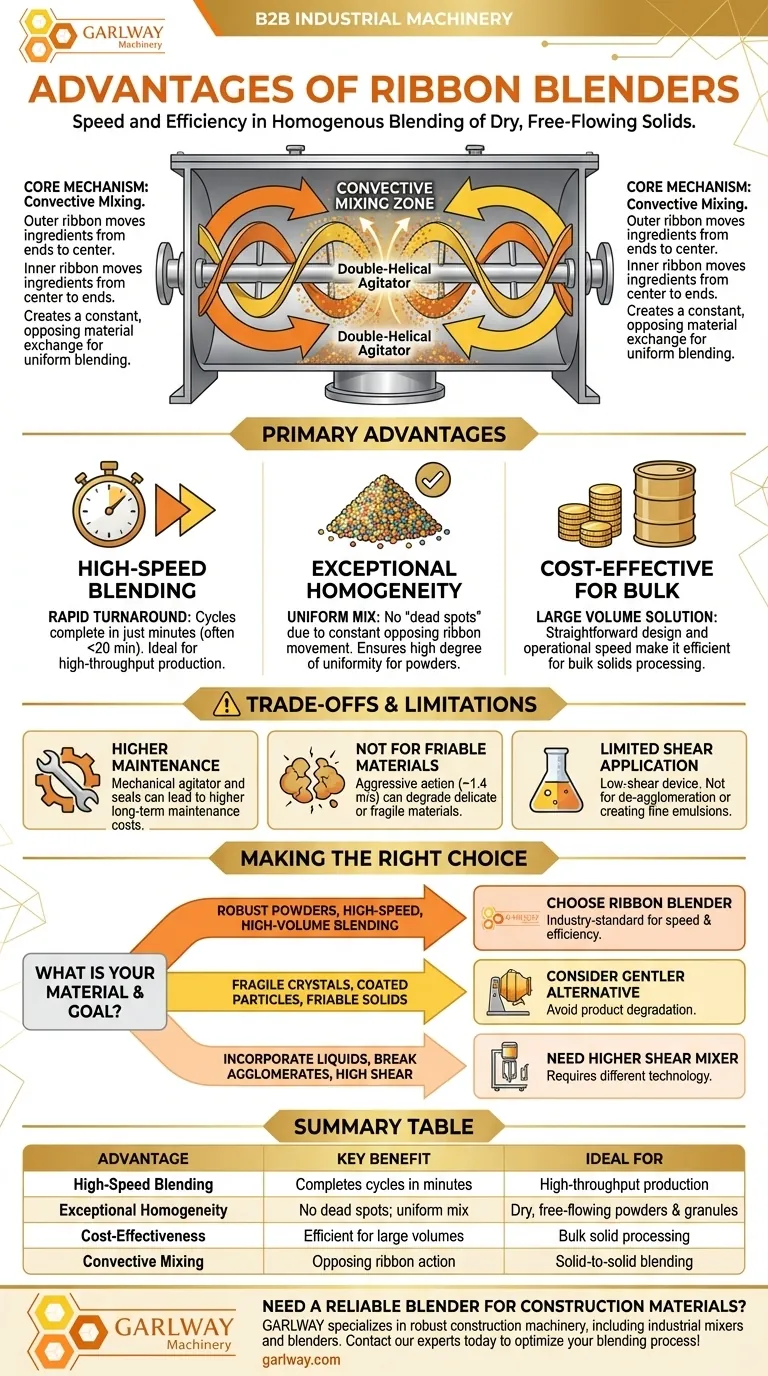
At the heart of the blender is an agitator featuring two helical ribbons. An outer ribbon and an inner ribbon are precisely pitched to move material in opposite axial directions.
The outer ribbon moves ingredients from the ends of the trough toward the center. Simultaneously, the inner ribbon moves ingredients from the center out toward the ends.
Creating a Blending Zone
This counter-directional movement forces a constant exchange of material throughout the entire trough. It generates a highly efficient and repeatable blending pattern known as convective mixing.
This action is particularly effective for solid-to-solid or powder-to-powder applications where ingredients are relatively free-flowing.
Primary Advantages in Detail
The specific design of a ribbon blender directly leads to several key operational benefits.
High-Speed Blending Cycles
The convective mixing pattern is extremely fast. Complete blending cycles often take between a few minutes and twenty minutes.
This rapid turnaround makes ribbon blenders ideal for high-throughput production environments where batch speed is a critical factor.
Exceptional Homogeneity
For the right application (dry powders), the blender's action produces a very high degree of uniformity. The constant, opposing movement of the ribbons ensures that there are no "dead spots" in the trough where material can remain unmixed.
Cost-Effective for Bulk Solids
Because of their straightforward design and operational speed, ribbon blenders are a very common and cost-effective solution for blending large volumes of powders, granules, and other bulk solids.
Understanding the Trade-offs and Limitations
No single piece of equipment is perfect for every task. The advantages of a ribbon blender come with clear limitations.
Higher Maintenance Costs
The mechanical nature of the agitator, seals, and drive system means that, compared to some other blender types, ribbon blenders can be more expensive to maintain over their lifespan.
Not Ideal for Friable Materials
The agitator's typical tip speed of around 1.4 meters per second can be too aggressive for fragile or delicate materials. This can lead to particle breakage, degradation, or unwanted changes in the final product's physical properties.
Limited Shear Application
Ribbon blenders are low-shear devices. They are not designed to break down lumps, de-agglomerate dense clumps, or create fine emulsions. If your process requires high shear, a different type of mixer is necessary.
Making the Right Choice for Your Application
Selecting the correct blender requires aligning the equipment's strengths with your process goals.
- If your primary focus is high-speed, high-volume blending of robust powders: The ribbon blender is an industry-standard choice for its speed and efficiency.
- If your primary focus is blending fragile crystals, coated particles, or other friable solids: You should consider a gentler alternative, such as a tumble blender, to avoid product degradation.
- If your primary focus is incorporating liquids or breaking apart agglomerates: You will need a mixer capable of delivering higher shear forces to achieve a homogenous result.
Ultimately, choosing a ribbon blender is a sound decision when its powerful convective mixing action directly serves your material and process needs.
Summary Table:
| Advantage | Key Benefit | Ideal For |
|---|---|---|
| High-Speed Blending | Completes cycles in minutes | High-throughput production |
| Exceptional Homogeneity | No dead spots; uniform mix | Dry, free-flowing powders & granules |
| Cost-Effectiveness | Efficient for large volumes | Bulk solid processing |
| Convective Mixing | Opposing ribbon action | Solid-to-solid blending |
Need a reliable blender for your construction materials?
GARLWAY specializes in robust construction machinery, including industrial mixers and blenders designed for demanding applications. If you are a construction company or contractor looking for efficient equipment to handle powders, aggregates, or other dry materials, our solutions are built for durability and performance.
Contact our experts today to discuss how we can optimize your blending process!
Visual Guide
Related Products
- Portable Electric Small Cement Mixer Concrete Machine
- Portable Concrete Mixer Machine Equipment for Mixing Concrete
People Also Ask
- What is a portable cement mixer? Achieve Consistent, On-Demand Concrete Mixing
- What are the power sources for portable cement mixers? Choose the Right Power for Your Job Site
- What are the size and portability options for portable cement mixers? Find Your Perfect Match for Any Job
- What was the first recorded version of the portable concrete mixer and who invented it? Discover the 1904 Horse-Drawn Innovation
- How does a portable concrete mixer benefit construction projects? Boost Efficiency & Cut Costs On-Site

