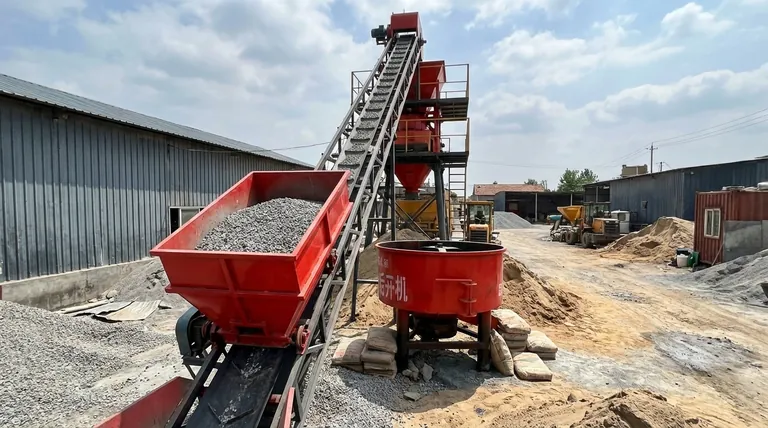
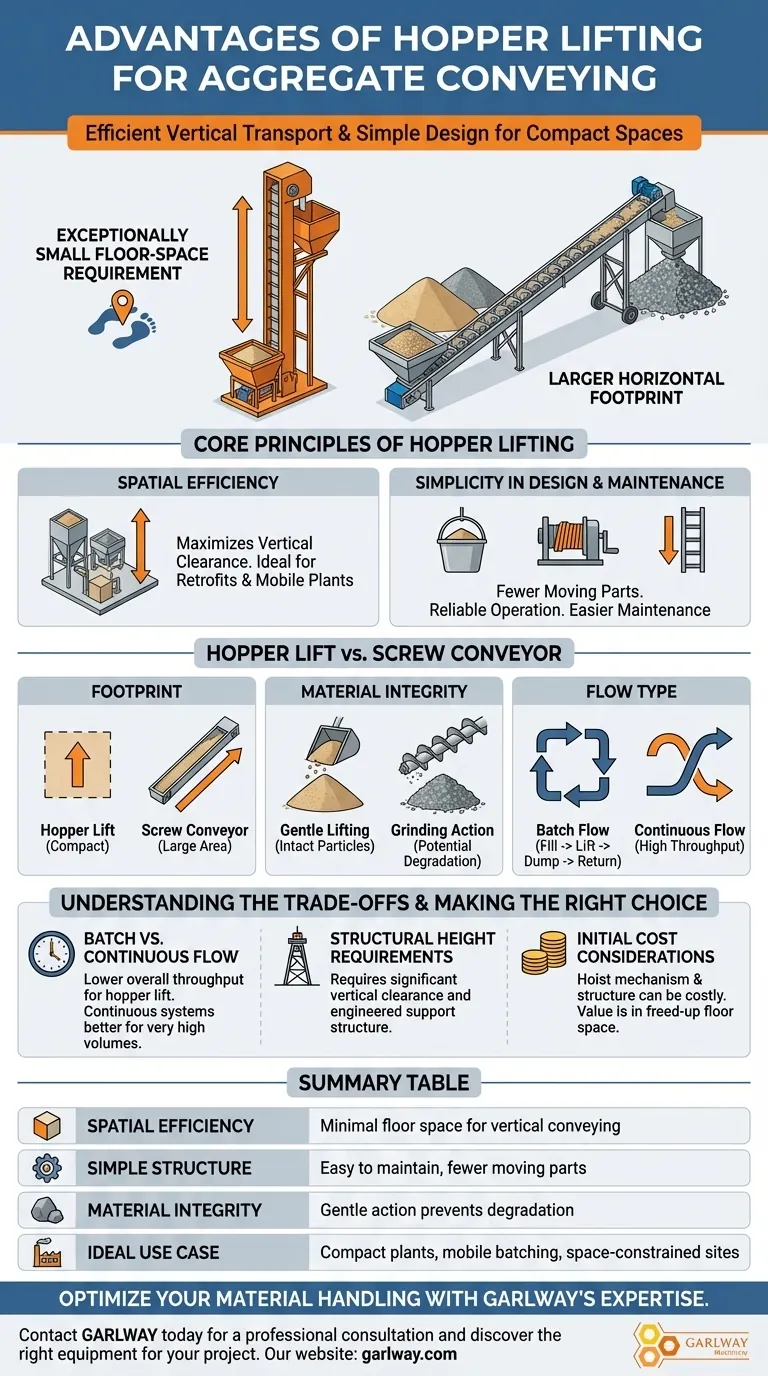
The primary advantages of hopper lifting for aggregate conveying are its exceptionally small floor-space requirement and its simple, straightforward structural design. This makes it a highly effective solution for vertically moving materials like sand, gravel, and cement in spatially constrained environments.
Hopper lifting excels in applications where vertical conveying is necessary but horizontal floor space is at a premium. Its core value lies in trading a larger horizontal footprint, typical of other systems, for vertical clearance.
The Core Principles of Hopper Lifting
Hopper lifting, often executed with a skip hoist or bucket elevator, is a fundamentally simple method for material handling. Understanding its design principles reveals its primary benefits.
Vertical Conveying in a Minimal Footprint
The most significant advantage is spatial efficiency. By moving material almost purely vertically, a hopper lift system occupies a fraction of the floor space required by inclined belt or screw conveyors to achieve the same elevation change.
This is critical in compact plant layouts, mobile batching plants, or when retrofitting existing facilities where space is limited.
Simplicity in Design and Maintenance
Hopper lifting systems possess a simple structure. They typically consist of a bucket (the hopper), a winch or hoist mechanism, and a vertical track.
This mechanical simplicity results in fewer moving parts compared to more complex systems. This often translates to more reliable operation and easier maintenance, as there are fewer components to wear out or fail.
How It Compares to Other Systems
To fully appreciate the advantages of hopper lifting, it's useful to compare it to another common method for moving aggregates: the screw conveyor.
Hopper Lift vs. Screw Conveyor
A screw conveyor is also valued for its simple structure and reliable, low-cost operation. However, its primary function is horizontal or low-angle inclined conveying.
While a screw conveyor can be inclined, achieving significant vertical lift requires a very long machine, consuming substantial floor space. The hopper lift accomplishes the same vertical task in a much smaller area.
Impact on Material Integrity
The method of conveyance also affects the aggregate. Hopper lifting simply scoops and lifts the material, which is a relatively gentle process.
A screw conveyor, which uses a rotating auger, can cause grinding and degradation of softer or more friable aggregates. This is a critical consideration in applications where particle size and integrity are important.
Understanding the Trade-offs
No system is perfect for every scenario. Being an effective technical advisor means acknowledging the limitations and potential downsides.
Batch vs. Continuous Flow
A key characteristic of a simple hopper lift is that it operates in batches. The hopper fills, lifts, dumps, and returns.
This can result in a lower overall throughput (tons per hour) compared to continuous systems like a belt or screw conveyor. For very high-volume operations, a continuous system may be more suitable.
Structural Height Requirements
While a hopper lift saves floor space, it requires significant vertical clearance. The support structure for the track and hoist mechanism must be properly engineered, especially for significant lifting heights.
Initial Cost Considerations
While mechanically simple, the cost of the hoist mechanism and the necessary vertical structure can sometimes exceed that of a basic, short-distance screw conveyor. The true cost savings comes from the value of the floor space it frees up.
Making the Right Choice for Your Application
Selecting the correct system requires a clear understanding of your project's primary constraints and goals.
- If your primary focus is maximizing floor space in a compact facility: Hopper lifting is the definitive choice for vertical material transfer.
- If your primary focus is the lowest initial cost for horizontal or low-incline transfer: A screw conveyor is often the more economical solution.
- If your primary focus is preserving the physical integrity of the aggregate: The gentle lifting action of a hopper is superior to the grinding motion of a screw conveyor.
Ultimately, choosing the right conveying system requires a clear assessment of your site's spatial limitations, budget, and material handling priorities.
Summary Table:
| Advantage | Key Benefit |
|---|---|
| Spatial Efficiency | Minimal floor space requirement for vertical conveying |
| Simple Structure | Easy to maintain and operate with fewer moving parts |
| Material Integrity | Gentle lifting action prevents aggregate degradation |
| Ideal Use Case | Compact plants, mobile batching, and space-constrained sites |
Optimize your material handling with GARLWAY's expertise.
Choosing the right conveying system is critical for your project's efficiency and cost-effectiveness. GARLWAY specializes in construction machinery, offering reliable solutions like winches and concrete batching plants for construction companies and contractors globally.
Let our engineering team help you determine if a hopper lifting system is the ideal choice for your spatial and operational needs. We provide tailored solutions to maximize your plant's productivity.
Contact GARLWAY today for a professional consultation and discover the right equipment for your project.
Visual Guide
Related Products
- Hydraulic Winding Engine Harbor Freight Winch
- Portable Cement Mixer with Lift Concrete Machine
- Electric and Hydraulic Winch for Heavy Duty Applications
- Portable Small Trailer Winch
- Auto Concrete Cement Mixer Machine New
People Also Ask
- What role does hydraulic fluid play in hydraulic winches? It's the Lifeblood of Your Heavy-Duty Pulling Power
- What vehicles commonly use hydraulic winches? For Industrial Trucks Needing Unmatched Power
- What are the features of hydraulic winches? Unmatched Power and Continuous Duty for Heavy Loads
- What preventive measures can be taken to avoid oil leakage in hydraulic winches? Ensure Long-Term Reliability
- What does 'power out' mean in a hydraulic winch? Achieve Absolute Control When Lowering Heavy Loads