
The primary advantage of a front-discharging truck mixer is its ability to give the driver complete control over the concrete pour from within the cab. By allowing the driver to drive forward onto a site and hydraulically manipulate the discharge chute, this design enhances efficiency, improves safety, and significantly reduces the labor required for placement.
The front-discharge mixer transforms concrete placement from a two-person coordinated effort into a precise, one-person operation. This fundamental shift streamlines the entire process, impacting job site speed, safety, and cost.
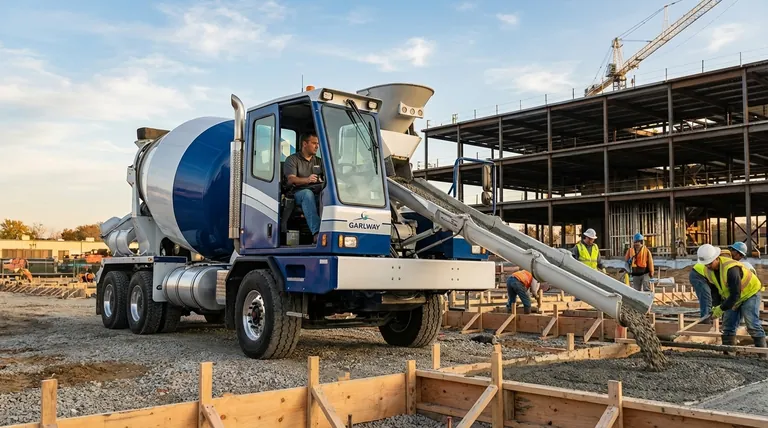
The Core Advantage: Driver-Centric Operation
A truck mixer’s basic function is to transport concrete while keeping it agitated. However, the front-discharge design rethinks the entire delivery and placement workflow by centering it around the driver.
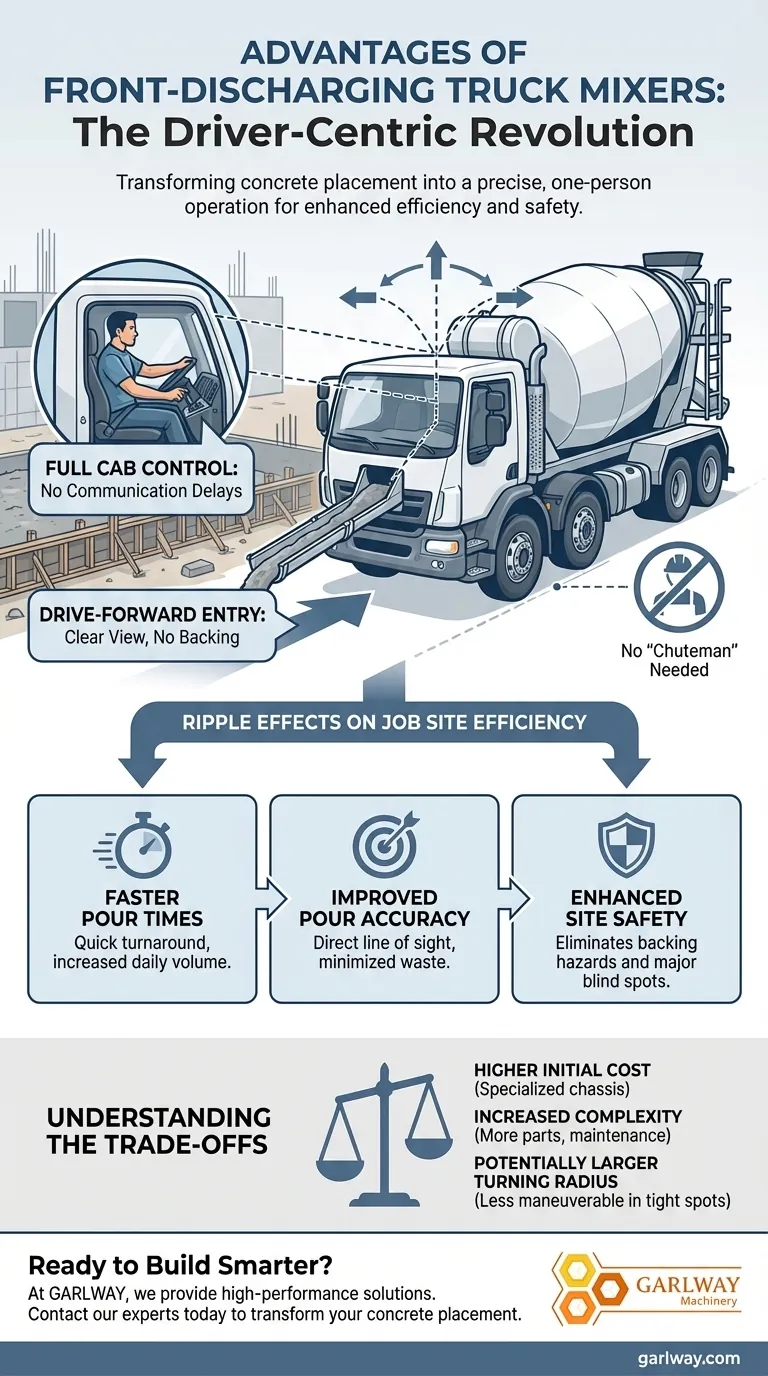
Full Control from the Cab
The driver has a set of controls inside the cab to hydraulically operate the discharge chute. This includes moving it left and right, raising and lowering it, and even extending it, all without leaving their seat.
This direct mechanical control removes communication delays and misunderstandings between the driver and ground crew.
Drive-Forward Site Entry
Unlike rear-discharge mixers that must slowly and carefully back into position, front-discharge trucks can simply drive forward towards the forms.
This provides the driver with a clear, unobstructed view of the pour area, significantly improving placement accuracy and site awareness.
Eliminating the Need for a "Chuteman"
With a traditional rear-discharge mixer, a separate worker (often called a "chuteman" or spotter) is required to guide the driver, direct the pour, and physically move the chute.
The front-discharge design makes this role redundant. The driver becomes both the operator of the vehicle and the director of the pour, reducing labor requirements on-site.
The Ripple Effects on Job Site Efficiency
This shift to a one-person operation creates several downstream benefits that compound to make a job site more productive and safer.
Faster Pour Times
With no need to wait for a spotter or manually position a heavy chute, the time from arrival to the start of the pour is dramatically reduced. This allows for a quicker turnaround for each truck, increasing the total volume of concrete that can be placed in a day.
Improved Pour Accuracy
The driver's direct line of sight to the concrete forms is the single biggest factor in placement accuracy. They can precisely control the flow and placement of concrete, minimizing spillage, reducing waste, and cutting down on the manual labor needed to spread the concrete afterward.
Enhanced Site Safety
Large vehicles backing up are a significant hazard on any construction site. By driving forward, the front-discharge mixer eliminates a major blind spot and reduces the risk of accidents involving ground personnel.
Understanding the Trade-offs
While highly efficient, the front-discharge design is not without its considerations. Objectivity requires acknowledging its specific challenges.
Higher Initial Cost
The specialized chassis and complex hydraulic systems make front-discharge mixers more expensive to purchase than their conventional rear-discharge counterparts.
Increased Mechanical Complexity
More moving parts and hydraulic controls mean there are more potential points of failure. Maintenance can be more involved and require specialized knowledge, potentially leading to greater lifetime service costs.
Potentially Larger Turning Radius
The forward-cab design, while excellent for visibility, can sometimes result in a less maneuverable vehicle on tight job sites compared to the conventional truck chassis used for many rear-discharge mixers.
Making the Right Choice for Your Goal
Selecting the right type of mixer depends entirely on the operational priorities of your project or business.
- If your primary focus is reducing on-site labor costs and maximizing safety: The one-person operation of a front-discharge mixer is the definitive choice.
- If your primary focus is speed and precision for residential or small commercial pours: The front-discharge design's accuracy and quick setup provide a distinct advantage.
- If your primary focus is minimizing initial fleet investment and you operate in wide-open areas: A traditional rear-discharge mixer remains a simple and cost-effective solution.
Ultimately, choosing a front-discharge mixer is an investment in operational efficiency and on-site control.
Summary Table:
| Advantage | Key Benefit |
|---|---|
| Driver-Centric Operation | Full control of the pour from the cab, eliminating the need for a spotter. |
| Drive-Forward Entry | Clear line of sight for improved accuracy and safety; no need to reverse. |
| Increased Efficiency | Faster pour times and reduced labor requirements streamline the entire process. |
| Enhanced Safety | Reduces risks associated with backing vehicles and improves site awareness. |
Ready to enhance your project's efficiency and safety?
At GARLWAY, we specialize in providing high-performance construction machinery, including advanced concrete mixers and batching plants, to contractors and construction companies worldwide. A front-discharge truck mixer from GARLWAY can transform your concrete placement into a faster, safer, and more cost-effective one-person operation.
Contact our experts today to find the perfect solution for your specific needs and see how we can help you build smarter.
Visual Guide
Related Products
- Ready Mixer Machine for Construction Ready Mix Machinery
- Mini Cement Mortar Mixer Truck for Construction
- JW1000 Mobile Cement Mixer Concrete Mixer Truck and Batching Plant
- Harbor Freight JS1500 On Site Concrete Mixing Volumetric Cement Mixer
- Belle Mixer Drum Self Loading Mortar Mixers JS3000
People Also Ask
- What are the purposes of low-speed agitation in truck mixers? Preserve Concrete Quality During Transit
- How is ready-mixed concrete transported from a commercial concrete batching plant? Ensuring Quality & Timely Delivery
- What are the main ingredients mixed in a concrete mixer truck? Master the Formula for Strong Concrete
- In what ways does a mobile concrete mixer improve quality control and consistency? Achieve Superior On-Site Concrete Quality
- What types of construction projects typically use concrete mixer trucks? From Highways to Home Foundations


