
At their core, electric wire rope hoists are engineered for superior performance in demanding applications. Their primary advantages are the ability to lift heavier loads to greater heights at faster speeds than most alternatives, all while offering highly precise and smooth control over the load's movement.
The true advantage of an electric wire rope hoist lies not in a single feature, but in its combination of industrial-grade power, speed, and refined control, making it the definitive choice for high-stakes, high-volume lifting operations.
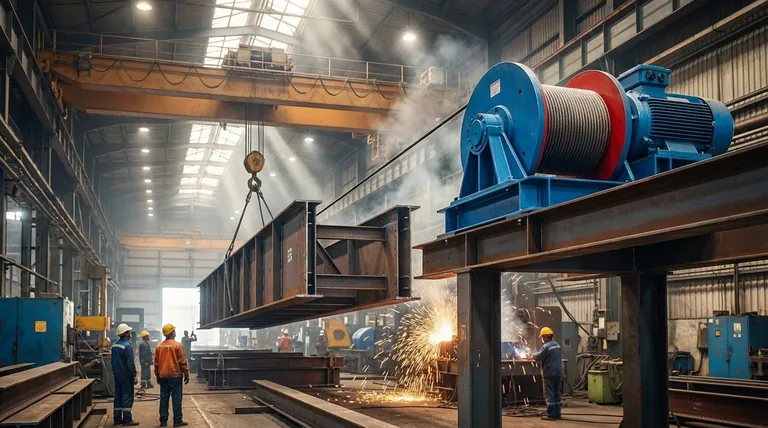
Engineered for Power and Speed
The fundamental design of an electric wire rope hoist is optimized for performance criteria that are critical in industrial, construction, and manufacturing environments.
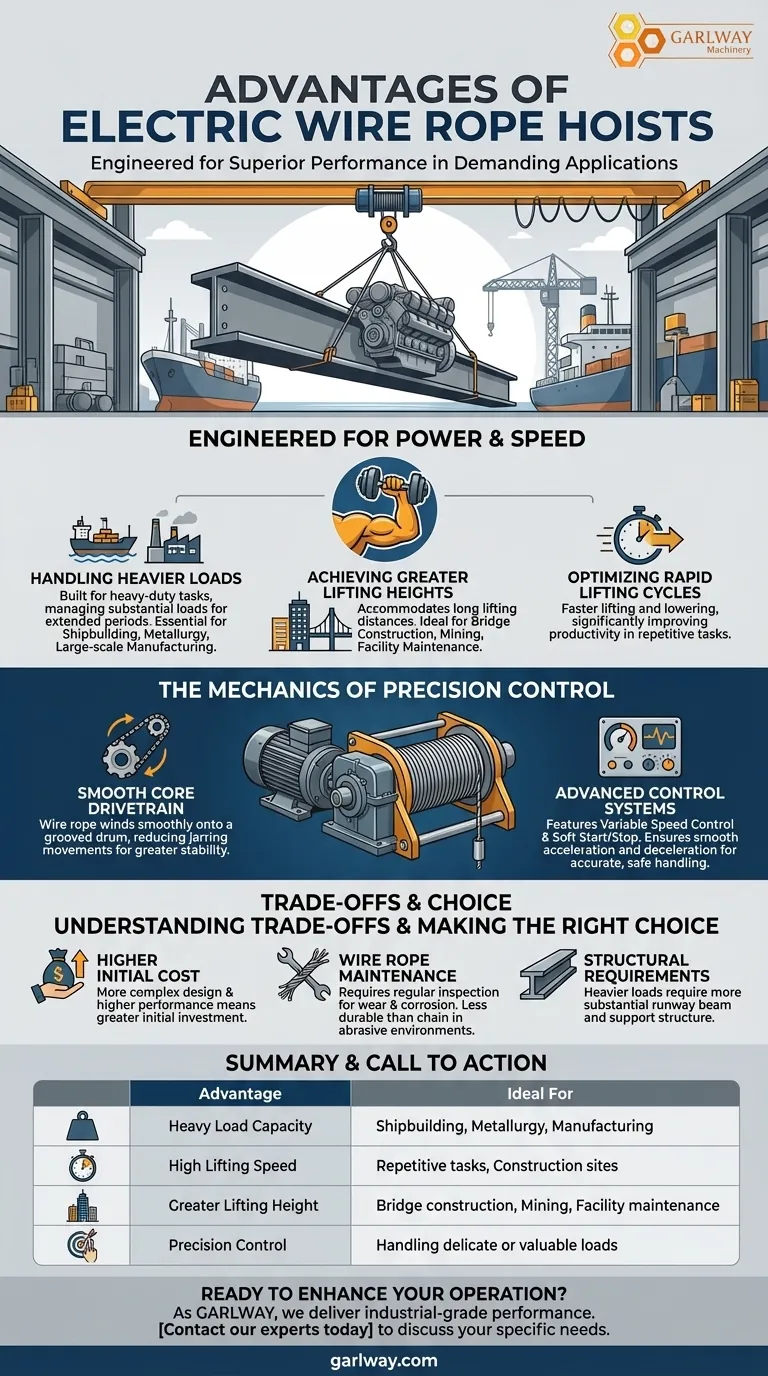
Handling Heavier Loads
Electric wire rope hoists are specifically built for heavy-duty and rapid lifting tasks. Their robust construction allows them to manage and support substantial loads for extended periods.
This makes them essential equipment in sectors like shipbuilding, metallurgy, and large-scale manufacturing where moving heavy machinery or materials is a daily requirement.
Achieving Greater Lifting Heights
The design, featuring a steel wire rope winding onto a grooved drum, naturally accommodates much longer lifting distances compared to chain-based systems.
This capability is indispensable for bridge construction, mining operations, and multi-story facility maintenance.
Optimizing for Rapid Lifting Cycles
A key performance benefit is their speed. Electric wire rope hoists can lift and lower loads much faster than many alternatives, significantly improving productivity and efficiency in repetitive tasks.
The Mechanics of Precision Control
The performance advantages of a wire rope hoist are made possible by its sophisticated mechanical and electrical systems, which provide a level of control essential for handling valuable or delicate assets.
The Core Drivetrain
An electric motor's torque is amplified through a gearbox, which drives a drum. The wire rope smoothly winds onto this drum, guided by a rope guide that ensures proper alignment and prevents tangling.
This mechanism is inherently smoother than the link-by-link action of a chain hoist, reducing jarring movements.
Advanced Control Systems
Modern wire rope hoists feature advanced controls like variable speed control and soft start/stop functionality.
These systems allow for smooth acceleration and deceleration, giving the operator exceptional control and enhancing the accuracy of load handling. This precision is critical for preventing accidents and damage to the load or surrounding equipment.
Understanding the Trade-offs
To make an informed decision, it's crucial to weigh the advantages against the practical considerations and limitations of this technology.
Higher Initial Cost
Electric wire rope hoists are generally more expensive to purchase than their electric chain hoist counterparts, reflecting their more complex design and higher performance capabilities.
Wire Rope Maintenance
While strong, the wire rope itself can be less durable than hardened steel chain when exposed to crushing, kinking, or highly abrasive environments. It requires regular inspection for fraying, wear, and corrosion to ensure safe operation.
Structural Requirements
Due to the heavier loads they are designed to carry, wire rope hoists and their corresponding trolley systems often require a more substantial runway beam and support structure for installation.
Making the Right Choice for Your Operation
Choosing the correct hoist requires matching its capabilities to the specific demands of your application.
- If your primary focus is heavy loads (>5 tons), long lifts, and high speed: An electric wire rope hoist is almost always the superior technical choice.
- If your primary focus is precision with valuable or delicate loads: The advanced variable speed controls on a modern wire rope hoist provide a critical advantage in safety and handling.
- If your primary focus is lower capacity lifting in a limited space or with budget constraints: A simpler solution, such as an electric chain hoist, may be a more practical fit.
Ultimately, selecting an electric wire rope hoist is an investment in operational efficiency, power, and control for your most critical lifting tasks.
Summary Table:
| Advantage | Key Feature | Ideal For |
|---|---|---|
| Heavy Load Capacity | Lifts over 5 tons reliably | Shipbuilding, Metallurgy, Manufacturing |
| High Lifting Speed | Faster cycle times for efficiency | Repetitive tasks, Construction sites |
| Greater Lifting Height | Long wire rope for multi-story lifts | Bridge construction, Mining, Facility maintenance |
| Precision Control | Variable speed & soft start/stop | Handling delicate or valuable loads |
Ready to enhance your operation's lifting power, speed, and safety?
As GARLWAY, a leading specialist in construction machinery, we understand the critical demands of construction companies and contractors. Our electric wire rope hoists are engineered to deliver the industrial-grade performance and reliability your projects require, helping you move heavier loads faster and with greater control.
Contact our experts today to discuss your specific needs and discover how a GARLWAY hoist can be a powerful investment in your productivity and safety.
Visual Guide
Related Products
- Electric Hoist Winch Boat Anchor Windlass for Marine Applications
- Electric and Hydraulic Winch for Heavy Duty Applications
People Also Ask
- How does an electric anchor winch work? Power, Safety, and Reliable Operation Explained
- What are the advantages of installing an electric anchor winch on a boat? Boost Safety & Ease for Boaters
- What are the operational differences between electric hoists and winches? A Guide to Safe Lifting vs. Pulling
- What are the main benefits of a boat anchor winch? Boost Safety & Efficiency for Your Vessel
- How does a boat anchor winch work? A Guide to Reliable Anchor Handling

