The primary advantages of concrete mix design are achieving significant cost savings through material optimization and producing a final product with specific, predictable performance characteristics. This engineered approach moves beyond generic recipes, allowing for the strategic use of locally available materials and ensuring the concrete meets the precise strength and durability requirements of the project.
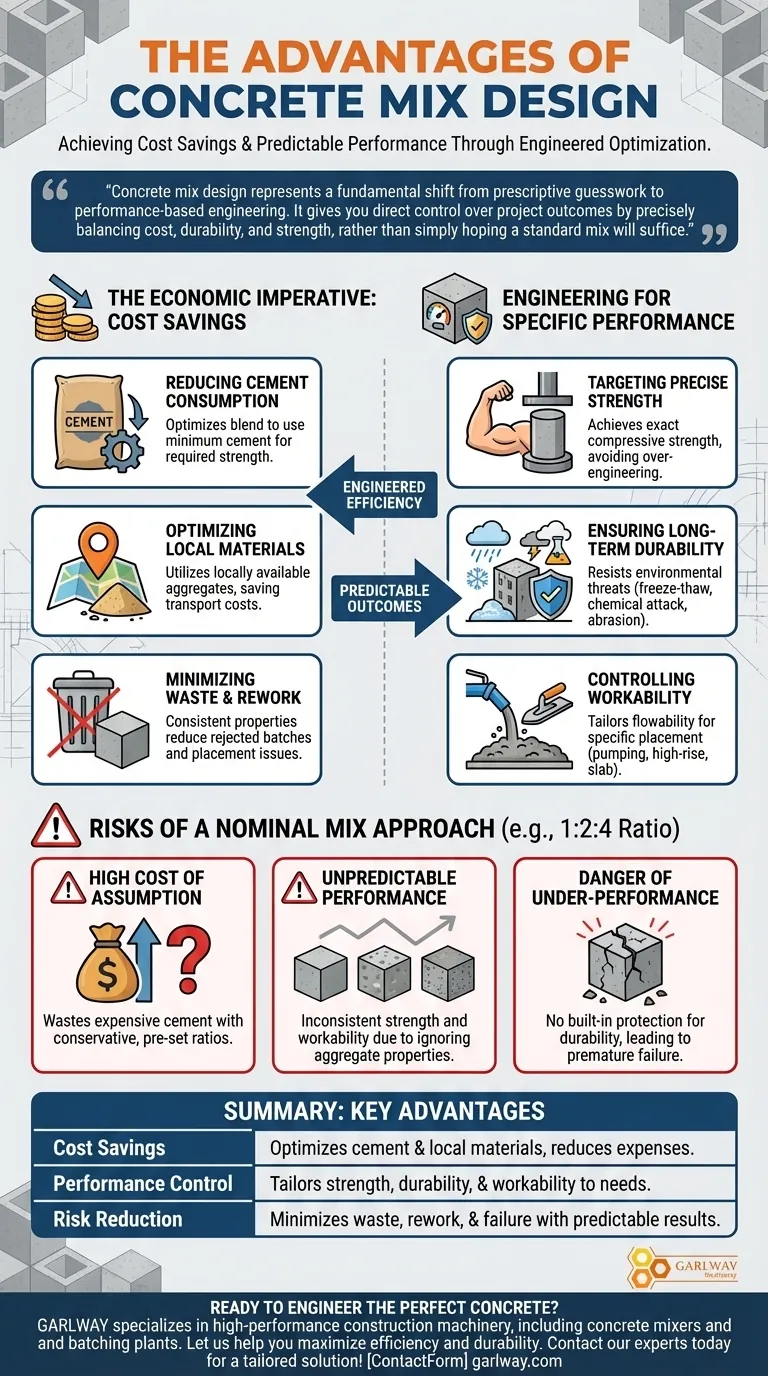
Concrete mix design represents a fundamental shift from prescriptive guesswork to performance-based engineering. It gives you direct control over project outcomes by precisely balancing cost, durability, and strength, rather than simply hoping a standard mix will suffice.
The Economic Imperative of Mix Design
For any project, controlling costs is paramount. A formal mix design process is one of the most effective tools for achieving economic efficiency without sacrificing quality.
Reducing Cement Consumption
Cement is the most expensive and energy-intensive component of concrete. Mix design optimizes the entire blend of materials, ensuring you use the minimum amount of cement necessary to achieve the required strength and durability.
Optimizing Local Materials
As noted in the references, mix design allows for the best use of locally available aggregates. By testing and understanding the specific properties of local sand and stone, an engineer can design a mix that performs perfectly, saving enormous costs on transporting materials from farther away.
Minimizing Waste and Rework
A well-designed mix has predictable properties like workability and setting time. This consistency reduces the chance of rejected batches, poor finishes, or placement difficulties, all of which lead to costly waste and rework.
Engineering for Specific Performance
A "one-size-fits-all" approach to concrete is rarely optimal. Mix design allows you to create a material tailored to the unique demands of its environment and structural role.
Targeting Precise Strength
Not all concrete needs to be exceptionally high-strength. Mix design allows you to target the exact compressive strength required by the structural engineer, preventing the common and costly mistake of over-engineering the mix.
Ensuring Long-Term Durability
Performance goes far beyond simple strength. A mix can be designed to resist specific environmental threats, such as freeze-thaw cycles, chemical attack, or abrasion, ensuring the longevity of the structure.
Controlling Workability
The physical demands of a pour are critical. A mix can be designed to be easily pumpable for a high-rise, highly flowable for a complex form, or have a specific finishability for a large slab, ensuring quality and efficiency during construction.
The Risks of a Nominal Mix Approach
Understanding the advantages of a designed mix becomes clearer when contrasted with the alternative: a nominal mix (e.g., a simple 1:2:4 ratio).
The High Cost of Assumption
Nominal mixes use pre-set, conservative ratios that often result in a significantly higher cement content than necessary. This approach builds in a margin of safety by wasting the most expensive material.
Unpredictable Performance
Because a nominal mix does not account for the specific properties of the aggregates (like shape, grading, or moisture content), the final strength and workability can be highly inconsistent from batch to batch.
The Danger of Under-Performance
While often over-engineered for strength, a nominal mix has no built-in protection for durability. It may fail prematurely when placed in an environment with specific challenges that a tailored mix design would have addressed.
Applying Mix Design to Your Project Goals
Your project's primary driver should dictate your approach to concrete.
- If your primary focus is cost-efficiency on a large project: A formal mix design is non-negotiable to optimize material quantities and reduce the overall cement factor.
- If your primary focus is performance and longevity (e.g., infrastructure, foundations): Mix design is essential to engineer the concrete for specific durability requirements and exposure conditions.
- If your primary focus is quality control and consistency: A designed mix provides a reliable, repeatable formula that accounts for the unique properties of your local materials.
Ultimately, a proper mix design transforms concrete from a simple commodity into a precisely engineered material for your specific application.
Summary Table:
| Key Advantage | Description |
|---|---|
| Cost Savings | Optimizes cement use and leverages local materials to reduce expenses. |
| Performance Control | Tailors strength, durability, and workability to specific project needs. |
| Risk Reduction | Minimizes waste, rework, and premature failure with predictable results. |
Ready to engineer the perfect concrete for your project? GARLWAY specializes in providing high-performance construction machinery, including reliable concrete mixers and batching plants, to help contractors and construction companies achieve optimal results. Let us help you maximize efficiency and durability—contact our experts today for a tailored solution!
Visual Guide
Related Products
- Portable Concrete Mixer Machine Equipment for Mixing Concrete
- Construction Products Concrete Plant Machine Mixing Concrete Mixer
- Concrete Cement Mixer Machine Drum Mixer for Construction
- Portable Ready Mix Concrete Mixer Equipment
- HZS180 Ready Mix Concrete Plant for Foundations with Sand and Cement
People Also Ask
- Why is it necessary to use a portable concrete mixer? Gain Total Control & Efficiency
- How much concrete can you pour with a portable mixer? Find the Perfect Fit for Your Project
- What types of projects are portable concrete mixers suitable for? Ideal for DIY & Small-Scale Construction
- How much does a portable concrete mixer hold? A Guide to Choosing the Right Capacity
- What types of portable concrete mixers exist? Find the Perfect Mixer for Your Project