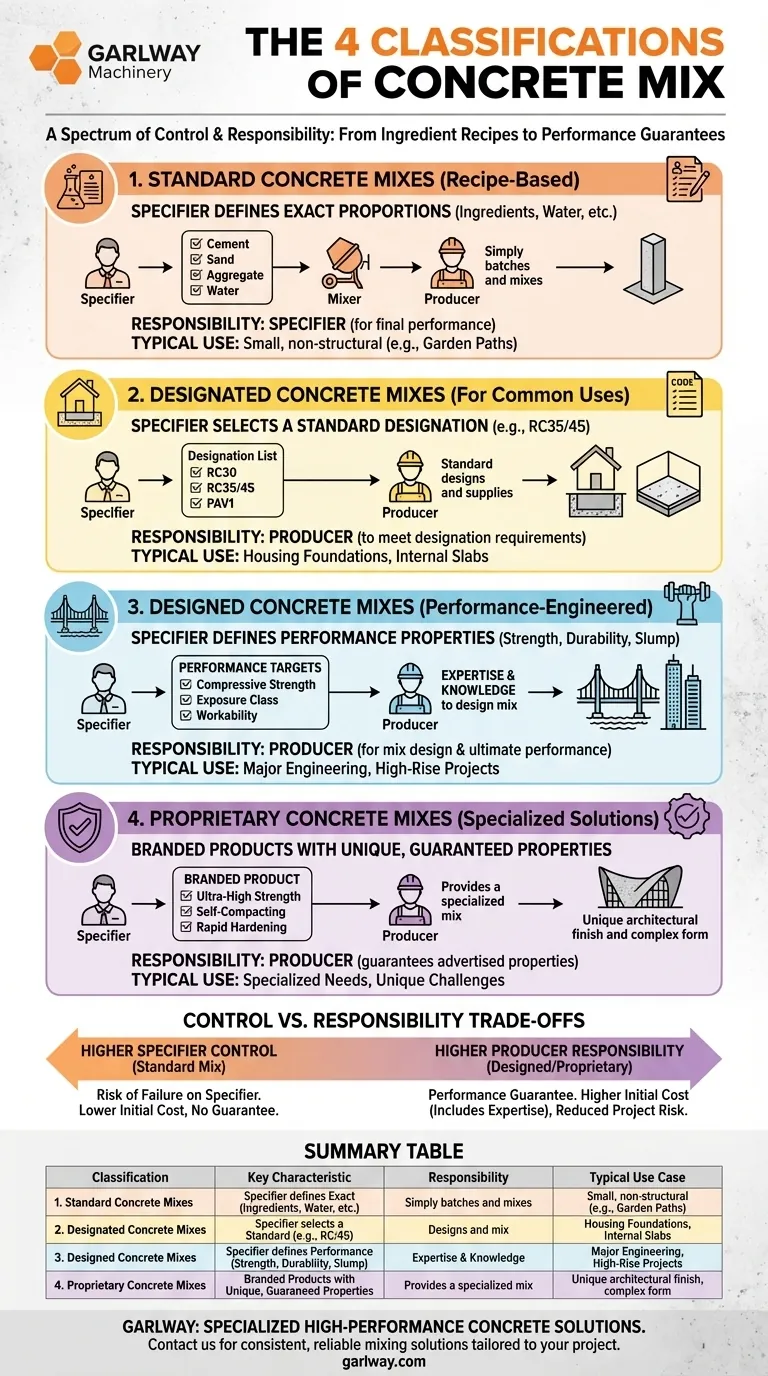
At a high level, concrete mix is specified in one of four ways: standard, designated, designed, or proprietary. Each classification represents a different method for defining the concrete's composition and required performance. This distinction is critical because it determines who holds responsibility for the final quality and strength of the mix—the specifier or the producer.
The four classifications of concrete are not simply different recipes; they represent a spectrum of control and responsibility. The choice moves from the user dictating the exact ingredients (Standard) to the producer guaranteeing a specific performance outcome (Designed and Proprietary), with a simplified middle ground for common applications (Designated).
Deconstructing the Four Concrete Classifications
Understanding each classification is essential for aligning the project's technical requirements with the right level of quality assurance and liability.
1. Standard Concrete Mixes (Recipe-Based)
This is the most basic classification, often compared to following a recipe. The specifier—such as an engineer or contractor—defines the exact proportions of cement, sand, aggregates, and water.
The concrete producer’s only responsibility is to batch and mix these components as instructed. The performance and strength of the final product are the sole responsibility of the specifier.
These mixes are typically used for very small-scale, non-structural applications like fence posts or garden paths, where precise performance guarantees are not critical.
2. Designated Concrete Mixes (For Common Uses)
Designated mixes offer a simplified approach for common, well-understood applications, such as housing foundations or internal slabs.
Instead of a full recipe, the specifier selects a "designation" from a standard list (e.g., "RC35/45," indicating its use in reinforced concrete and its strength class).
The producer is then responsible for designing and supplying a mix that meets the requirements for that specific designation. This shifts some responsibility to the producer while keeping the specification process simple.
3. Designed Concrete Mixes (Performance-Engineered)
This is the most common classification for professional engineering and major construction projects. Here, the focus shifts entirely from ingredients to outcomes.
The specifier defines the required performance properties of the hardened concrete, such as compressive strength, durability requirements (e.g., exposure class), and properties of the fresh concrete like slump (workability).
The concrete producer uses its expertise and materials knowledge to design a mix that achieves these specified performance targets. The producer is fully responsible for the mix design and its ultimate performance.
4. Proprietary Concrete Mixes (Specialized Solutions)
Proprietary mixes are specialized, high-performance products developed and trademarked by a specific concrete manufacturer.
These mixes are engineered to provide unique characteristics that go beyond standard performance, such as ultra-high strength, self-compaction, rapid hardening, or unique architectural finishes.
When specifying a proprietary mix, you are selecting a branded product to solve a specific technical challenge, and the producer guarantees its unique, advertised properties.
Understanding the Trade-offs: Control vs. Responsibility
Choosing a classification is a strategic decision that balances control, cost, and risk. Misunderstanding this can lead to project delays, cost overruns, or structural failures.
The Burden of Proof
With a Standard Mix, the specifier is liable if the concrete fails to perform. If the recipe was flawed, the fault lies with the person who wrote it.
With Designed and Designated Mixes, the producer is liable if their mix does not meet the specified performance criteria. This provides a critical quality assurance guarantee for structural applications.
Cost vs. Assurance
While a Standard Mix might appear cheaper on the surface, it carries no performance guarantee.
Designed and Proprietary mixes may have a higher upfront cost, but this includes the producer's expertise and liability, which significantly reduces project risk.
The Risk of Contradictory Specifications
A common and critical error is to over-specify by providing both a recipe and a performance requirement (e.g., defining cement content while also demanding a specific strength).
This creates a contractual conflict. If the mix fails, it is unclear whether the fault lies with the flawed recipe or the producer who executed it. A specification should be based on either performance or prescription, but not both.
How to Choose the Right Classification
Your choice should be directly informed by the project's scale, structural importance, and unique requirements.
- If your primary focus is a small, non-structural project (e.g., a garden path): A Standard Mix gives you direct control over a simple recipe where performance guarantees are not critical.
- If your primary focus is a common structural application (e.g., house foundations): A Designated Mix provides a reliable, standardized solution without requiring you to be a mix design expert.
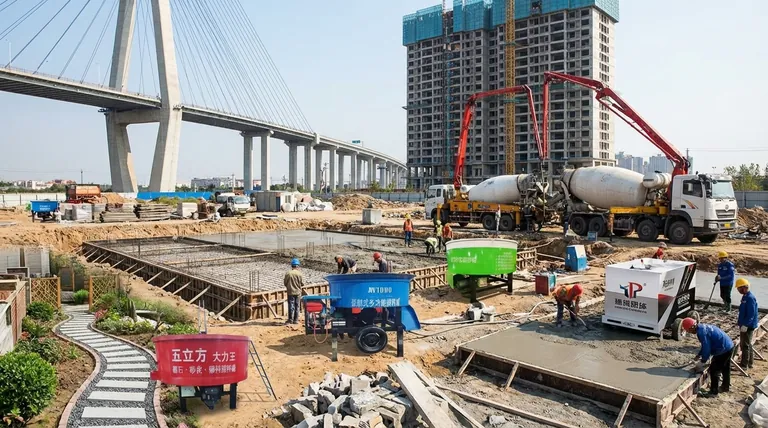
- If your primary focus is a large or complex engineering project (e.g., a bridge or high-rise): A Designed Mix is essential, as it places the responsibility for achieving critical performance metrics on the specialist concrete producer.
- If your primary focus is achieving a unique performance characteristic (e.g., rapid hardening or extreme durability): A Proprietary Mix from a trusted supplier is the most effective way to leverage specialized concrete technology.
Understanding these classifications allows you to specify concrete with precision, aligning project requirements with the appropriate level of technical assurance.
Summary Table:
| Classification | Key Characteristic | Responsibility | Typical Use Case |
|---|---|---|---|
| Standard (Recipe) | Specifier defines exact ingredient proportions. | Specifier | Small, non-structural projects (e.g., garden paths). |
| Designated | Specifier selects a standard designation (e.g., RC35/45). | Producer | Common structural applications (e.g., house foundations). |
| Designed (Performance) | Specifier defines performance requirements (e.g., strength). | Producer | Major engineering projects (e.g., bridges, high-rises). |
| Proprietary | Branded product with unique, guaranteed properties. | Producer | Specialized needs (e.g., rapid hardening, self-compacting). |
Ensure Your Project's Structural Integrity with the Right Concrete Mix
Choosing the correct concrete classification is critical for managing risk, controlling costs, and guaranteeing the performance of your build. Missteps can lead to delays, budget overruns, or even structural failure.
GARLWAY specializes in providing high-performance concrete mixing solutions for construction companies and contractors globally. Our expertise in concrete mixers and batching plants ensures you get a consistent, reliable mix tailored to your project's specific performance requirements, whether it's a standard foundation or a complex, high-specification structure.
Let our experts help you specify the perfect mix. Contact GARLWAY today for a consultation and ensure your project is built on a solid foundation.
Visual Guide
Related Products
- Portable Concrete Mixer Machine Equipment for Mixing Concrete
- Construction Products Concrete Plant Machine Mixing Concrete Mixer
- Portable Ready Mix Concrete Mixer Equipment
- Ready Mixer Machine for Construction Ready Mix Machinery
- Concrete Cement Mixer Machine Drum Mixer for Construction
People Also Ask
- Why is it necessary to use a portable concrete mixer? Gain Total Control & Efficiency
- How much concrete can you pour with a portable mixer? Find the Perfect Fit for Your Project
- What types of projects are portable concrete mixers suitable for? Ideal for DIY & Small-Scale Construction
- How much does a portable concrete mixer hold? A Guide to Choosing the Right Capacity
- What types of portable concrete mixers exist? Find the Perfect Mixer for Your Project