
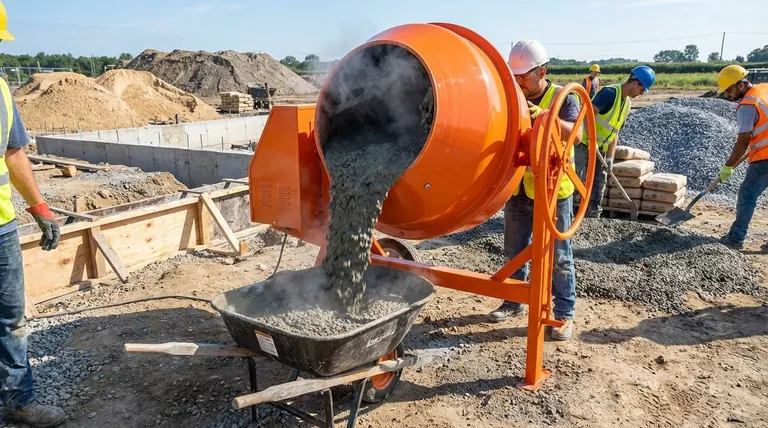
At its core, a tilting drum concrete mixer operates on a simple, two-phase principle. It uses a rotating drum with internal blades to tumble and blend materials like sand, aggregate, cement, and water into a uniform mixture. Once mixing is complete, the entire drum tilts downwards to rapidly pour out the finished concrete.
The defining characteristic of a tilting drum mixer isn't just how it mixes, but how it discharges. Its ability to use gravity for a fast, clean pour is what prevents material segregation and makes it highly efficient for projects demanding consistent, high-quality concrete.
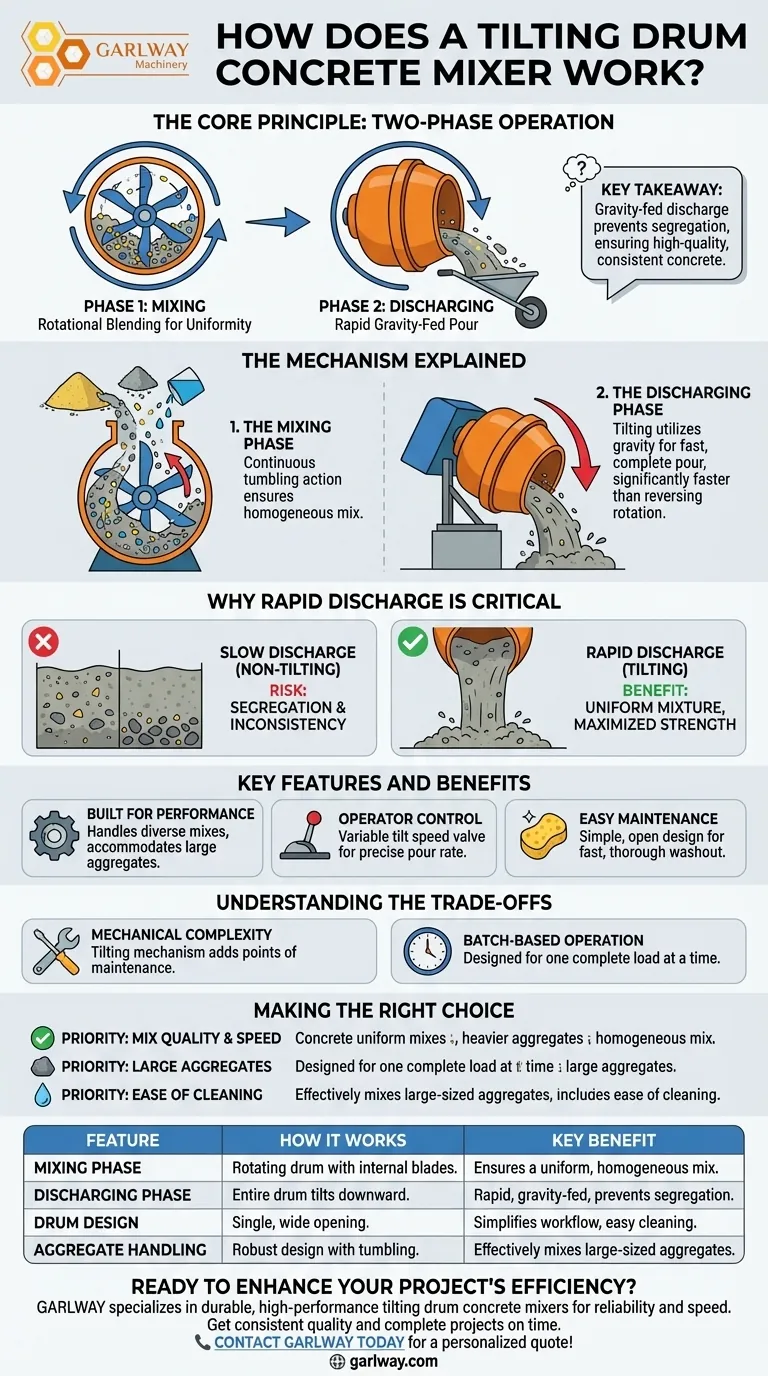
The Core Mechanism Explained
To understand this mixer's value, it's essential to break down its two primary functions: the mixing phase and the discharging phase.
The Mixing Phase: Rotational Blending
The process begins by loading all constituent materials into the drum's single opening.
The drum then rotates on its axis. Inside, fixed blades or fins continuously lift and drop the materials, forcing them to combine into a homogeneous concrete mix.
This constant tumbling action prevents the heavier aggregates from settling and ensures the cement paste is evenly distributed throughout the batch.
The Discharging Phase: The Tilting Advantage
This is the feature that sets this mixer apart. The entire drum assembly pivots, or tilts, downwards.
Gravity takes over, causing the finished concrete to flow out of the drum's opening quickly and completely. This process is significantly faster than that of non-tilting mixers, which rely on reversing the drum's rotation to slowly "screw" the material out.
Why Rapid Discharge is Critical
The speed of the discharge is not just for convenience; it's crucial for quality.
Slowly discharging concrete can cause segregation, where heavier aggregates separate from the sand and cement paste. This compromises the strength and consistency of the final product.
By emptying the drum rapidly, the tilting mixer ensures the concrete remains a uniform mixture from the first pour to the last.
Key Features and Benefits
The design of a tilting drum mixer is driven by efficiency and the demands of professional construction work.
Built for Performance
These mixers can effectively handle a wide range of mixes, from semi-dry to plastic concrete, and can accommodate large-sized aggregates required for major engineering projects.
The single, wide opening for both loading materials and discharging the final mix simplifies the entire workflow.
Operator Control and Maintenance
Many models feature a variable tilt speed valve, giving the operator precise control over the rate of the pour.
The simple, open design of the drum makes it remarkably easy to clean. This is a significant advantage, as hardened concrete can damage a mixer and reduce its efficiency.
Understanding the Trade-offs
While highly effective, the tilting drum design has considerations that are important to understand.
Mechanical Complexity
The tilting mechanism, whether operated by a hydraulic system or manual gears, adds mechanical complexity compared to a simpler, fixed-drum mixer. This introduces additional points of maintenance and potential failure.
Batch-Based Operation
Like most drum mixers, this is a batch mixer. It is designed to mix and discharge one complete load at a time. For massive projects requiring a non-stop flow of concrete, a continuous mixing plant would be more appropriate.
Making the Right Choice for Your Goal
Selecting the right mixer depends entirely on the priorities of your project.
- If your primary focus is mix quality and speed on medium to large pours: The tilting drum's rapid, gravity-fed discharge is its defining advantage, preventing segregation and maximizing operational efficiency.
- If your primary focus is handling diverse or large aggregates: This design is well-suited for blending tougher, more demanding concrete mixes without compromising consistency.
- If your primary focus is ease of cleaning and minimizing downtime: The wide, accessible drum is a significant practical benefit, making washout faster and more thorough than in other designs.
Ultimately, the tilting drum mixer is a powerful tool designed to deliver high-quality concrete quickly and reliably.
Summary Table:
| Feature | How It Works | Key Benefit |
|---|---|---|
| Mixing Phase | Rotating drum with internal blades tumbles materials. | Ensures a uniform, homogeneous concrete mix. |
| Discharging Phase | Entire drum tilts downward to pour out concrete. | Rapid, gravity-fed discharge prevents material segregation. |
| Drum Design | Single, wide opening for loading and discharging. | Simplifies workflow and makes cleaning easier. |
| Aggregate Handling | Robust design with tumbling action. | Effectively mixes large-sized aggregates for demanding projects. |
Ready to enhance your project's efficiency and concrete quality?
GARLWAY specializes in durable and high-performance construction machinery, including tilting drum concrete mixers designed for contractors and construction companies who demand reliability and speed. Our equipment ensures consistent, high-quality concrete batches, helping you complete projects on time and to specification.
Contact GARLWAY today to discuss the perfect mixer for your needs and get a personalized quote!
Visual Guide
Related Products
- Concrete Cement Mixer Machine Drum Mixer for Construction
- Belle Mixer Drum Self Loading Mortar Mixers JS3000
- Portable Cement Mixer with Lift Concrete Machine
- Skid Steer Self Loading Concrete Mixers for Construction
- JDY350 Electric Hydraulic Mortar Mud Concrete Mixer
People Also Ask
- What are the key advantages of using drum mixers in concrete mixing? Boost Volume & Efficiency on Your Site
- What are the key components that maintain concrete mix consistency in the drum? Ensure Uniform Quality from Plant to Site
- How do cement mixers enhance safety on construction sites? Reduce Strain, Hazards, and Accidents
- When was the first concrete mixer developed and by whom? Discover the 1900 Breakthrough
- What is the average lifespan of a concrete mixer? Maximize Your Equipment's Lifespan & ROI





