In the oil and gas industry, industrial mixers are not auxiliary equipment; they are mission-critical. These machines are indispensable for creating complex drilling fluids, maintaining the quality of stored crude oil, producing asphalt, and blending fuel additives. Their role extends from the initial upstream drilling operations all the way to the final downstream refining and distribution processes.
The core function of an industrial mixer in oil and gas is to ensure fluid and material integrity. Whether preventing costly sediment buildup in a storage tank or creating a high-performance drilling mud, the right mixing technology is a direct investment in operational efficiency, safety, and product value.
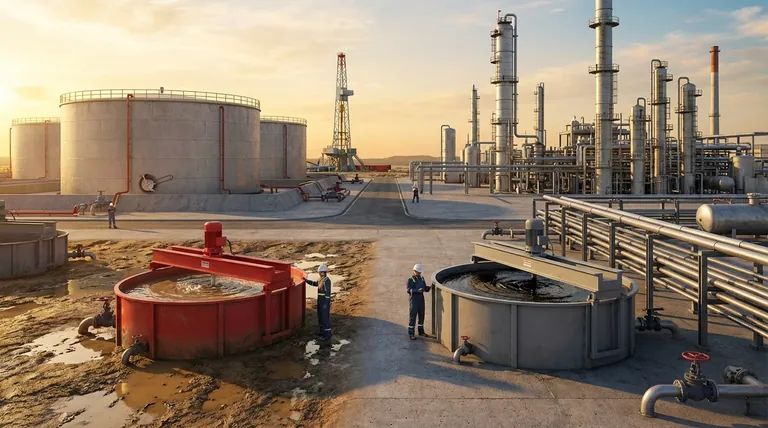
Upstream Operations: The Foundation of Drilling
In the early stages of oil and gas extraction, the performance of the drilling operation itself hinges on the quality of the fluids used. This is where mixing plays its first critical role.
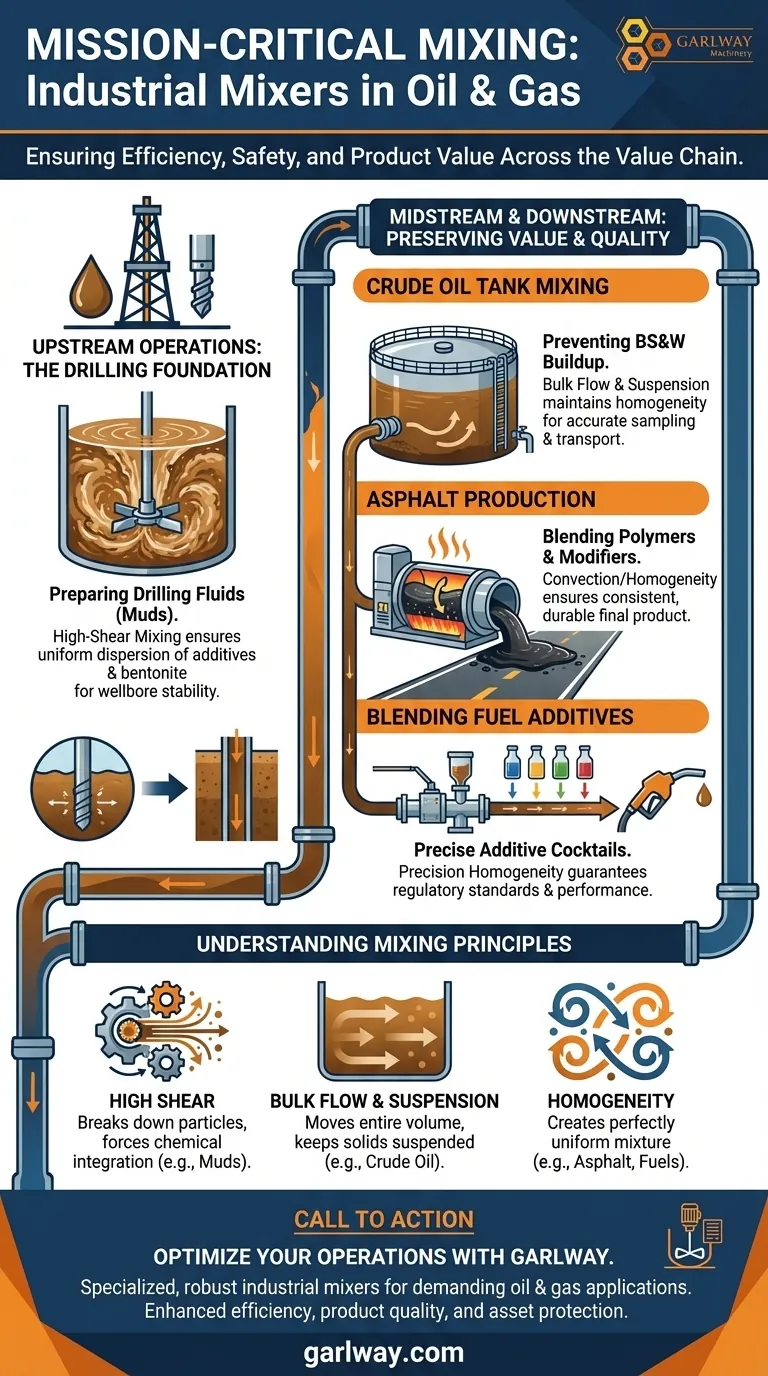
Preparing Drilling Fluids (Muds)
Drilling fluid, or "mud," is a complex mixture engineered to cool the drill bit, transport rock cuttings to the surface, and maintain pressure to stabilize the wellbore.
Achieving the correct viscosity, density, and suspension properties requires high-shear mixing. This process ensures that additives like bentonite clay are fully hydrated and other chemicals are uniformly dispersed, creating a stable and effective fluid.
Midstream & Downstream: Preserving Value and Quality
Once crude oil is extracted, mixing remains essential for maintaining its value during storage and for creating finished, market-ready products.
Crude Oil Tank Mixing
Crude oil storage tanks face a constant problem with Basic Sediment and Water (BS&W). This sludge settles at the bottom of tanks, reducing storage capacity, causing corrosion, and creating a non-uniform product.
Large-scale mixers, often side-entry models, are used to create a gentle, consistent flow throughout the tank. This keeps the BS&W suspended, ensuring the crude oil remains homogenous for accurate sampling, transport, and refining.
Asphalt Production
Asphalt is a heavy byproduct of the crude oil refining process. To create commercial-grade asphalt for paving or roofing, the base asphalt cement must be blended with various polymers and modifiers.
Industrial mixers provide the necessary agitation to ensure these components are completely and uniformly dispersed, resulting in a final product that meets strict performance and durability specifications.
Blending Fuel Additives
Modern fuels are sophisticated chemical blends. Gasoline and diesel require a precise cocktail of additives—such as octane boosters, detergents, and stabilizers—to meet regulatory standards and performance expectations.
Mixing systems are used to introduce these additives into the base fuel stream with extreme precision, guaranteeing a homogenous final product that is ready for distribution.
Understanding the Mixing Principles
Different applications demand fundamentally different types of mixing. Selecting the wrong technology leads to inefficiency, product failure, and increased costs. The type of mixer—be it diffusing, shearing, or convective—is chosen based on the specific goal.
The Principle of High Shear
For tasks like creating drilling muds, the goal is to break down particles and force chemical integration. High-shear mixers use high-speed impellers to create intense mechanical and hydraulic force, ensuring rapid and complete dispersion of solids and additives.
The Principle of Bulk Flow and Suspension
In crude oil tanks, the objective is not to break particles down but to gently keep them suspended. This is achieved with mixers designed for bulk flow, which use large impellers at lower speeds to move the entire volume of the tank, preventing sediment from settling without creating excessive turbulence.
The Principle of Homogeneity
For downstream products like blended fuels and asphalt, the primary goal is creating a perfectly uniform mixture. This often requires convection mixers that efficiently blend liquids or semi-solids to ensure every part of the batch has the exact same composition.
Making the Right Choice for Your Goal
Your specific operational goal dictates the type of mixing technology you need.
- If your primary focus is drilling efficiency and wellbore stability: Your priority is high-shear mixing technology to create perfectly conditioned and reliable drilling fluids.
- If your primary focus is preserving crude oil value and tank integrity: You need large-scale, flow-driven mixers designed for effective and continuous BS&W control in storage tanks.
- If your primary focus is downstream product quality and specification: Your success depends on precision mixing systems engineered for the complete and uniform blending required in asphalt and fuel production.
Ultimately, selecting the correct industrial mixer is a critical decision that directly impacts asset integrity, product quality, and operational profitability across the entire value chain.
Summary Table:
| Application Area | Key Function | Mixing Principle |
|---|---|---|
| Upstream Drilling | Prepare drilling muds (fluids) | High-Shear Mixing |
| Crude Oil Storage | Prevent sediment (BS&W) buildup | Bulk Flow & Suspension |
| Asphalt Production | Blend polymers and modifiers | Convection/Homogeneity |
| Fuel Blending | Add additives uniformly | Precision Homogeneity |
Optimize your oil and gas operations with the right mixing technology. GARLWAY specializes in robust industrial mixers for demanding applications in the oil and gas industry. Whether you're a global contractor needing reliable drilling fluid mixers or a refinery requiring precise blending systems, our expertise ensures enhanced efficiency, product quality, and asset protection. Contact GARLWAY today to discuss a tailored solution for your specific challenges!
Visual Guide
Related Products
- JZC1000 Industrial Concrete Mixer Machine Cement Mixer Price
- Commercial Construction Mixer Machine for Soil Cement Mixing Concrete
- JDY350 Electric Hydraulic Mortar Mud Concrete Mixer
- Mini Cement Mortar Mixer Truck for Construction
- JDC350 Small Cement Concrete Mortar Mixer
People Also Ask
- How are industrial mixers used in the construction industry? The Foundation of Strong, Durable Structures
- What are the three main categories of industrial concrete mixers? Choose the Right Mixer for Your Plant
- What types of materials can be processed in these mixers? Match Your Material to the Perfect Mixer
- Why are industrial mixers important in mining and mineral processing? Maximize Recovery & Ensure Safety
- How are industrial mixers used in the pulp and paper industry? Ensure Consistent, High-Quality Pulp