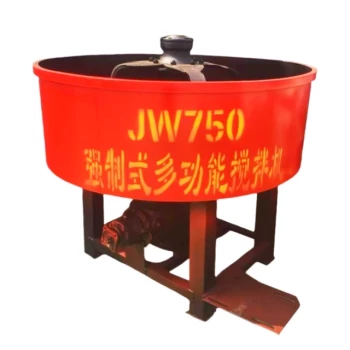
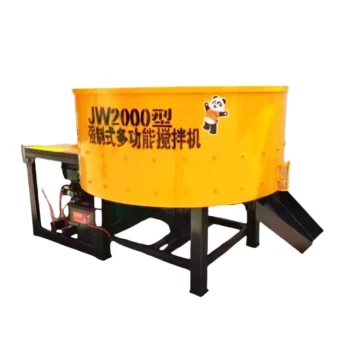
At its core, a continuous concrete mixer is a high-output machine designed to load raw materials, mix them, and discharge fresh concrete in a single, uninterrupted stream. Unlike traditional batch mixers that produce concrete in distinct, separate loads, continuous systems operate without stopping, providing a steady flow ideal for large-scale construction.
The essential difference is one of philosophy: batch mixers deliver precision in discrete quantities, while continuous mixers deliver relentless volume. Your project's scale and demand for on-site flexibility will determine which approach is superior.
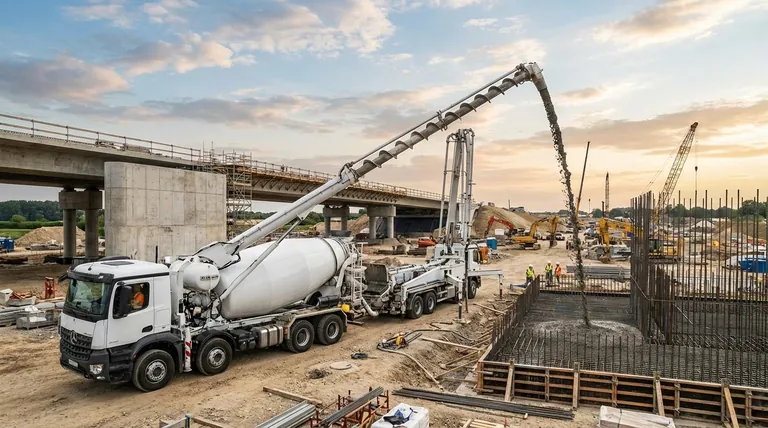
How Continuous Mixing Works
A continuous mixer is fundamentally an on-demand concrete plant. It shifts the production process from a central plant to the job site itself, offering unique operational advantages.
The Uninterrupted Flow
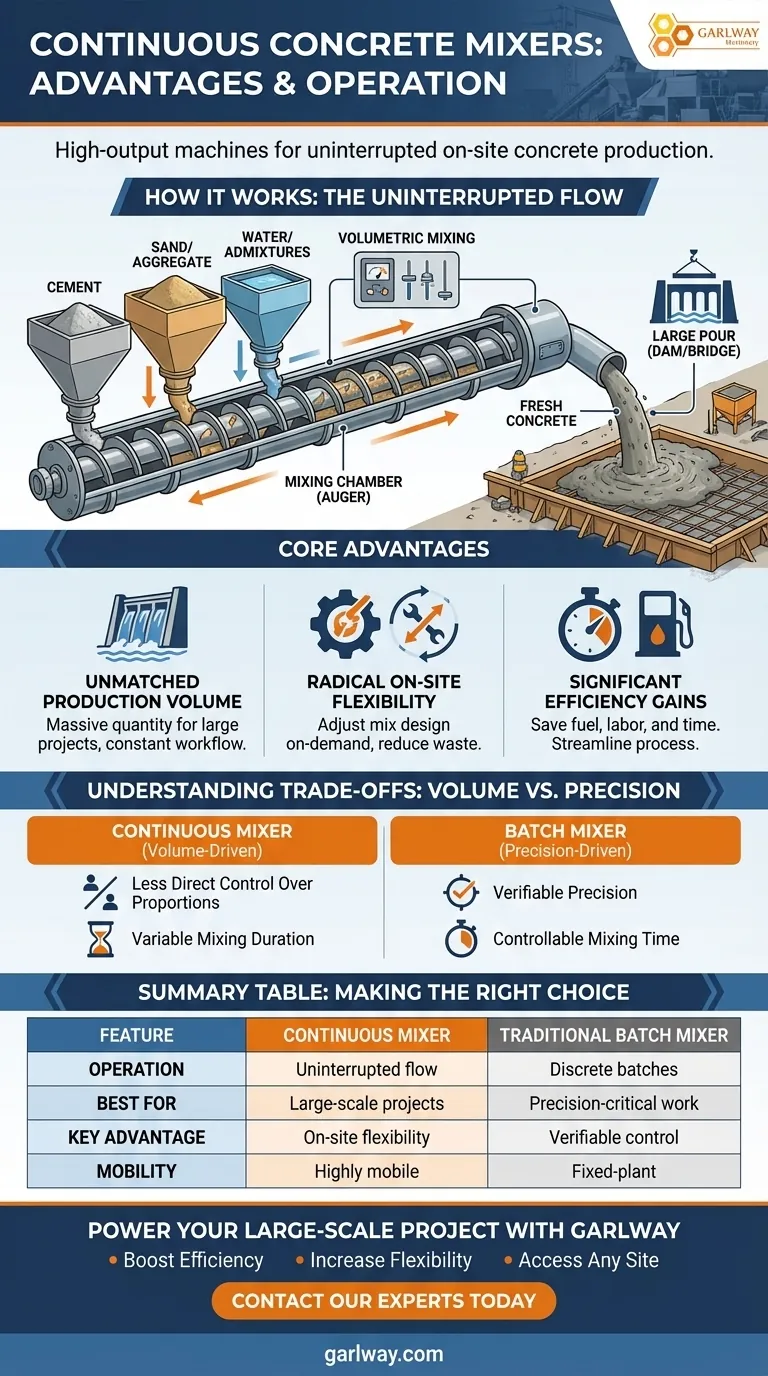
Instead of being loaded with a set recipe for a single batch, a continuous mixer is fed raw materials—like cement, sand, and water—from separate hoppers. These ingredients are metered and fed into a mixing chamber, typically using a long auger or screw. As the materials travel down the length of the auger, they are thoroughly mixed and discharged at the other end as fresh concrete.
Volumetric Mixing On-Demand
Many modern continuous mixers are volumetric mixers. This technology allows operators to adjust the ratio of ingredients in real time. You can produce the exact amount and type of concrete needed at any given moment, directly at the pour site, which drastically reduces waste and eliminates issues with concrete setting during transit.
Mobility and Site Access
Often mounted on a truck chassis, these mixers can navigate remote or difficult-to-access job sites that are impractical for traditional ready-mix trucks. This "go-anywhere" capability is a significant advantage for infrastructure projects in undeveloped or complex terrains.
The Core Advantages of Continuous Systems
The design of a continuous mixer directly translates into several key benefits on a construction site, primarily centered on efficiency and adaptability.
Unmatched Production Volume
Because the machine never stops, it can produce a massive quantity of concrete over a work period. This makes it the ideal solution for large projects like dams, bridges, high-rise foundations, and extensive paving work where a constant supply is critical to prevent cold joints and maintain workflow.
Radical On-Site Flexibility
With a continuous mixer, you are no longer limited to pre-mixed concrete from a batch plant. You can change the mix design as needed, produce small or large quantities on demand, and start or stop the pour without wasting an entire truckload of material.
Significant Efficiency Gains
By eliminating the need for multiple ready-mix trucks to travel back and forth, you save on fuel, labor, and time. The self-loading capabilities of some models further reduce the need for additional machinery, streamlining the entire concrete production process and reducing overall project costs.
Understanding the Trade-offs: Volume vs. Precision
While powerful, continuous mixers are not the universal solution for every concrete job. Their primary strength—high volume—comes with a trade-off in control compared to batch systems.
Control Over Proportions
High-specification projects often require absolute certainty in the water-cement ratio and admixture dosage for every single yard of concrete. A controlled, computerized batch plant provides a higher degree of verifiable precision for each individual batch. Continuous mixers, while highly accurate, rely on the continuous metering of materials, which can have slight variations.
Mixing Time Consistency
In a batch mixer, all materials are held in the drum for a specific, controllable amount of time. In a continuous mixer, the mixing happens as materials move along the auger. This process is highly effective, but it offers less direct control over the exact mixing duration for every particle of aggregate and cement.
Making the Right Choice for Your Project
Selecting the right mixing technology requires aligning the equipment's strengths with your project's primary goal.
- If your primary focus is massive volume and speed for large pours: A continuous mixer is the definitive choice for maximizing output and maintaining a constant workflow.
- If your primary focus is absolute precision and quality control for specialized work: A traditional batch mixer offers superior, verifiable control over individual loads.
- If your primary focus is flexibility, remote access, or eliminating waste: A mobile volumetric continuous mixer provides the ideal balance of on-demand production and go-anywhere capability.
Ultimately, understanding this distinction between volume-driven and precision-driven mixing empowers you to select the most effective and economical tool for the job.
Summary Table:
| Feature | Continuous Mixer | Traditional Batch Mixer |
|---|---|---|
| Operation | Uninterrupted flow | Discrete, separate batches |
| Best For | Large-scale, high-volume projects | Precision-critical, specialized work |
| Key Advantage | On-site flexibility & reduced waste | Verifiable control per batch |
| Mobility | Highly mobile, ideal for remote sites | Typically fixed-plant based |
Ready to Power Your Large-Scale Project with Unstoppable Concrete Production?
GARLWAY specializes in construction machinery, offering robust and reliable continuous concrete mixers for construction companies and contractors globally. Our solutions are engineered to deliver the high-volume, on-site mixing capacity you need to complete dams, bridges, and major infrastructure projects on time and on budget.
We help you:
- Boost Efficiency: Eliminate delays and reduce costs with continuous, on-demand production.
- Increase Flexibility: Adjust mix designs in real-time and pour exactly what you need, where you need it.
- Access Any Site: Navigate complex terrains with our mobile, go-anywhere mixer designs.
Let's discuss how a GARLWAY continuous mixer can be the backbone of your next big project. Contact our experts today for a personalized consultation!
Visual Guide
Related Products
- JS1000 Volumetric Concrete Mortar Mixer for Sale Skid Steer Cement Mixer
- Portable Concrete Mixer Machine Equipment for Mixing Concrete
- Hydraulic Concrete Mixer Machine Cement Mixing Equipment for Mixture Concrete
- JDY350 Electric Hydraulic Mortar Mud Concrete Mixer
- Portable Cement Mixer with Lift Concrete Machine
People Also Ask
- What is the basic working principle of volumetric concrete mixers? On-Demand Mixing for Zero Waste
- What are the advantages of using volumetric mixers for small concrete jobs? Save Costs and Gain On-Site Control
- What are the advantages of volumetric concrete mixers compared to drum mixers? Achieve On-Demand Mixing & Zero Waste
- What are some innovations in volumetric concrete mixers? Boost Efficiency with On-Demand Production
- Why do volumetric mixers provide better ROI? Maximize Profit with On-Demand Concrete Production