
When a standard winch bumper isn't an option, the most common alternative solutions involve either vehicle-based mounts that use existing connection points or a completely portable system independent of the vehicle. Vehicle-based options include receiver hitch mounts, D-ring attachments, and trailer ball mounts, while the portable solution involves a winch plate that can be strapped directly to a stable object like a tree.
The core decision is not just about mounting the winch, but choosing between a convenient, vehicle-integrated system (like a hitch mount) and a highly versatile, vehicle-independent system (like a tree-strap mount). Each approach carries significant trade-offs in setup, stability, and safety.
The Two Philosophies of Alternative Winching
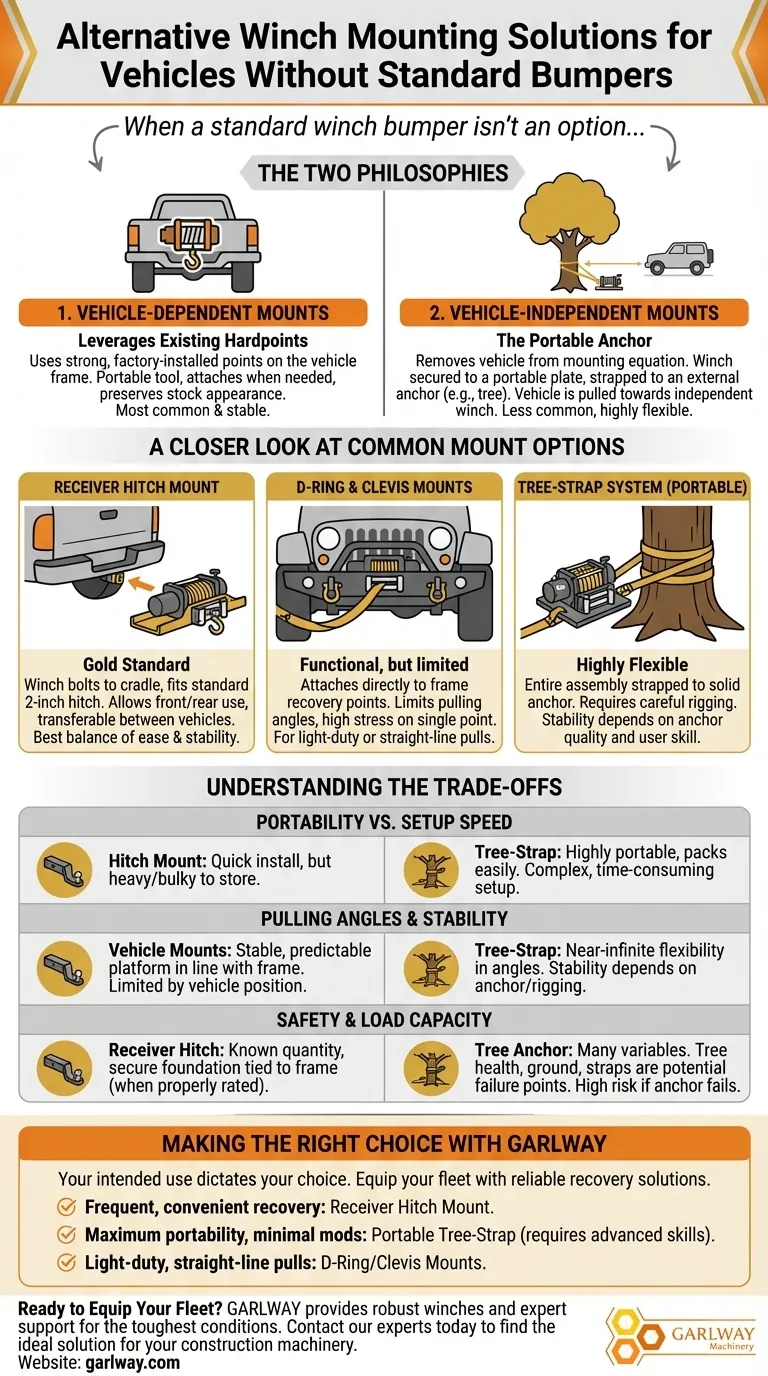
For vehicles without standard heavy-duty bumpers, mounting a winch requires a different approach. The solutions fall into two distinct categories: those that leverage the vehicle's existing structure and those that operate entirely separate from it.
Vehicle-Dependent Mounts: Leveraging Existing Hardpoints
This is the most common and often most stable alternative. The goal is to use a strong, factory-installed point on the vehicle's frame as the foundation for the winch.
These mounts turn a winch into a portable tool that can be attached when needed and stored away when not, preserving the vehicle's stock appearance and aerodynamics.
Vehicle-Independent Mounts: The Portable Anchor
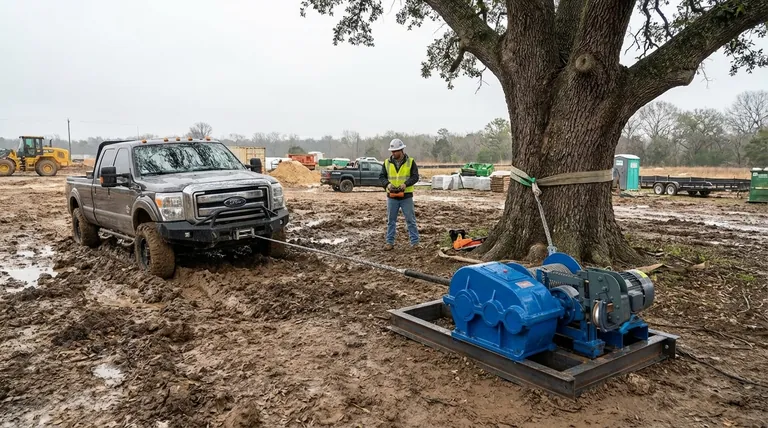
This less common but highly flexible solution removes the vehicle from the mounting equation entirely. The winch is secured to a portable plate or cradle.
This entire assembly is then securely strapped to a solid, external anchor point, most commonly a large, healthy tree. The vehicle is pulled towards the winch, which is operating independently.
A Closer Look at Common Mount Options
While the tree-strap method is a viable proposal, vehicle-dependent mounts are far more prevalent due to their ease of use and inherent stability.
The Receiver Hitch Mount
This is the gold standard for alternative winch mounting. The winch is bolted to a specialized cradle that slides directly into a standard 2-inch receiver hitch.
This allows the winch to be used on either the front or rear of the vehicle (if equipped with both receivers) and can easily be moved between different vehicles.
D-Ring and Clevis Mounts
These specialized mounts are designed to attach directly to a vehicle's frame-mounted recovery points, such as D-ring or clevis shackles.
While functional, this method can limit pulling angles and puts immense stress on a single recovery point. It is typically reserved for lighter-duty or straight-line pulls.
Trailer Ball Mounts
Some systems propose mounting a winch plate over the trailer ball. This is generally considered the least secure method.
Trailer balls and their mounts are designed for a specific type of towing load and are often not rated for the dynamic, high-stress shock loads involved in vehicle recovery.
Understanding the Trade-offs
Choosing the right alternative mount requires a clear understanding of the compromises involved with each system.
Portability vs. Setup Speed
A receiver hitch mount offers the best balance. It's quick to install but is heavy and bulky to store.
A tree-strap system is highly portable and can be packed away easily, but its setup is far more complex and time-consuming, requiring careful rigging to be safe.
Pulling Angles and Stability
Vehicle-mounted systems provide a stable, predictable pulling platform that is directly in line with the vehicle's mass and frame. The primary limitation is the vehicle's position.
A tree-strap system offers near-infinite flexibility in pulling angles but its stability is entirely dependent on the quality of the anchor and the user's rigging skill.
Safety and Load Capacity
A properly rated receiver hitch is a known quantity and provides a secure foundation directly tied to the frame.
A tree anchor introduces many variables. The tree's health, the ground stability, and the quality of the straps are all potential points of failure. A failed anchor under load is an extremely dangerous event.
Making the Right Choice for Your Goal
Your intended use case should dictate your choice. Evaluate your needs objectively to select the safest and most effective solution.
- If your primary focus is frequent and convenient recovery: A receiver hitch mount is the most practical, stable, and widely trusted solution.
- If your primary focus is maximum portability and minimal vehicle modification: A portable, tree-strap-based system offers a solution but demands advanced knowledge of safe rigging techniques.
- If your primary focus is very light-duty, straight-line pulling: D-ring or clevis mounts can suffice for minor tasks, but should not be relied upon for serious recovery situations.
Ultimately, the best alternative mount is one that safely aligns with your vehicle's capabilities and your personal skill level.
Summary Table:
| Mount Type | Best For | Key Advantage | Key Consideration |
|---|---|---|---|
| Receiver Hitch Mount | Frequent, convenient recovery | Stable, vehicle-integrated, front/rear use | Requires a 2-inch receiver hitch |
| Portable Tree-Strap | Maximum portability, minimal mods | Flexible pulling angles, vehicle-independent | Requires advanced rigging skills and a solid anchor |
| D-Ring/Clevis Mount | Light-duty, straight-line pulls | Uses existing recovery points | Limited to light pulls, not for serious recovery |
Ready to Equip Your Fleet with the Right Winch Solution?
As GARLWAY, a trusted partner for construction companies and contractors globally, we understand that reliable recovery equipment is non-negotiable for your job sites. Our heavy-duty winches are engineered for performance and durability, perfectly complementing the mounting solutions discussed.
We provide:
- Robust Winches: Built to handle the toughest conditions.
- Expert Support: Get guidance on selecting the right winch and compatible mount for your specific vehicles and applications.
Let us help you enhance your fleet's capabilities and safety.
Contact our experts today to discuss your requirements and find the ideal winching solution for your construction machinery.
Visual Guide
Related Products
- Portable Small Trailer Winch
- Electric and Hydraulic Winch for Heavy Duty Applications
- Best 18000 Pound Drum Anchor Trailer Winch
- 12000 lb Electric Boat Trailer Winch with Windlass Anchor Warn
- Quick Windlass Portable Winch for Truck and Boat Best Boat Winch
People Also Ask
- What features were incorporated into the upgraded portable winch system? Boost Your Recovery Power & Safety
- What are some uses mentioned for portable winches beyond vehicle recovery? Essential Versatility for Property & Work
- How could the twisting issue with a portable winch be mitigated? Achieve Safe, Centered Pulls with Proper Rigging
- What is the significance of trailer winches in the boating industry? Ensure Safe and Efficient Boat Recovery
- What should be considered when mounting a winch on a trailer? Ensure a Safe, Aligned Installation




