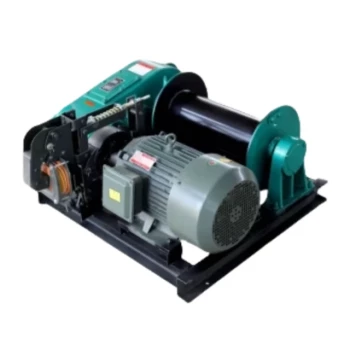
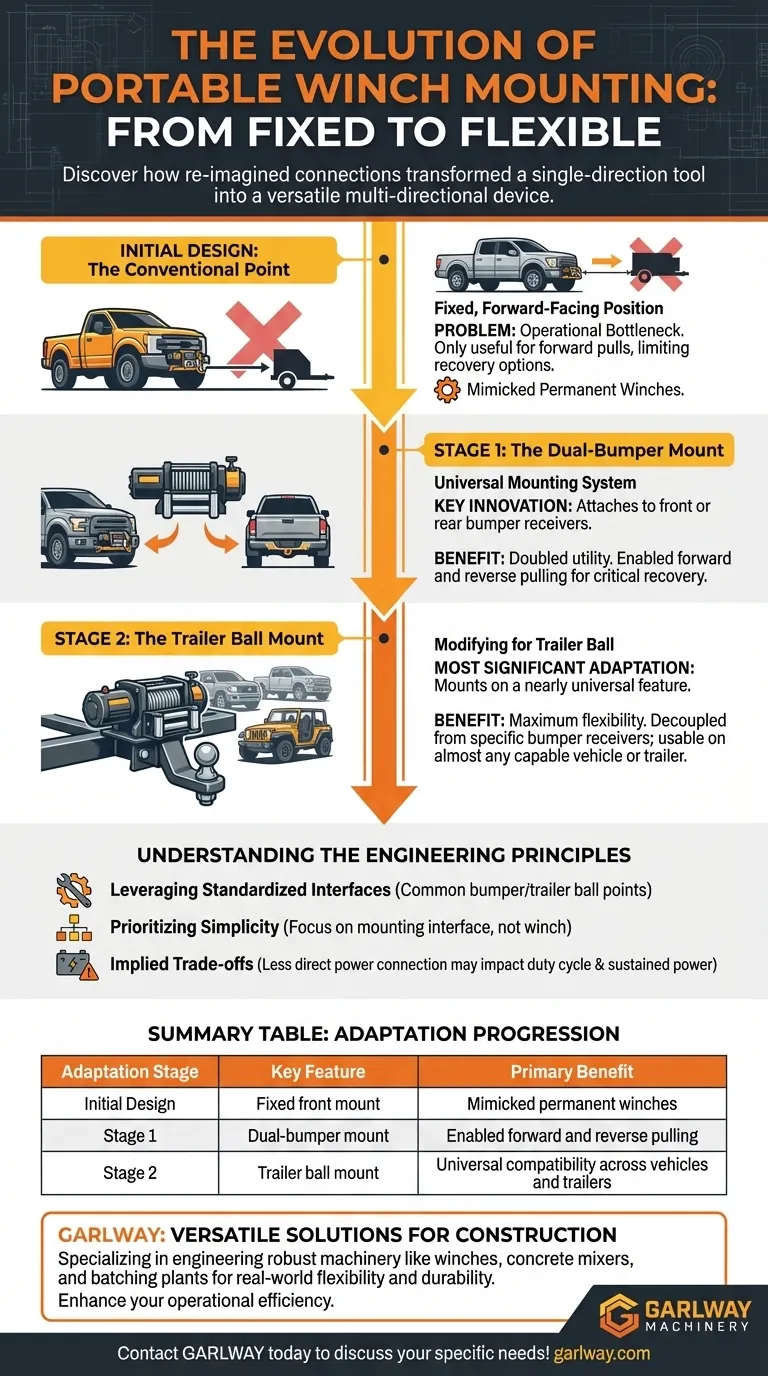
Initially, the first portable winch was adapted by creating a universal mount that could attach to either the front or rear bumper. This innovation was later enhanced by modifying the winch to fit directly onto a standard trailer ball, dramatically expanding its operational flexibility beyond a single, fixed position.
The core innovation was not in changing the winch itself, but in re-imagining its connection to the vehicle. This progression shows a deliberate shift from a fixed, single-direction tool to a truly versatile, multi-directional recovery and utility device.
The Problem With the Initial Design
The Conventional Starting Point
The first portable winches were engineered to mimic their permanently installed counterparts. They were designed to be mounted conventionally on the front of a vehicle.
The Inherent Limitation
This fixed, forward-facing position created a significant operational bottleneck. The winch was only useful for pulling the vehicle forward, rendering it useless if the recovery required pulling backward, sideways, or assisting another vehicle from a different angle.
The Evolution to True Portability
Stage 1: The Dual-Bumper Mount
The first major adaptation was the creation of a universal mounting system. This allowed the same winch unit to be attached to a receiver on either the front or the rear bumper.
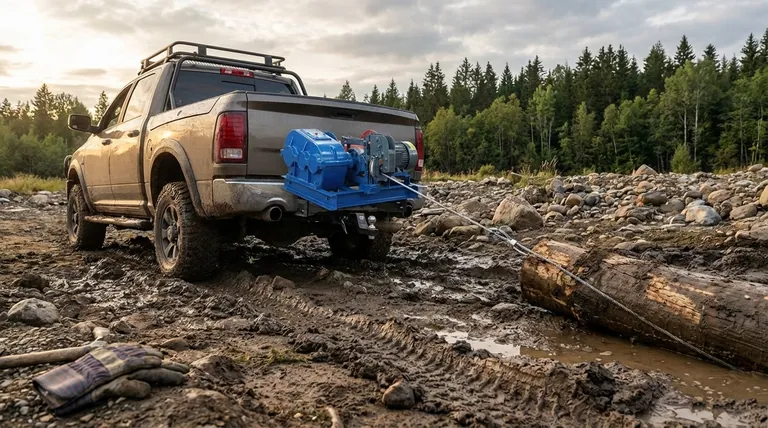
This single change immediately doubled the winch's utility. A vehicle stuck in mud could now pull itself out backward, a critical option that was previously impossible.
Stage 2: The Trailer Ball Mount
The final and most significant adaptation was modifying the winch to mount on a standard trailer ball.
This was a pivotal development because the trailer ball is a nearly universal feature on trucks, SUVs, and utility vehicles. It decoupled the winch from specific bumper receivers and transformed it into a tool that could be used on almost any capable vehicle, or even on a trailer itself, for maximum flexibility.
Understanding the Engineering Principles
Leveraging Standardized Interfaces
The success of these adaptations hinged on a key insight: using the standardized connection points already present on vehicles. By designing mounts for common bumper receivers and trailer balls, the inventors ensured wide compatibility without requiring custom fabrication by the user.
Prioritizing Simplicity
These adaptations were brilliantly simple. Instead of over-engineering the winch itself, the focus was entirely on the mounting interface. This kept the core tool reliable while making its application far more versatile.
The Implied Trade-offs
While portability offers immense flexibility, it comes with considerations. A portable winch system typically relies on a less direct power connection than a permanently hard-wired winch, which can impact its duty cycle and sustained pulling power in extreme recovery situations.
How This Progression Informs Your Choice
Understanding this evolution helps you select the right tool for your specific needs.
- If your primary focus is dedicated off-road recovery: A powerful, permanently installed front winch remains the most robust and instantly available solution.
- If your primary focus is versatility and utility: A modern portable winch with multiple mounting options (receiver and trailer ball) provides unmatched flexibility for various tasks and vehicles.
- If you work with multiple vehicles or trailers: A trailer ball mount is a critical feature, allowing one winch to serve an entire fleet.
Ultimately, the journey of the portable winch demonstrates how the best engineering solves a core problem by focusing on practical, real-world application.
Summary Table:
| Adaptation Stage | Key Feature | Primary Benefit |
|---|---|---|
| Initial Design | Fixed front mount | Mimicked permanent winches |
| Stage 1 | Dual-bumper mount | Enabled forward and reverse pulling |
| Stage 2 | Trailer ball mount | Universal compatibility across vehicles and trailers |
Need a versatile winch solution for your construction or contracting projects?
GARLWAY specializes in engineering robust construction machinery, including winches, concrete mixers, and batching plants designed for real-world flexibility and durability. Whether you're managing a fleet or need equipment that adapts to multiple job sites, our solutions are built to enhance your operational efficiency.
Contact GARLWAY today to discuss how our portable winches and other machinery can meet your specific needs!
Visual Guide
Related Products
- Quick Windlass Portable Winch for Truck and Boat Best Boat Winch
- Portable Small Trailer Winch
- Small Electric Winch 120V and 240V for Compact Applications
- Electric Hoist Winch Boat Anchor Windlass for Marine Applications
- Warn Winch Windlass Boat Trailer Winch
People Also Ask
- What features were incorporated into the upgraded portable winch system? Boost Your Recovery Power & Safety
- What are some uses mentioned for portable winches beyond vehicle recovery? Essential Versatility for Property & Work
- How could the twisting issue with a portable winch be mitigated? Achieve Safe, Centered Pulls with Proper Rigging
- What are the primary uses of a portable winch for a truck? Boost Your Truck's Capability and Self-Reliance
- What is the single rope traction force of the quick winch without a pulley block? 0.5 to 40 Tons Explained