
To be precise, a 2-ton winch has a rated line pull of 4,000 pounds. This rating represents the maximum pulling force the winch can exert under ideal conditions, which is a straight-line pull with the first layer of cable wrapped around the drum.
The number on the box is only the starting point. The winch's true capability depends entirely on the situation, and for tasks like vehicle recovery, the object's actual weight is only one part of the calculation.
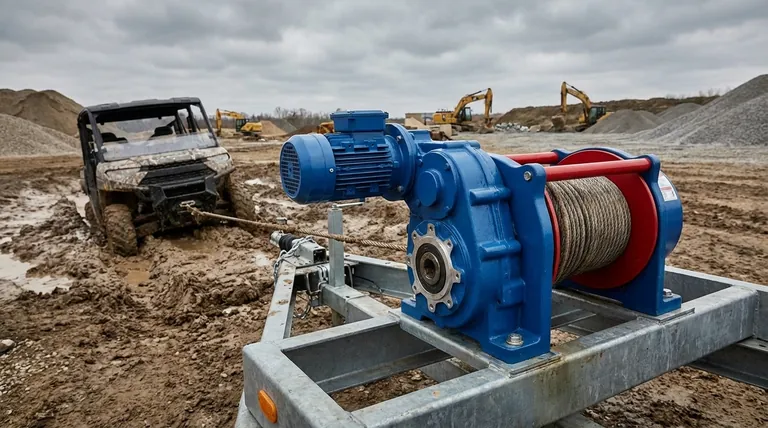
Deconstructing the "2-Ton" Rating
A winch's rated capacity is a standardized measurement, but understanding what it truly signifies is critical for safe and effective use. The 4,000-pound figure is a best-case scenario.
What Rated Line Pull Really Means
The rated line pull is the maximum load a winch can pull with the cable on its innermost layer on the drum. This is where the winch has the most mechanical advantage, similar to using a lower gear on a bicycle.
How Cable Layers Reduce Pulling Power
As you wind more cable onto the drum, the effective diameter of the drum increases. This reduces the winch's gear ratio and, consequently, its pulling power. With each additional layer of cable, the maximum force the winch can exert decreases significantly.
The Critical Difference: Static vs. Rolling Loads
The 4,000-pound rating assumes a static, rolling load on a flat, hard surface. Pulling a car on wheels across a paved lot is very different from dragging a disabled vehicle through deep mud or up an incline.
Calculating Your Actual Pulling Needs
The most common reason for using a winch is vehicle recovery, which requires a substantial safety margin to account for resistance.
The 1.5x Rule of Thumb
For vehicle recovery, the standard guideline is to choose a winch with a rated capacity of at least 1.5 times the gross vehicle weight (GVW). This accounts for the additional forces required to overcome suction from mud, friction, and the incline of the terrain.
Applying the Rule to a 2-Ton Winch
Using this formula, a 2-ton (4,000 lb) winch is appropriately sized for a vehicle with a maximum gross weight of about 2,667 pounds (4,000 lbs ÷ 1.5). This makes it suitable for ATVs, UTVs, or very small, lightweight cars, but insufficient for most standard cars, SUVs, or trucks.
Why Resistance Matters More Than Weight
A 3,500-pound vehicle stuck deep in the mud can require 7,000 pounds of force or more to break free. The resistance from the environment, not just the vehicle's weight, creates the real load on the winch.
Understanding the Trade-offs and Risks
Choosing the wrong winch is not just an inconvenience; it's a significant safety hazard.
The Dangers of an Undersized Winch
Using a winch that is too small for the task puts immense strain on its motor, gears, and cable. This can lead to overheating, component failure, and a snapped cable—which can be incredibly dangerous.
Key Features Beyond Capacity
While pulling power is the headline feature, look for other signs of quality. Components like dual gears and double locking pawls (a mechanism that prevents the drum from slipping backward) ensure that force is distributed evenly and the load is held securely.
Making the Right Choice for Your Goal
To select the correct winch, you must match its capacity to your specific application.
- If your primary focus is workshop or farm use: A 2-ton winch is excellent for pulling rolling machinery, logs, or other heavy objects across relatively flat, hard surfaces where resistance is low.
- If your primary focus is vehicle recovery: You must use the 1.5x rule. A 2-ton winch is only safe for vehicles weighing less than approximately 2,700 pounds.
Ultimately, your winch must be powerful enough to handle the worst-case scenario you realistically expect to encounter.
Summary Table:
| Factor | Impact on a 2-Ton (4,000 lb) Winch |
|---|---|
| Rated Line Pull | Maximum 4,000 lbs of force on the first cable layer. |
| Additional Cable Layers | Pulling power decreases significantly with each new layer. |
| Vehicle Recovery Rule | Suitable for vehicles with a max weight of ~2,667 lbs (1.5x rule). |
| Ideal For | ATVs, UTVs, lightweight cars, or pulling rolling loads on hard surfaces. |
Don't risk an undersized winch. Ensure your equipment is up to the task.
GARLWAY specializes in durable construction machinery, offering a full range of winches, concrete mixers, and batching plants designed for the demanding needs of construction companies and contractors globally.
Contact our experts today for a personalized recommendation to match the perfect winch to your specific vehicle and job site requirements.
Visual Guide

Related Products
- Electric and Hydraulic Winch for Heavy Duty Applications
- Portable Small Trailer Winch
- 12000 lb Electric Boat Trailer Winch with Windlass Anchor Warn
- 12000 lb Heavy Duty Electric Boat Winch
- Heavy Duty Electric Boat Winch Windlass Anchor
People Also Ask
- What are the differences between electric and hydraulic winches? Choose the Right Winch for Your Job
- What are some common uses for a heavy-duty winch? Power Your Construction & Industrial Projects
- What are electro-hydraulic winches and their applications? The Integrated Power Solution for Heavy-Duty Operations
- How do winches assist in bridge launching? Accelerate Bridge Placement with Controlled Pulling Power
- What are the benefits of using heavy-duty winches for large projects? Boost Efficiency & Safety




