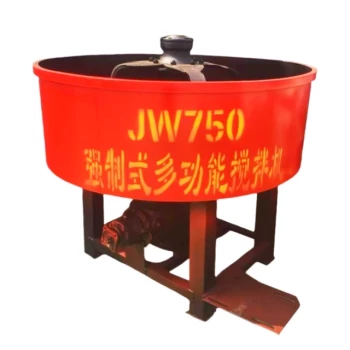
At its core, a batch concrete mixer operates on a simple, cyclical principle. All raw materials for a single, specific volume of concrete—aggregates, sand, cement, and water—are loaded, mixed together thoroughly, and then completely discharged. Only after the drum is empty is the next batch introduced, ensuring precise control over each load.
The key to understanding a batch mixer is its one-at-a-time process. Unlike a continuous mixer, its entire operation is designed to produce a distinct, measured quantity of concrete, guaranteeing consistency from the first ingredient to the final pour.
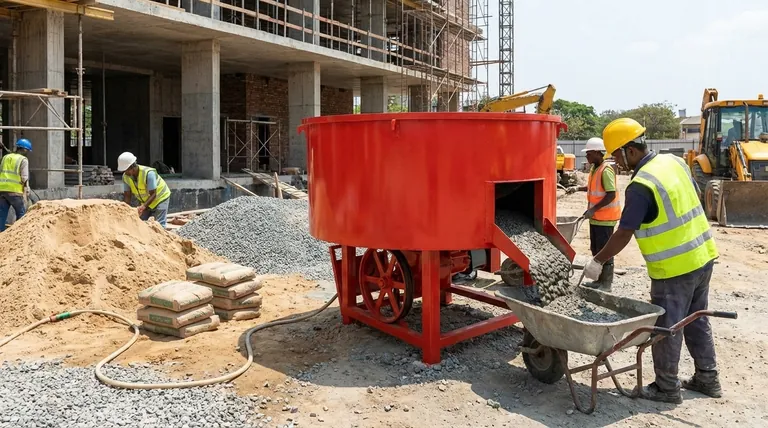
The Core Operational Cycle: From Raw Materials to Concrete
The operation of a batch mixer follows a distinct, repeatable sequence. Each step is critical for producing a high-quality, homogenous final product.
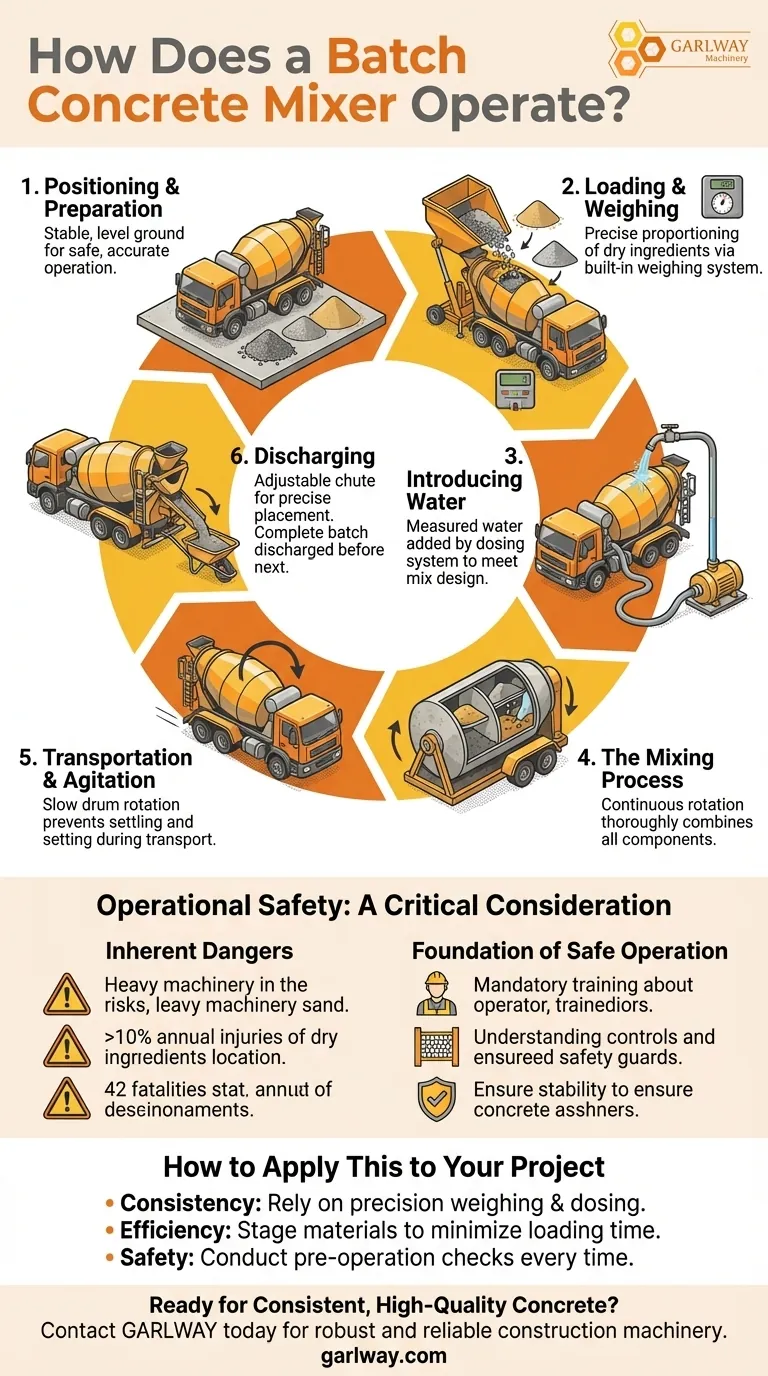
Step 1: Positioning and Preparation
Before any mixing begins, the mixer must be positioned on stable, level ground. This is crucial for both operational safety and the accuracy of weighing systems. The raw material piles (sand, gravel) should be located nearby to streamline the loading process.
Step 2: Loading and Weighing
The operator uses a hydraulic hopper or loader bucket to scoop and load the dry ingredients—aggregates, sand, and cement—into the mixer. Modern systems have a built-in weighing system that allows for precise proportioning of these materials, which is fundamental to achieving the desired concrete strength.
Step 3: Introducing Water
Once the dry components are loaded, water is added. This is typically managed by a water dosing system or pump, allowing the operator to add a specific, measured amount of water to meet the mix design requirements.
Step 4: The Mixing Process
The heart of the operation is the rotating drum. As the drum turns, internal shelves or projections lift and tumble the materials. This continuous motion thoroughly combines the cement, aggregates, and water, preventing any ingredients from settling or caking to the inside of the drum.
Step 5: Transportation and Agitation
For mobile units, the drum continues to rotate at a slow speed during transport. This gentle agitation ensures the concrete remains perfectly mixed and prevents it from beginning to set before it reaches the pour site.
Step 6: Discharging the Final Product
Upon arrival, the operator controls the discharge of the finished concrete. The material flows out through an adjustable chute, allowing for precise placement into forms, wheelbarrows, or pump hoppers. The entire batch is discharged before the cycle begins again.
A Critical Consideration: Operational Safety
It is impossible to discuss mixer operation without addressing the significant safety risks involved. The process involves heavy machinery, powerful moving parts, and caustic materials.
The Inherent Dangers
Statistics show that working with concrete processing equipment carries a high risk. Annually, over 10% of related workers can experience injuries, and in one year, 42 fatalities were recorded among concrete processing workers in the United States.
The Foundation of Safe Operation
Proper training is non-negotiable. Operators must understand every control, from the engine start-up to the discharge mechanism, and be fully aware of all safety guards and emergency-stop procedures. Never bypass safety features, and always ensure the machine is stable before loading.
How to Apply This to Your Project
Understanding the operational sequence allows you to optimize for your specific project goals.
- If your primary focus is consistency: Rely on the precision of the weighing and water dosing systems to ensure every batch meets the exact same specifications.
- If your primary focus is efficiency: Stage your raw materials intelligently to minimize loading time between batches, which is the most time-consuming part of the cycle.
- If your primary focus is safety: Conduct a pre-operation check of the mixer and the work area every single time, confirming stable ground and functional safety mechanisms.
Mastering this cyclical process is the key to producing consistent, high-quality concrete safely on every job.
Summary Table:
| Step | Key Action | Purpose |
|---|---|---|
| 1 | Positioning & Preparation | Ensure stable, level ground for safe and accurate operation. |
| 2 | Loading & Weighing | Precisely proportion dry ingredients (aggregates, sand, cement) for mix strength. |
| 3 | Introducing Water | Add a measured amount of water to meet mix design requirements. |
| 4 | The Mixing Process | Rotate drum to thoroughly combine all materials into a homogenous mixture. |
| 5 | Transportation & Agitation | Keep concrete mixed and prevent setting during transit to the site. |
| 6 | Discharging | Empty the complete batch via an adjustable chute for precise placement. |
Ready to achieve consistent, high-quality concrete on your project?
GARLWAY specializes in providing robust and reliable construction machinery, including concrete mixers, for construction companies and contractors globally. Our equipment is designed with precision weighing systems and safety features to support your operational efficiency and project success.
Contact GARLWAY today to discuss your concrete mixing needs and find the perfect solution for your job site.
Visual Guide
Related Products
- Commercial Electric Concrete Mixer Machine HZS 50 Small Batch Plant for Sale
- HZS25 Best Cement Mixer for Quick Mix Concrete at Bunnings
- HZS35 Small Cement Concrete Mixing Batch Plant
- HZS120 Ready Mix Concrete Batching Plant Commercial Mud Cement Mixer
- Portable Concrete Mixer Machine Equipment for Mixing Concrete
People Also Ask
- What are the types of concrete mixers used in batching plants? Choose the Right Mixer for Your Project
- What is the core component of a concrete batching plant? The Mixer Unit Defines Your Concrete Quality
- Why is proper maintenance important for a concrete batch mix plant? Maximize Uptime & Profitability
- Why buy concrete batch plant parts only from the manufacturer? Protect Your Investment and Maximize Uptime
- What are the two main types of concrete batch mixers? Choose the Right Mixer for Your Project