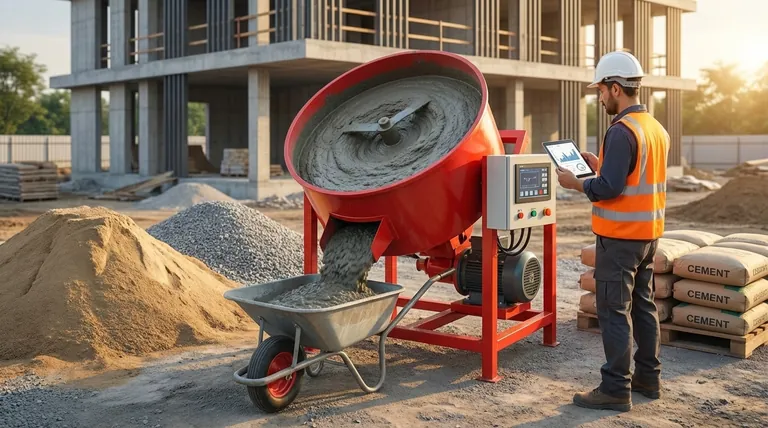
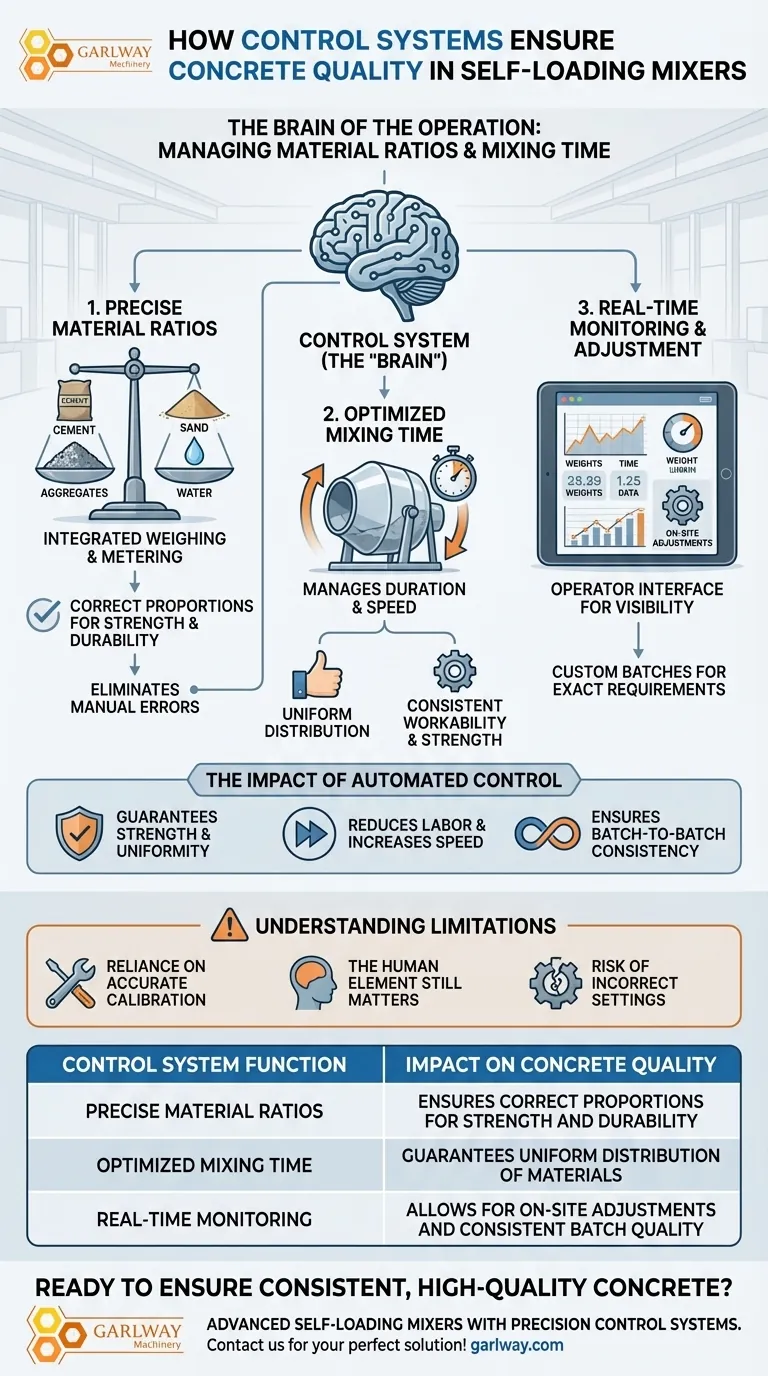
At its core, a self-loading concrete mixer's control system ensures concrete quality by precisely managing material ratios and mixing time. This automation acts as the brain of the operation, guaranteeing that every batch meets the required specifications for strength, uniformity, and durability by removing the inconsistencies of manual guesswork.
The control system's primary role is to transform the mixer from a simple machine into a precision instrument. It achieves this by enforcing consistency in every step of the process, from loading raw materials to discharging the final, uniform product.
How the Control System Governs Quality
The control system is the central nervous system of the mixer, overseeing the entire production cycle to guarantee a high-quality end product. It achieves this through several critical functions working in harmony.
Precise Material Ratios
The foundational principle of quality concrete is the correct proportion of its components. The control system uses integrated weighing and metering technology to ensure every batch has the exact amount of cement, sand, aggregates, and water required.
This eliminates the human error common in manual loading, directly contributing to the concrete's final compressive strength and long-term durability.
Optimized Mixing Time
The system controls not just the ingredients, but the process itself. It manages the duration and speed of the mixing drum to ensure all components are uniformly distributed.
This controlled environment is crucial. Insufficient mixing leads to an uneven, weak product, while excessive mixing can negatively affect the concrete's workability and ultimate strength.
Real-Time Monitoring and Adjustment
A key feature of modern control systems is the interface that allows operators to monitor the process as it happens. This provides visibility into weights, mixing times, and other critical parameters.
This capability also allows for on-site adjustments. If a specific project requires a slightly different mix design, the operator can modify the parameters to produce a custom batch that meets the exact structural requirements.
The Impact of Automated Control
Automating the concrete production process has a direct and measurable impact on both the quality of the concrete and the efficiency of the project.
Guaranteeing Strength and Uniformity
By ensuring a uniform distribution of all materials in every batch, the control system is the primary guarantor of quality. This consistency ensures that the final structure performs exactly as designed.
Reducing Labor and Increasing Speed
Automation significantly reduces the need for manual labor and the time required for each production cycle. This allows for a faster, more streamlined construction process, leading to improved project timelines.
Ensuring Batch-to-Batch Consistency
The system's ability to replicate the exact same recipe and process time after time is perhaps its greatest advantage. This ensures that the concrete poured on day one has the same properties as the concrete poured on day ten, enhancing overall structural integrity.
Understanding the Limitations
While highly effective, the control system is not infallible. Its performance depends on proper use and maintenance to avoid common pitfalls.
Reliance on Accurate Calibration
The entire system's accuracy hinges on the calibration of its weighing sensors and water meters. If these are not calibrated correctly, even a "perfectly" executed automated process will yield a flawed mix.
The Human Element Still Matters
The operator remains a critical factor. They must be skilled enough to select the correct pre-programmed mix, monitor the system for any anomalies, and know when an on-site adjustment is necessary and appropriate.
Risk of Incorrect Settings
The system will only execute the commands it is given. If an operator sets an incorrect mixing time or selects the wrong material ratio program, the control system will dutifully produce poor-quality concrete.
Applying This to Your Project
Your operational priorities will determine which aspects of the control system are most important for your success.
- If your primary focus is maximum structural integrity: Prioritize systems with highly precise, certified weighing and water metering components to guarantee mix accuracy.
- If your primary focus is high-volume production speed: Emphasize systems that offer efficient automation, rapid loading, and quick mixing cycles to maximize output.
- If your primary focus is versatility for varied job sites: Look for control systems with intuitive interfaces that make it simple to adjust mix designs on-the-fly.
Ultimately, the control system is what ensures a self-loading mixer can deliver on its promise of consistent, high-quality concrete, anywhere.
Summary Table:
| Control System Function | Impact on Concrete Quality |
|---|---|
| Precise Material Ratios | Ensures correct proportions for strength and durability. |
| Optimized Mixing Time | Guarantees uniform distribution of materials. |
| Real-Time Monitoring | Allows for on-site adjustments and consistent batch quality. |
Ready to ensure consistent, high-quality concrete on your projects? GARLWAY specializes in construction machinery, offering advanced self-loading concrete mixers for construction companies and contractors globally. Our machines feature precision control systems designed to deliver the strength and uniformity your structures demand. Contact us today to find the perfect solution for your operational needs!
Visual Guide
Related Products
- Skid Steer Self Loading Concrete Mixers for Construction
- Belle Mixer Drum Self Loading Mortar Mixers JS3000
- Portable Cement Mixer with Lift Concrete Machine
- Portable Concrete Mixer Machine Equipment for Mixing Concrete
- Portable Ready Mix Concrete Mixer Equipment
People Also Ask
- How does the control system improve production efficiency in a self loading concrete mixer? Automate Mixing for Speed & Quality
- What is the purpose of keeping the drum rotating during transportation in a self loading concrete mixer? Ensure Quality & Consistency
- How does the weighing process work in a self loading concrete mixer? Achieve Precise, On-Site Concrete Batching
- What components are involved in the loading process of a self loading concrete mixer? A Guide to the Key Systems
- How should materials be loaded into a self-loading concrete mixer? Master the Step-by-Step Process