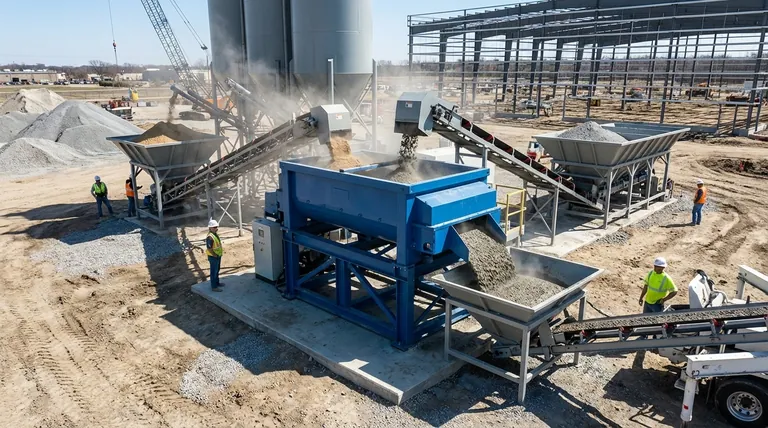
At its core, a continuous mixer operates by transforming the stop-and-start process of traditional mixing into a single, uninterrupted flow. It continuously weighs, feeds, blends, and discharges materials like cement, sand, and water, creating a consistent stream of finished product without the need for discrete batches.
The fundamental advantage of a continuous mixer is its ability to automate a non-stop production line. This replaces the cyclical nature of batch mixing with a highly efficient, consistent, and faster process ideal for large-scale operations.
The Core Operational Principle: A Non-Stop Flow
To understand the continuous mixer, it's best to visualize it as an automated assembly line for mixed materials. Each stage happens simultaneously and in constant motion.
Automated Ingredient Feeding
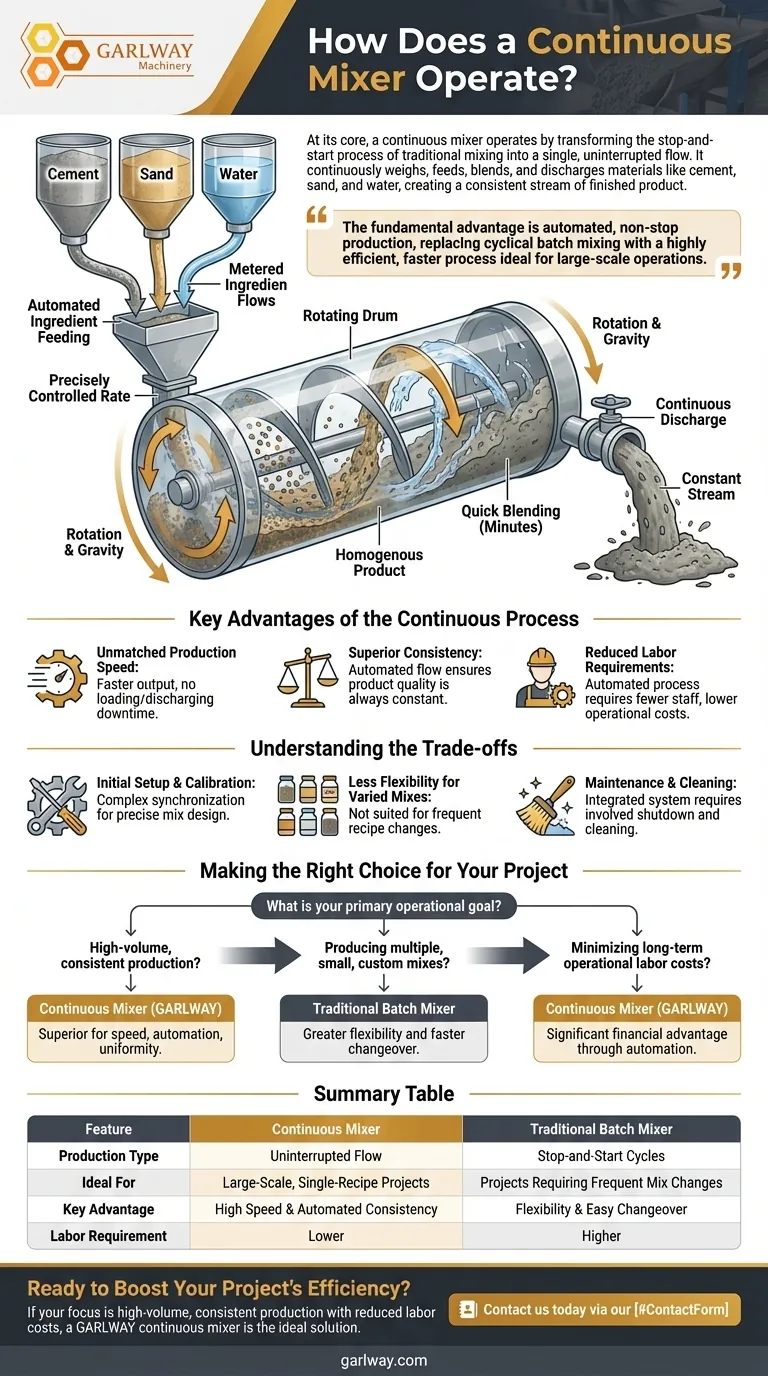
The process begins with the automated feeding of raw materials. Unlike a batch system where pre-measured ingredients are loaded all at once, a continuous mixer draws materials from hoppers or silos at a precisely controlled rate. This ensures the recipe proportions remain constant throughout the entire production run.
The Mixing Mechanism
These ingredients are introduced into a rotating drum or mixing vessel. This vessel is equipped with strategically shaped internal components, often described as spiral mixing blades or vanes, which are crucial for the blending process.
The Role of Rotation and Gravity
As the drum rotates at a specific speed, it lifts the materials. Gravity then causes them to tumble back down, creating a gentle but thorough mixing action. The spiral blades guide the product through the vessel, ensuring all ingredients—sand, cement, and water—are evenly incorporated.
Achieving a Homogenous Product
This combined motion of rotation and tumbling creates random flows and even some backflow, which prevents any single ingredient from passing through unmixed. This process is remarkably quick, resulting in a homogenous product in just a few minutes as it travels the length of the drum.
Continuous Discharge
As new raw materials are fed into the intake, the perfectly mixed product exits through a discharge point, such as an opened valve at the opposite end. The mixer quickly reaches a steady state, producing a constant and predictable stream of finished material until the operation is stopped.
Key Advantages of the Continuous Process
Shifting from a batch to a continuous model provides several significant operational benefits that address the core needs of high-volume production.
Unmatched Production Speed
Because there is no downtime for loading or discharging separate batches, the output is significantly faster. Production is constant for as long as the machine is running, making it ideal for large projects with tight deadlines.
Superior Consistency
Automation removes the potential for human error in measuring ingredients for each batch. The continuous, metered flow of materials ensures that the product quality is exceptionally consistent from the first yard of concrete to the last.
Reduced Labor Requirements
The entire process—from feeding to discharge—is automated. This means a continuous mixing operation requires far less staff to manage, reducing operational costs and improving site efficiency.
Understanding the Trade-offs
While powerful, the continuous mixer is a specialized tool. Its strengths in one area create trade-offs in others, which are critical to consider.
Initial Setup and Calibration
Continuous systems are more complex than simple batch mixers. Achieving the correct, synchronized feed rates for all ingredients requires careful initial calibration to guarantee the mix design is met precisely.
Less Flexibility for Varied Mixes
These machines excel at producing a large volume of a single, consistent recipe. They are not well-suited for projects that require frequent changes between small, different mix designs, as the changeover process is more involved than simply starting a new batch.
Maintenance and Cleaning
Because the system is more integrated, shutdown and cleaning procedures can be more complex. Any material left to harden inside the mixing vessel can be difficult to remove and may cause significant downtime if not managed properly.
Making the Right Choice for Your Project
Selecting the right mixing technology depends entirely on the primary goals of your operation.
- If your primary focus is high-volume, consistent production: The continuous mixer is the superior choice for its unmatched speed, automation, and product uniformity.
- If your primary focus is producing multiple, small, custom mixes: A traditional batch mixer offers greater flexibility and faster changeover between different recipes.
- If your primary focus is minimizing long-term operational labor costs: The high degree of automation in a continuous mixer provides a clear and significant financial advantage.
Understanding this core operational difference empowers you to select the mixing technology that directly aligns with your production goals.
Summary Table:
| Feature | Continuous Mixer | Traditional Batch Mixer |
|---|---|---|
| Production Type | Uninterrupted Flow | Stop-and-Start Cycles |
| Ideal For | Large-Scale, Single-Recipe Projects | Projects Requiring Frequent Mix Changes |
| Key Advantage | High Speed & Automated Consistency | Flexibility & Easy Changeover |
| Labor Requirement | Lower | Higher |
Ready to Boost Your Project's Efficiency?
If your primary focus is high-volume, consistent production with reduced labor costs, a GARLWAY continuous mixer is the ideal solution. Our expertise in construction machinery ensures you get a reliable system designed for maximum output and uniformity.
Contact us today via our [#ContactForm] to discuss how a GARLWAY continuous mixer can be integrated into your operation for superior performance.
Visual Guide
Related Products
- JS1000 Volumetric Concrete Mortar Mixer for Sale Skid Steer Cement Mixer
- Portable Concrete Mixer Machine Equipment for Mixing Concrete
- Portable Cement Mixer with Lift Concrete Machine
- JDY350 Electric Hydraulic Mortar Mud Concrete Mixer
- Portable Electric Concrete Mixer Machine for Cement Mixing
People Also Ask
- What is the basic working principle of volumetric concrete mixers? On-Demand Mixing for Zero Waste
- What are the advantages of using volumetric mixers for small concrete jobs? Save Costs and Gain On-Site Control
- What are the advantages of volumetric concrete mixers compared to drum mixers? Achieve On-Demand Mixing & Zero Waste
- What are some innovations in volumetric concrete mixers? Boost Efficiency with On-Demand Production
- Why do volumetric mixers provide better ROI? Maximize Profit with On-Demand Concrete Production