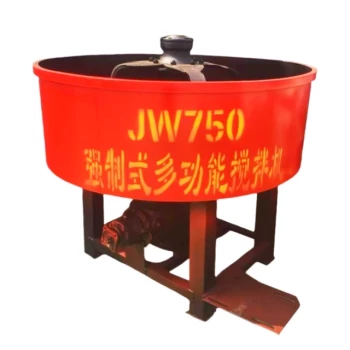
At its core, a top-loading concrete mixer is defined by its simple design: a hatch on the top of the drum where raw materials are loaded from above. This straightforward mechanism makes them easy to use and well-suited for producing large, consistent batches of concrete, contrasting sharply with mixers that automate loading or mix materials on-demand.
The primary difference between a top-loading mixer and other types is not just the loading method, but the entire operational philosophy—manual batch production versus automated loading, on-site customization, or specialized material handling.

The Defining Feature: Direct Manual Loading
Simplicity in Design
A top-loading mixer operates on a very direct principle. You bring the aggregate, sand, cement, and water to the machine and load them through the top opening.
This design is valued for its mechanical simplicity and reliability. Fewer moving parts in the loading system mean fewer potential points of failure.
The Standard Workflow
This type of mixer is ideal for stationary setups where materials can be easily stockpiled nearby. It excels at producing one large batch at a time, making it a workhorse for predictable, high-volume tasks.
How Other Mixers Solve Different Problems
While a top-loader focuses on simple batch production, other mixers are designed to solve specific challenges related to labor, precision, and material type.
Self-Loading Mixers: The Efficiency Play
Self-loading mixers integrate a built-in mechanism, like a shovel or bucket, to load raw materials into the drum automatically.
This design eliminates the need for separate loading equipment and significantly reduces manual labor. It functions like a small, mobile batching plant, ideal for sites where speed and operational efficiency are critical.
Volumetric Mixers: Precision and Freshness
A volumetric mixer does not mix materials until the moment of the pour. It carries unmixed materials in separate compartments and combines them on-site.
This provides ultimate flexibility, allowing you to customize the mix design for different parts of a job and ensuring the concrete is always fresh. It is perfect for projects requiring multiple small, custom pours.
Mortar Mixers: The Specialist Tool
It is crucial not to confuse a concrete mixer with a mortar mixer. Mortar mixers are designed for more viscous materials like mortar or plaster.
They typically use a stationary drum with rotating paddles inside to thoroughly combine the fine materials, whereas a concrete mixer uses a rotating drum to tumble the heavy aggregate.
Understanding the Trade-offs
Each mixer design represents a different balance of simplicity, efficiency, and cost.
Top-Loader: Simplicity vs. Labor
The primary advantage is simplicity and often a lower initial cost. The trade-off is its reliance on manual labor and potentially other machinery (like a front-end loader) to load the materials.
Self-Loader: Automation vs. Complexity
The key benefit is a massive reduction in labor and time. The downside is a more complex and expensive machine that requires more maintenance than a simple top-loader.
Volumetric: Flexibility vs. Throughput
Its strength is unparalleled control over the mix and the elimination of waste from "hot loads." However, for pouring a single, massive, uniform slab, a large-capacity batch mixer might be more efficient.
Making the Right Choice for Your Goal
Selecting the correct mixer depends entirely on the priorities of your project.
- If your primary focus is reliable, high-volume batch production: A top-loading concrete mixer offers a straightforward and cost-effective solution.
- If your primary focus is minimizing on-site labor and equipment: A self-loading mixer is the clear choice for its all-in-one operational efficiency.
- If your primary focus is custom mixes and eliminating waste: A volumetric mixer provides the flexibility needed for complex or multi-stage pours.
- If your primary focus is masonry or plastering: A dedicated mortar mixer is non-negotiable for achieving the correct consistency and material integrity.
Choosing the right tool for the job transforms your workflow from a challenge into a streamlined process.
Summary Table:
| Mixer Type | Key Feature | Best For | Main Trade-off |
|---|---|---|---|
| Top-Loading | Manual loading through top hatch | High-volume batch production | Relies on manual labor/equipment |
| Self-Loading | Built-in automated loading system | Labor-efficient, all-in-one operation | Higher complexity and cost |
| Volumetric | Mixes materials on-demand at pour site | Custom mixes, zero waste projects | Lower throughput for large uniform pours |
| Mortar Mixer | Stationary drum with rotating paddles | Masonry, plaster, viscous materials | Not suitable for concrete with aggregate |
Still Unsure Which Concrete Mixer is Right for Your Project?
GARLWAY specializes in construction machinery, offering a complete range of concrete mixers including top-loading, self-loading, and volumetric models for construction companies and contractors globally. Our experts will help you:
- Analyze your specific project requirements and workflow
- Select the optimal mixer type to maximize efficiency and ROI
- Access reliable, high-performance equipment built for demanding job sites
Let us help you transform your concrete workflow from a challenge into a streamlined process. Contact our experts today for a personalized consultation!
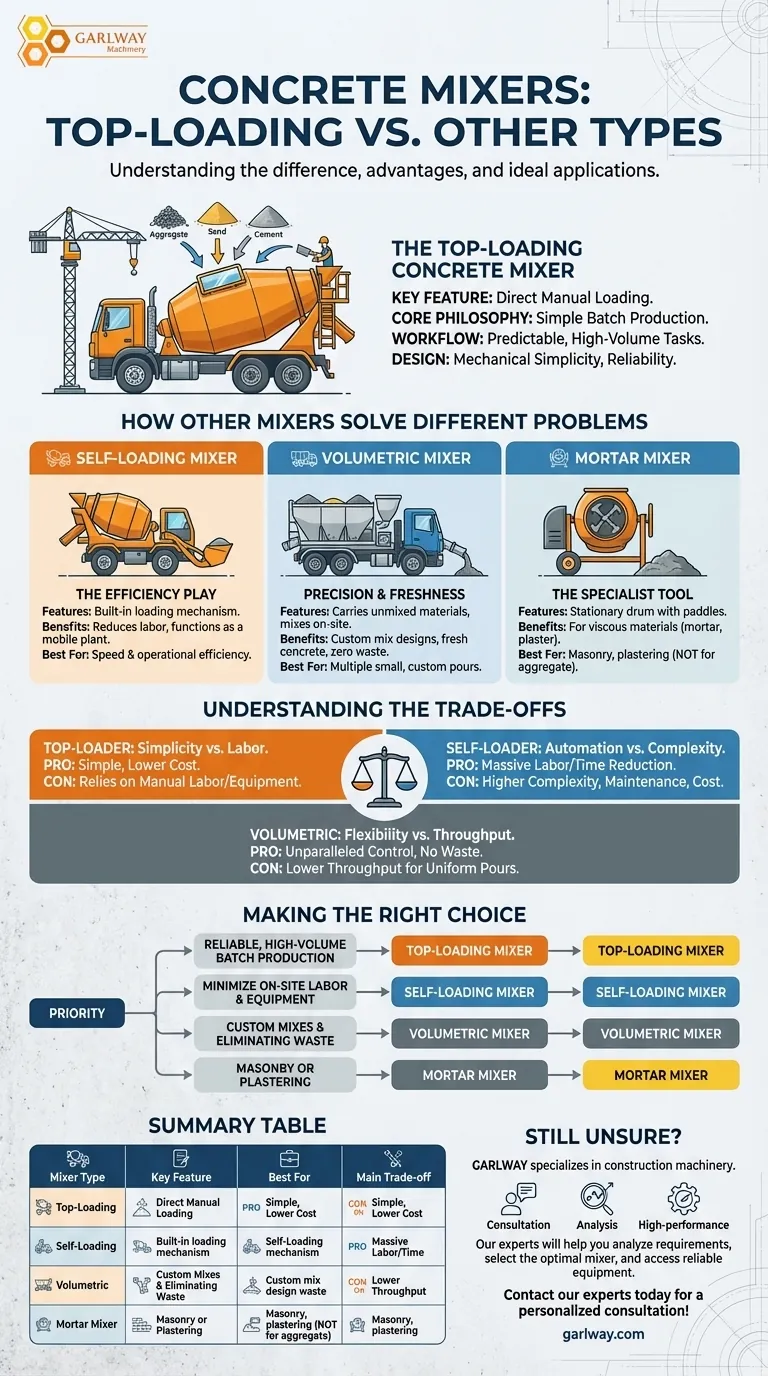
Visual Guide
Related Products
- Portable Cement Mixer with Lift Concrete Machine
- Skid Steer Self Loading Concrete Mixers for Construction
- Belle Mixer Drum Self Loading Mortar Mixers JS3000
- Portable Concrete Mixer Machine Equipment for Mixing Concrete
- HZS25 Best Cement Mixer for Quick Mix Concrete at Bunnings
People Also Ask
- What are the size and portability options for portable cement mixers? Find Your Perfect Match for Any Job
- Why is it necessary to use a portable concrete mixer? Gain Total Control & Efficiency
- How much concrete can you pour with a portable mixer? Find the Perfect Fit for Your Project
- What is a portable cement mixer? Achieve Consistent, On-Demand Concrete Mixing
- What are the power sources for portable cement mixers? Choose the Right Power for Your Job Site