
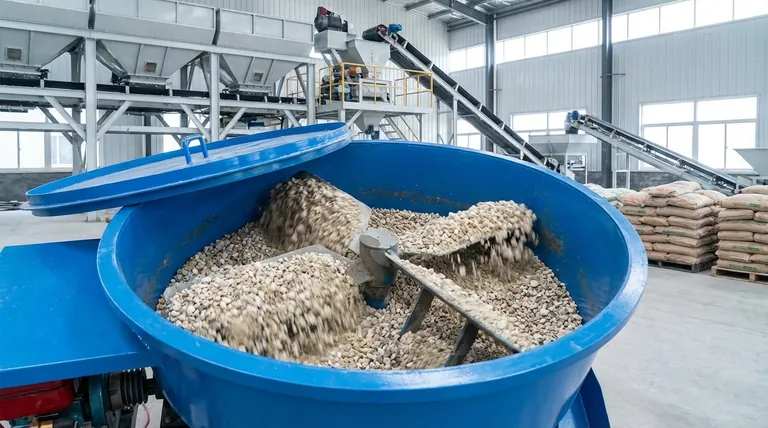
At their core, paddle mixers operate by using specially designed paddle-shaped agitators to gently scoop, lift, and tumble materials. This unique motion creates a three-dimensional, figure-eight pattern within the mixing chamber, ensuring a thorough blend while preserving the structure of fragile ingredients.
The primary value of a paddle mixer lies in its ability to achieve a completely homogeneous mixture without damaging or breaking down the individual components, making it the ideal choice for delicate and shear-sensitive materials.
The Mechanics of a Gentle Mix
The effectiveness of a paddle mixer comes from its specific, low-impact mechanical action. Unlike high-shear mixers that rely on force, paddle mixers use a more methodical process of movement and repositioning.
The Figure-Eight Mixing Pattern
The agitators are precisely angled to scoop material from the bottom of the trough and lift it upwards. As the paddles rotate, they gently tumble the material back down into the center, creating a continuous, repeating figure-eight motion that circulates the entire batch.
Kneading and Folding Action
This movement is less of a violent agitation and more of a kneading and folding process. It ensures that all particles are consistently interacting and blending without being crushed, smashed, or aggressively sheared.
Maintaining Component Integrity
The entire design is centered around preserving the physical characteristics of the ingredients. This is critical for products where the final texture and appearance depend on keeping components like nuts, fibers, or soft solids intact.
How Paddle Mixers Compare to Other Technologies
Understanding when to use a paddle mixer requires knowing how it differs from other common mixing technologies. The choice almost always comes down to the nature of your materials.
Paddle vs. Drum Mixers
Drum mixers operate by rotating an entire vessel, often with internal blades, to mix contents. They are excellent for low-to-medium viscosity materials like adhesives, slurries, or cement in sealed, transportable batches. Their action is more aggressive and is not suited for delicate solids.
Paddle vs. Tumbler Mixers
Tumbler mixers (like V-blenders or cone mixers) also use rotation, but they rely purely on gravity to tumble and blend powders and solids. They contain no internal agitators or impellers. While gentle, their passive action may not be sufficient for mixtures requiring the more active, guided folding of a paddle mixer.
Understanding the Trade-offs
While exceptional for certain applications, paddle mixers are not a universal solution. Their primary limitation is their low-shear, gentle nature.
When Aggressive Action is Required
For applications requiring intense shearing, de-agglomeration, or the mixing of high-viscosity pastes, a paddle mixer will be ineffective. In these cases, mixers designed for high-impact force, like drum or planetary mixers, are the appropriate choice.
Not Ideal for High-Viscosity Liquids
The scooping and tumbling motion of a paddle mixer is most effective with solid-solid or solid-liquid blends where the materials can flow freely. It will struggle to properly mix thick, viscous liquids or heavy pastes.
Making the Right Choice for Your Goal
Selecting the correct mixer is critical to ensuring product quality and process efficiency. Your decision should be guided entirely by the properties of the materials you need to combine.
- If your primary focus is blending delicate solids without degradation: The gentle kneading and folding action of a paddle mixer is the definitive choice.
- If your primary focus is mixing low-to-medium viscosity liquids or slurries in sealed batches: A drum mixer offers a better combination of mixing force and containment.
- If your primary focus is simply blending dry powders or granules: A tumbler mixer provides a simple, energy-efficient solution driven by gravity.
Ultimately, choosing a paddle mixer is a deliberate decision to prioritize the integrity of your ingredients above all else.
Summary Table:
| Feature | Description | Benefit |
|---|---|---|
| Mixing Action | Gentle scooping, lifting, and tumbling | Preserves integrity of fragile ingredients |
| Mixing Pattern | Three-dimensional figure-eight motion | Ensures a completely homogeneous blend |
| Ideal For | Delicate solids, shear-sensitive materials | Prevents crushing or breaking of components |
| Comparison | Less aggressive than drum mixers; more active than tumbler mixers | Optimal for specific material handling needs |
Need a Reliable Mixer for Your Construction Materials?
GARLWAY specializes in providing robust construction machinery, including concrete mixers and batching plants, for contractors and construction companies globally. Our equipment is engineered for efficiency, durability, and consistent performance on your job site.
Let us help you enhance your project's productivity. Contact our experts today to discuss your specific requirements and find the perfect mixing solution!
Visual Guide

Related Products
- Portable Concrete Mixer Machine Equipment for Mixing Concrete
- Portable Ready Mix Concrete Mixer Equipment
- Skid Steer Self Loading Concrete Mixers for Construction
- Portable Cement Mixer with Lift Concrete Machine
- Portable Electric Concrete Mixer Machine for Cement Mixing
People Also Ask
- Why is it necessary to use a portable concrete mixer? Gain Total Control & Efficiency
- How much concrete can you pour with a portable mixer? Find the Perfect Fit for Your Project
- What types of projects are portable concrete mixers suitable for? Ideal for DIY & Small-Scale Construction
- How much does a portable concrete mixer hold? A Guide to Choosing the Right Capacity
- What types of portable concrete mixers exist? Find the Perfect Mixer for Your Project


