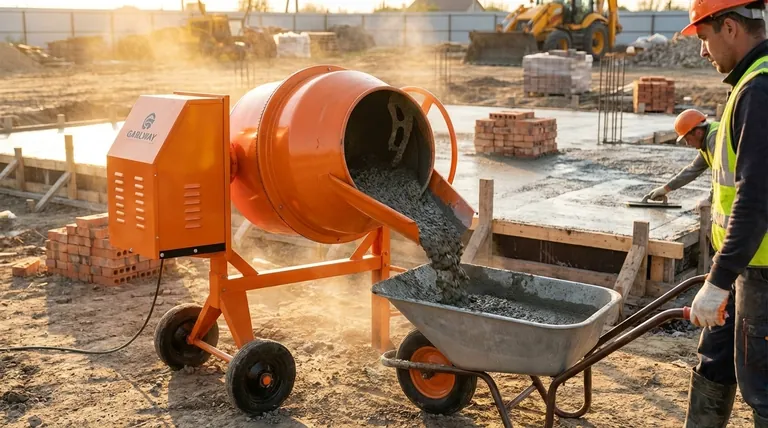
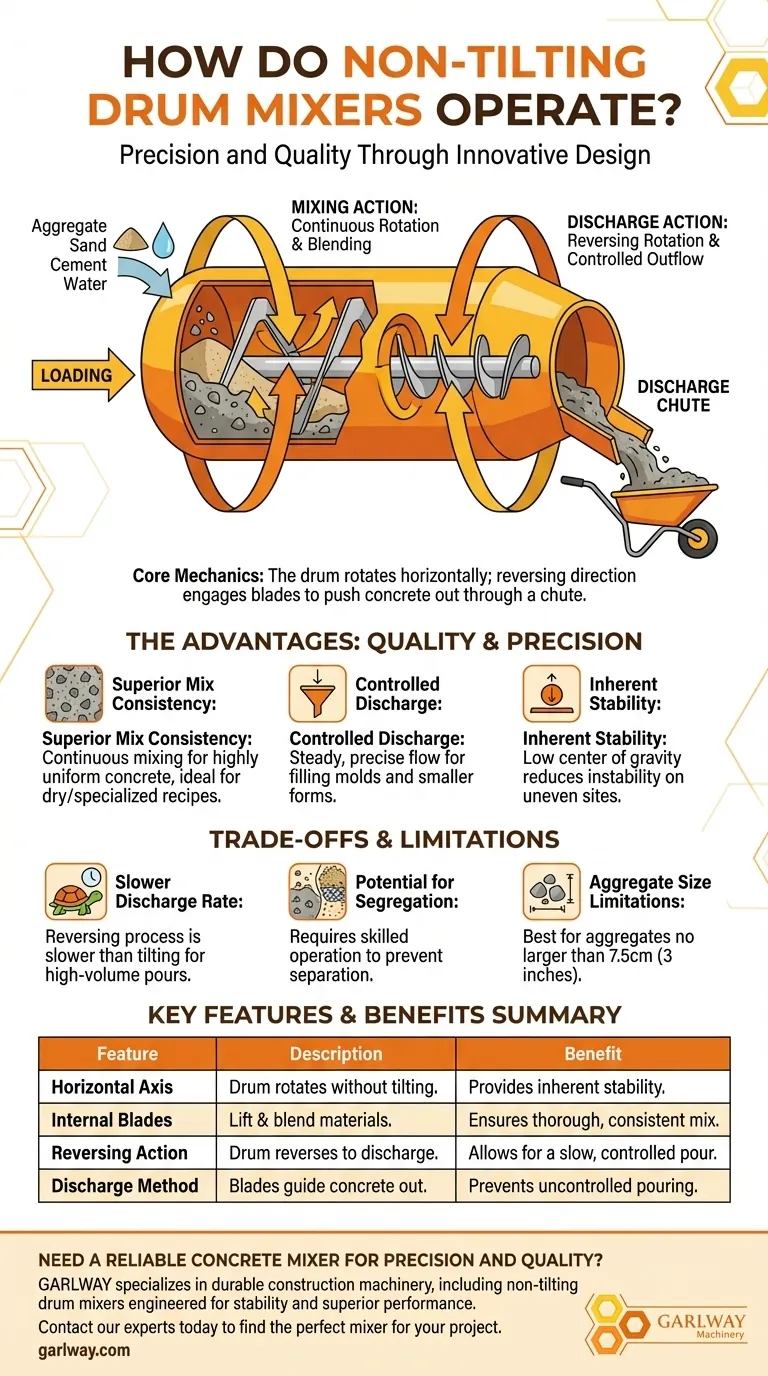
At its core, a non-tilting drum mixer operates by rotating a horizontally-oriented drum to blend materials. Instead of tilting downwards to pour, it ingeniously reverses its direction of rotation, using an internal set of blades to push the finished concrete out through a discharge chute.
The defining characteristic of a non-tilting mixer is its method of discharge. It sacrifices the rapid pouring speed of a tilting mixer for a more controlled, consistent flow, making it a specialized tool for high-quality and uniform concrete mixes.
The Core Mechanics: Rotation Without Tilting
To understand a non-tilting mixer, focus on its three key design elements: its axis, its internal blades, and its reversing capability.
The Horizontal Axis
A non-tilting mixer drum is positioned horizontally, with openings at both ends for loading and unloading. This design provides significant operational stability compared to models that must lift and tilt a heavy, rotating drum.
The Internal Blade System
Inside the drum are fixed blades. As the drum rotates in one direction (the mixing direction), these blades continuously lift the aggregate, sand, cement, and water, dropping them on top of each other to ensure a thorough blend.
Many models, often called reversing drum mixers, feature two sets of blades designed for different tasks.
The Reversing Action for Discharge
This is the key to its operation. When the concrete is ready, the operator reverses the drum's rotation. A second set of blades, or the unique shape of the primary blades, engages the mixture and acts like a screw, guiding the concrete out of the drum through the discharge chute in a steady, controlled manner.
Why Choose a Non-Tilting Mixer?
The unique design of a non-tilting mixer offers distinct advantages for specific applications, prioritizing quality over sheer speed.
Superior Mix Consistency
The continuous mixing action and controlled discharge produce an extremely uniform concrete mix. This makes them particularly effective for drier or more specialized concrete recipes where consistency is paramount.
Controlled Discharge
While slower than a tilting mixer's pour, the discharge from a non-tilting mixer is highly controlled. This is ideal for smaller projects or applications where concrete needs to be placed with precision, such as filling molds or smaller forms.
Inherent Stability
Because the drum maintains its horizontal axis, the mixer's center of gravity is low and stable. This reduces the mechanical complexity and potential for instability associated with tilting mechanisms, especially on uneven job sites.
Understanding the Trade-offs and Limitations
No single design is perfect for every job. The non-tilting mixer's strengths in one area create limitations in others.
Slower Discharge Rate
The most significant trade-off is speed. The process of reversing and guiding the mix out with blades is inherently slower than simply tilting the drum and letting gravity do the work. This makes it less suitable for high-volume, rapid-pour projects.
Potential for Segregation
If not managed correctly, the slow discharge can sometimes lead to segregation, where the heavier aggregates separate from the cement paste. This requires a well-designed mix and a skilled operator.
Aggregate Size Limitations
These mixers perform best with smaller aggregates. The references suggest they are most effective for aggregates no larger than 7.5cm (approximately 3 inches), as larger stones can interfere with the blade-driven discharge mechanism.
Making the Right Choice for Your Project
Choosing the correct mixer depends entirely on the priorities of your specific task.
- If your primary focus is mix quality and precision: The non-tilting/reversing mixer is superior for its ability to produce highly uniform concrete and discharge it controllably.
- If your primary focus is speed and high-volume output: A traditional tilting drum mixer is likely the better choice for quickly pouring large foundations or slabs.
- If your primary focus is working with dry or specialized mixes: The thorough blending action of a non-tilting mixer makes it the ideal tool for these demanding applications.
Ultimately, understanding this mechanism allows you to select the right tool to achieve the desired result with efficiency and precision.
Summary Table:
| Feature | Description | Benefit |
|---|---|---|
| Horizontal Axis | Drum rotates without tilting. | Provides inherent stability on uneven job sites. |
| Internal Blades | Lift and blend materials during mixing. | Ensures a thorough, consistent mix, ideal for dry/specialized recipes. |
| Reversing Action | Drum reverses rotation to discharge. | Allows for a slow, controlled pour, perfect for precision work. |
| Discharge Method | Blades guide concrete out via a chute. | Prevents rapid, uncontrolled pouring and reduces material waste. |
Need a reliable concrete mixer for precision and quality?
GARLWAY specializes in durable construction machinery, including concrete mixers designed for contractors and construction companies who value mix consistency and controlled placement. Our non-tilting drum mixers are engineered for stability and superior performance.
Contact our experts today to find the perfect mixer for your project's needs and experience the GARLWAY difference in quality and support.
Visual Guide
Related Products
- Concrete Cement Mixer Machine Drum Mixer for Construction
- Belle Mixer Drum Self Loading Mortar Mixers JS3000
- JDC350 Small Cement Concrete Mortar Mixer
- HZS25 Best Cement Mixer for Quick Mix Concrete at Bunnings
- Portable Concrete Mixer Machine Equipment for Mixing Concrete
People Also Ask
- What are the key advantages of using drum mixers in concrete mixing? Boost Volume & Efficiency on Your Site
- What are the key components that maintain concrete mix consistency in the drum? Ensure Uniform Quality from Plant to Site
- How do cement mixers enhance safety on construction sites? Reduce Strain, Hazards, and Accidents
- When was the first concrete mixer developed and by whom? Discover the 1900 Breakthrough
- What is the average lifespan of a concrete mixer? Maximize Your Equipment's Lifespan & ROI