Mobile mixers improve labor efficiency by automating the entire concrete production process, allowing a small, specialized team to do the work that once required a larger manual labor force. This automation frees up your other workers to focus on higher-value tasks like placement, finishing, and site preparation, dramatically increasing overall project productivity.
The core value of a mobile mixer isn't just reducing the number of people needed to mix concrete; it's about transforming your labor allocation. It allows you to redeploy skilled workers from a repetitive, manual task to critical activities that directly impact project speed and quality.
From Manual Task to Automated Process
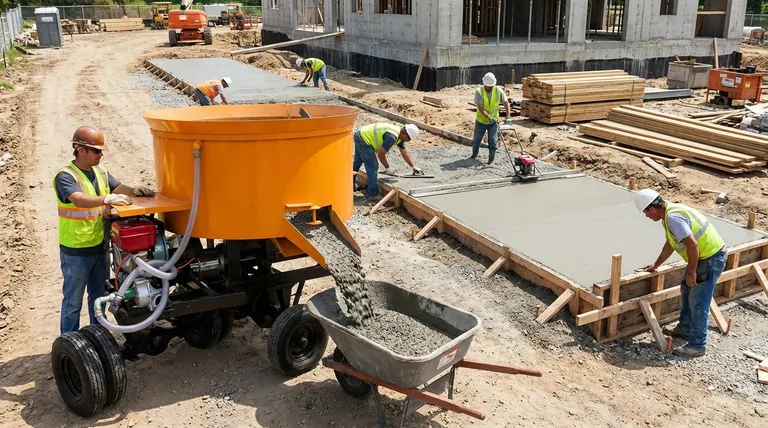
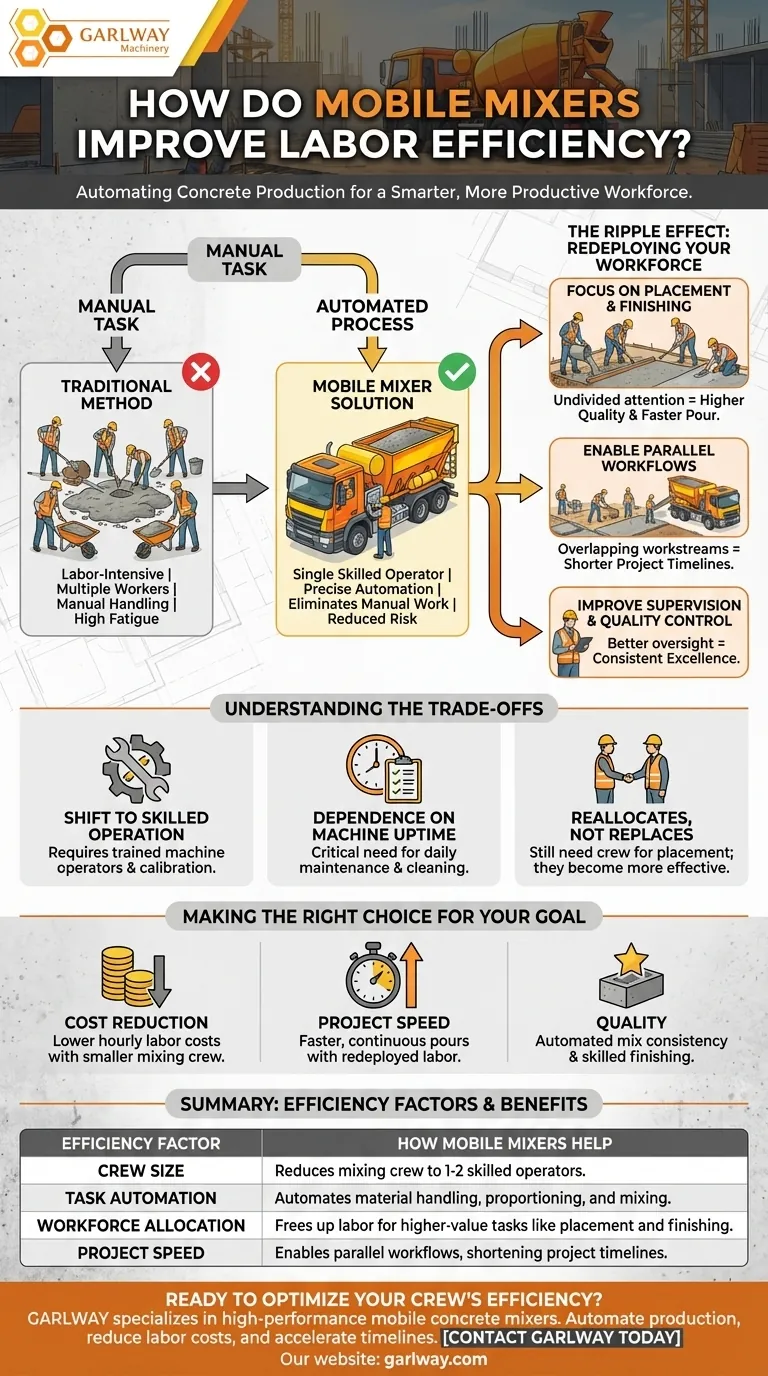
Traditionally, producing concrete on-site was a labor-intensive job requiring multiple workers to measure, load, mix, and transport materials. Mobile mixers fundamentally change this dynamic.
Reducing the Mixing Crew
A volumetric mobile mixer can be managed by a single trained operator. This one individual controls the precise mixing of sand, stone, cement, and water, eliminating the need for a team dedicated solely to that task.
Eliminating Manual Material Handling
The automated system handles the proportioning and mixing that was once done by hand. This removes the physically demanding and time-consuming work of shoveling aggregates and lifting cement bags, reducing worker fatigue and the risk of injury.
The Ripple Effect: Redeploying Your Workforce
The most significant efficiency gain comes from what your newly available workers can do instead of mixing concrete. This reallocation of labor acts as a force multiplier across the job site.
Focusing on Placement and Finishing
With the concrete supply automated, the rest of your crew can focus entirely on the skilled work of pouring, screeding, and finishing. This undivided attention leads to a higher-quality final product and a faster pour from start to finish.
Enabling Parallel Workflows
While the mixer is producing concrete, other team members can continue preparing the next section of the pour. This creates overlapping workstreams, effectively shortening the overall project timeline.
Improving Supervision and Quality Control
When site supervisors aren't tied up managing a manual mixing operation, they can dedicate their attention to ensuring proper placement techniques and overall job quality.
Understanding the Trade-offs
While the labor savings are significant, adopting a mobile mixer is not without its own requirements. Understanding these factors is key to realizing its full potential.
The Shift to Skilled Operation
You trade a larger team of manual laborers for one or two skilled operators. These individuals must be trained to manage the machine, calibrate mix designs, and perform routine maintenance, representing a shift from raw manpower to technical skill.
Dependence on Machine Uptime
Your project's efficiency becomes linked to the mixer's operational status. The labor savings are only realized when the machine is running smoothly, making daily maintenance and cleaning a critical, non-negotiable task.
It Reallocates, Not Replaces
A mobile mixer dramatically reduces the labor needed for production, but you still need a properly sized crew for the placement and finishing of the concrete. The goal is to make that crew more effective, not to eliminate it.
Making the Right Choice for Your Goal
To maximize your efficiency, align the use of a mobile mixer with your primary project objective.
- If your primary focus is cost reduction: The ability to use a smaller crew for on-demand mixing directly lowers the hourly labor costs associated with concrete production.
- If your primary focus is project speed: Reallocating workers from mixing to placement and site prep enables faster, more continuous pours that shorten project schedules.
- If your primary focus is quality: Automating the mix ensures consistency and allows your skilled finishers to concentrate solely on their craft, resulting in a superior final product.
Ultimately, a mobile mixer empowers your team by handling the heavy lifting, allowing your skilled workforce to apply their expertise where it matters most.
Summary Table:
| Efficiency Factor | How Mobile Mixers Help |
|---|---|
| Crew Size | Reduces mixing crew to 1-2 skilled operators. |
| Task Automation | Automates material handling, proportioning, and mixing. |
| Workforce Allocation | Frees up labor for higher-value tasks like placement and finishing. |
| Project Speed | Enables parallel workflows, shortening project timelines. |
Ready to optimize your construction crew's efficiency? GARLWAY specializes in construction machinery, offering high-performance mobile concrete mixers for construction companies and contractors globally. Our solutions help you automate production, reduce labor costs, and accelerate project timelines. Contact GARLWAY today to find the perfect mixer for your job site and transform your labor efficiency!
Visual Guide
Related Products
- JZC400 Mobile Small Concrete Mixer Cement Mixer Machine
- JW1000 Mobile Cement Mixer Concrete Mixer Truck and Batching Plant
- Portable Concrete Mixer Machine Equipment for Mixing Concrete
- Portable Ready Mix Concrete Mixer Equipment
- Portable Cement Mixer with Lift Concrete Machine
People Also Ask
- What are the different names for mobile concrete mixing equipment? Understand Volumetric vs. On-Site Mixers
- In what way do mobile mixers enhance quality control? Achieve Superior Concrete Quality On-Site
- What is a mobile mixer? The Ultimate Guide to On-Site Concrete Production
- What flexibility do mobile mixers offer in terms of material mixing? Unlock On-Demand Concrete Production
- How does the self-loading mechanism in mobile concrete mixers differ from regular mixers? Unlock On-Site Production Freedom