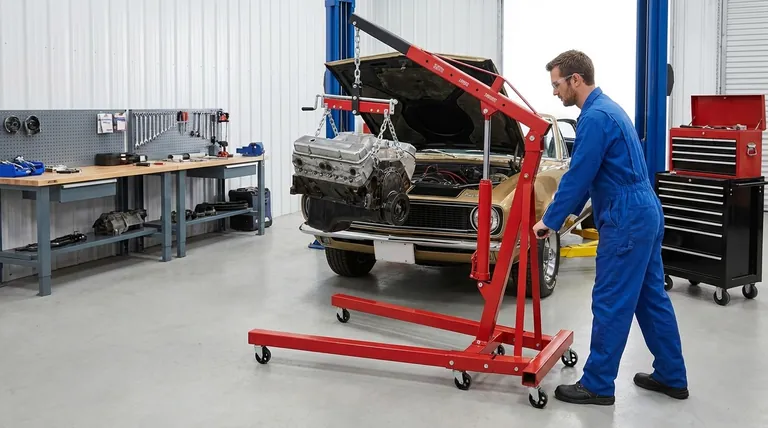
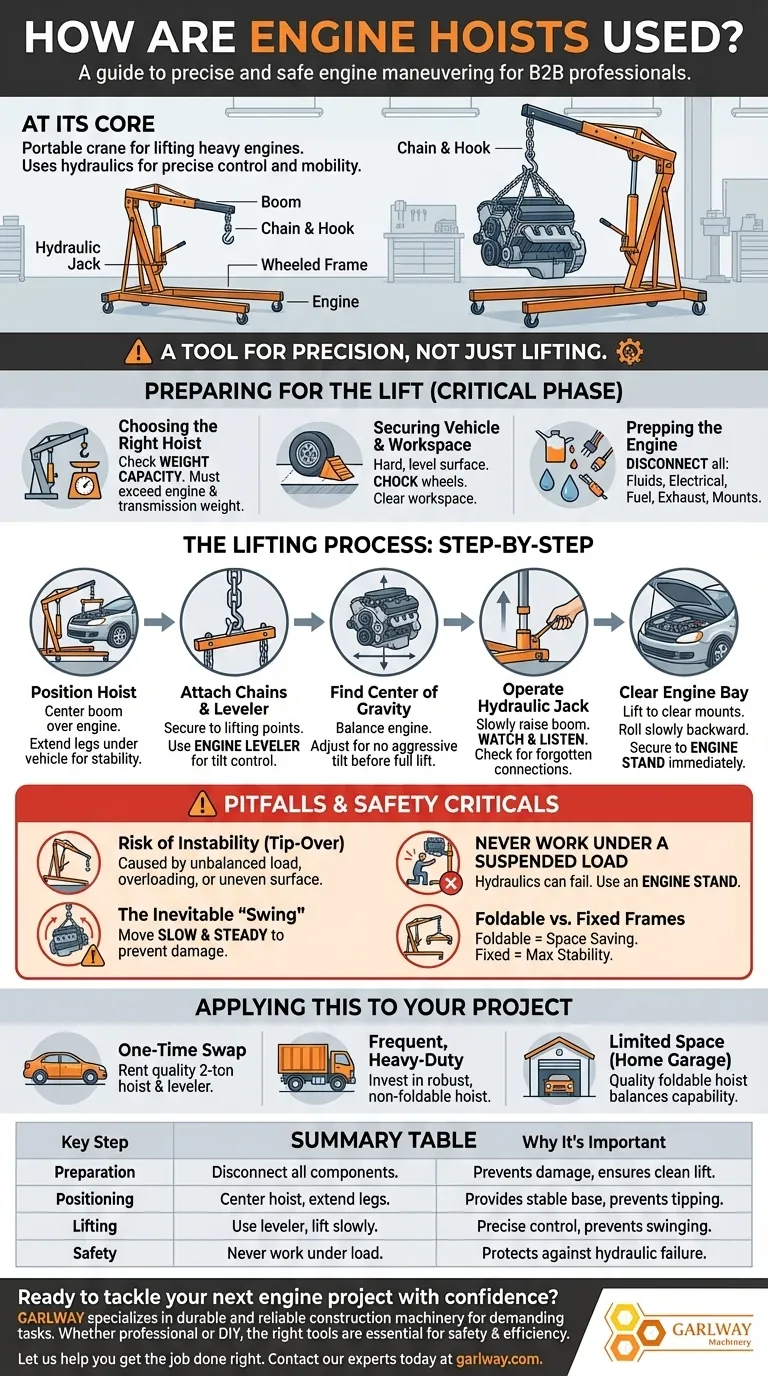
At its core, an engine hoist is a portable crane designed specifically for lifting and maneuvering heavy engines out of and into a vehicle's engine bay. It uses a hydraulic jack to raise a boom, which has a chain and hook at the end, all mounted on a wheeled frame for mobility.
An engine hoist is more than a simple lifting device; it is a tool for precise and safe maneuvering of an engine. Proper setup, balance, and a methodical approach are paramount to prevent damage to the vehicle, the engine, and most importantly, yourself.
Preparing for the Lift
Before the hoist touches the engine, proper preparation is the most critical phase of the job. Rushing this stage is the most common cause of problems.
Choosing the Right Hoist
Most workshops and home garages use a floor crane hoist, often called a "cherry picker." The single most important specification is its weight capacity. Always ensure the hoist's capacity significantly exceeds the combined weight of the engine and transmission if you are pulling them together.
Securing the Vehicle and Workspace
The vehicle must be on a hard, level surface like a concrete garage floor. Chock the wheels that will remain on the ground and ensure you have ample, clear space around the engine bay to move the hoist freely.
Prepping the Engine
The engine must be completely disconnected from the vehicle. This involves draining all fluids (oil, coolant), disconnecting all electrical harnesses, fuel lines, vacuum hoses, and exhaust components. Finally, the transmission and engine mounts must be unbolted.
The Lifting Process: Step-by-Step
With the engine fully disconnected, the hoist can be brought in to do its work. The key here is to move slowly and deliberately.
Positioning the Hoist
Roll the hoist into position so the boom is centered over the engine. The legs of the hoist should extend as far under the vehicle as possible to provide a stable base of support.
Attaching Chains and Leveler
Securely attach the lifting chains to the manufacturer's designated lifting points on the engine block or cylinder head. Using an engine leveler—an adjustable bar between the hook and the chains—is highly recommended as it allows you to tilt the engine during the lift.
Finding the Center of Gravity
Before lifting, ensure the engine is balanced. Adjust the chain positions or the leveler so the lifting hook is directly above the engine's center of gravity. When you apply a small amount of tension, the engine should not try to tilt aggressively in any direction.
Operating the Hydraulic Jack
Use the pumping handle to slowly operate the hydraulic jack, which will raise the boom. Watch the engine closely as it takes the weight. Listen for any unusual sounds and check for any forgotten connections.
Clearing the Engine Bay
Lift the engine just enough to clear the mounts and the top of the engine bay. Once it is clear, do not lift it any higher than necessary. Slowly and carefully roll the hoist backward, guiding the engine out of the vehicle. Immediately transfer the engine to a secure engine stand.
Understanding the Pitfalls and Safety Criticals
Using an engine hoist is straightforward but carries inherent risks that must be managed with care and attention.
Risk of Instability
The greatest risk is the hoist tipping over. This is almost always caused by an unbalanced load, trying to lift beyond the hoist's capacity, or attempting to roll the loaded hoist over an uneven or cluttered surface.
The Inevitable "Swing"
A suspended engine will swing freely at the end of the chain. All movements—both lifting and rolling the hoist—must be slow and steady to prevent the engine from swinging and damaging the vehicle body.
Never Work Under a Suspended Load
A hydraulic system can potentially fail. Never place any part of your body under an engine that is supported only by the hoist. Once the engine is out, it should be immediately secured to a proper engine stand.
Foldable vs. Fixed Frames
Foldable hoists are excellent for saving space in a home garage. However, they may require more care during setup to ensure all locking pins are secure. Fixed-frame hoists are typically more rigid and stable but require significant dedicated storage space.
Applying This to Your Project
Your specific goal will determine the best approach to using and selecting an engine hoist.
- If your primary focus is a one-time engine swap: Renting a high-quality 2-ton hoist and an engine leveler is the most cost-effective and safest option.
- If your primary focus is frequent, heavy-duty work: Investing in a robust, non-foldable hoist with a high weight capacity provides maximum stability and longevity.
- If your primary focus is home garage use with limited space: A quality foldable hoist offers a practical balance between capability and efficient storage.
By treating the engine hoist as a tool for precision control, you can tackle even the most demanding engine work safely and confidently.
Summary Table:
| Key Step | Critical Action | Why It's Important |
|---|---|---|
| Preparation | Disconnect all fluids, hoses, and mounts. | Prevents damage and ensures a clean lift. |
| Positioning | Center the hoist and extend legs under the vehicle. | Provides a stable base to prevent tipping. |
| Lifting | Use an engine leveler and lift slowly. | Allows for precise control and prevents swinging. |
| Safety | Never work under a suspended load. | Protects against potential hydraulic failure. |
Ready to tackle your next engine project with confidence?
GARLWAY specializes in providing durable and reliable construction machinery, including heavy-duty equipment perfect for demanding workshop tasks. Whether you're a professional contractor or a dedicated DIYer, the right tools are essential for safety and efficiency.
Let us help you get the job done right. Contact our experts today to discuss your equipment needs and find the perfect solution for your workshop.
Visual Guide
Related Products
- Hydraulic Winding Engine Harbor Freight Winch
- Electric Hoist Winch Boat Anchor Windlass for Marine Applications
- Electric and Hydraulic Winch for Heavy Duty Applications
People Also Ask
- What role does hydraulic fluid play in hydraulic winches? It's the Lifeblood of Your Heavy-Duty Pulling Power
- What vehicles commonly use hydraulic winches? For Industrial Trucks Needing Unmatched Power
- What are the features of hydraulic winches? Unmatched Power and Continuous Duty for Heavy Loads
- What preventive measures can be taken to avoid oil leakage in hydraulic winches? Ensure Long-Term Reliability
- What does 'power out' mean in a hydraulic winch? Achieve Absolute Control When Lowering Heavy Loads