The Illusion of a Perfect Recipe
We stand at the base of a skyscraper or on a newly commissioned bridge, marveling at the sheer scale of the concrete structure. Our minds naturally go to the formula—the precise ratios of cement, water, aggregates, and admixtures that give the material its specified strength.
This focus on the recipe is a psychological trap. We obsess over the what, assuming the how is a given. But the greatest mix design on paper is worthless if the mixing process fails to unlock its potential.
The most critical, yet often overlooked, variable in producing high-quality concrete is not an ingredient. It's the physics of the mixer itself.
A Tale of Two Forces: Gravity vs. Mechanical Shear
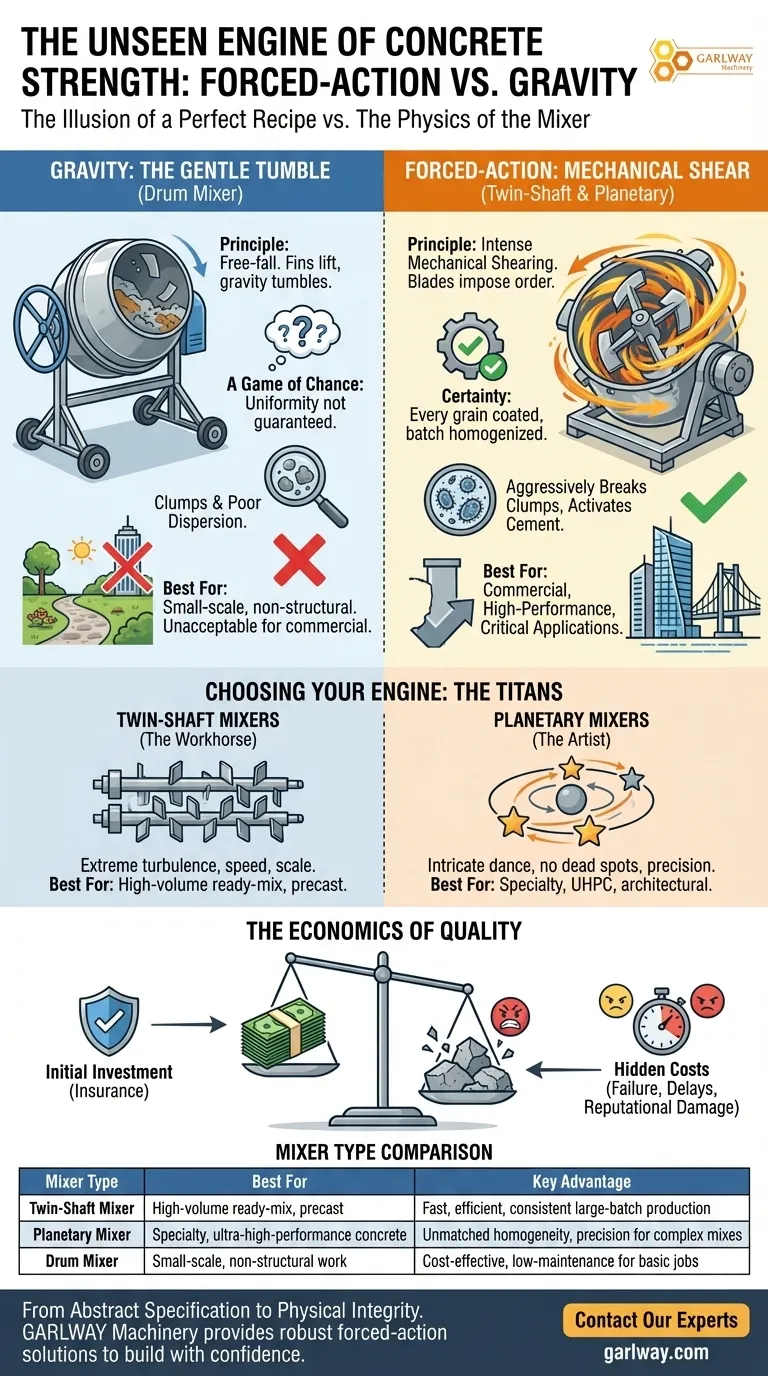
The difference between concrete for a garden path and concrete for a high-rise column comes down to one principle: how the components are combined. This is the divide between a gentle tumble and a violent, engineered collision.
The Gentle Tumble of a Drum Mixer
A standard drum mixer operates on a principle of "free-fall." It lifts materials with fins and lets gravity do the work, causing them to tumble over each other.
This is a game of chance. It's like shaking a jar of sand, gravel, and powder. Things will eventually appear mixed, but at a microscopic level, uniformity is not guaranteed. Clumps can remain, and fine particles like cement and additives may not be evenly dispersed. For non-structural applications, this is acceptable. For commercial projects, it's an unacceptable risk.
The Certainty of a Forced-Action System
Forced-action mixers, like twin-shaft and planetary models, abandon chance for certainty. They use powerful paddles or blades to churn through the material at high speed, creating intense mechanical shearing forces.
This isn't just mixing; it's a process of imposing order on chaos. The action forces particles together, ensuring every grain of sand and piece of aggregate is coated with cement paste. It aggressively breaks apart clumps and homogenizes the entire batch with incredible speed and efficiency. This process is what truly activates the cement and makes the concrete's final performance predictable and reliable.
Choosing Your Engine: The Titans of Commercial Mixing
In the world of commercial concrete, where performance is non-negotiable, two types of forced-action mixers dominate. Each is a master of its domain.
Twin-Shaft Mixers: The Workhorse of Volume
Imagine two parallel, horizontal shafts armed with interlocking paddles, spinning in opposite directions. This design creates a zone of extreme turbulence in the center of the mixer, ensuring a rapid, powerful, and consistent mix.
The twin-shaft mixer is the engine of the modern city. It is built for speed, scale, and relentless output, making it the standard for ready-mix plants and large-scale precast operations that need to produce huge volumes of high-quality concrete day in and day out.
Planetary Mixers: The Artist of Precision
A planetary mixer operates on a more complex principle. One or more mixing "stars" rotate on their own axes while also revolving around the center of the mixing pan, like planets orbiting a sun.
This intricate dance ensures that the paddles cover every single point within the drum, eliminating any "dead spots." It is the preferred choice for materials where absolute homogeneity is critical—specialty products like self-compacting concrete (SCC), architectural colored concrete, or ultra-high-performance concrete (UHPC), where the material science is as important as the structural engineering.
The Uncomfortable Economics of Quality
High-performance mixers represent a significant capital investment. Their complex drive systems and wear parts require more maintenance than a simple drum mixer. This initial cost can be a point of hesitation.
But this thinking is flawed. The initial cost is not an expense; it's a form of insurance.
The hidden costs of using an inadequate mixer are far greater: failed quality tests, rejected batches, costly project delays, and the catastrophic risk of reputational damage or structural failure. The "cheaper" option is almost always the most expensive in the long run.
| Mixer Type | Best For | Key Advantage |
|---|---|---|
| Twin-Shaft Mixer | High-volume ready-mix, precast | Fast, efficient, consistent large-batch production |
| Planetary Mixer | Specialty, ultra-high-performance concrete | Unmatched homogeneity, precision for complex mixes |
| Drum Mixer | Small-scale, non-structural work | Cost-effective, low-maintenance for basic jobs |
From Abstract Specification to Physical Integrity
High-quality concrete is not made by chance. It is engineered. The choice of mixer is the first, and most crucial, step in that engineering process. It's the moment a theoretical recipe is transformed into a physical reality with predictable strength and durability.
At GARLWAY, we understand that our machinery is the critical link between your design and its real-world integrity. We specialize in providing robust twin-shaft and planetary concrete mixers for construction companies and contractors who refuse to leave quality to chance. Our solutions are designed to deliver the powerful, forced-action mixing required to build with confidence.
To ensure your concrete meets and exceeds every specification, it's time to look beyond the recipe and focus on the engine that powers it. Contact Our Experts
Visual Guide
Related Products
- Portable Cement Mixer with Lift Concrete Machine
- Harbor Freight JS1500 On Site Concrete Mixing Volumetric Cement Mixer
- JDY350 Electric Hydraulic Mortar Mud Concrete Mixer
- HZS25 Best Cement Mixer for Quick Mix Concrete at Bunnings
- Hydraulic Concrete Mixer Machine Cement Mixing Equipment for Mixture Concrete
Related Articles
- How to Transform Your Cement Mixer into a High-Performance Art Tool
- How Component Engineering Elevates Cement Mixer Performance for Small Projects
- How to Repurpose Your Cement Mixer for Ammunition, Farming, and DIY Projects
- How to Repurpose Cement Mixers for High-Efficiency Farm Material Processing
- How Cement Mixers Solve Industrial Derusting Challenges Safely and Efficiently