
The Psychology of "Good Enough" Concrete
For decades, the quality of concrete mixed on-site often depended on an operator's "feel." An experienced hand could judge the mix by its slump, its color, its sound. This was a craftsman's skill, but it was also a project's biggest liability.
The core problem is psychological: the gap between human intuition and engineering necessity. We are good at approximations, but concrete strength is a matter of chemistry, not estimation. Its integrity relies on precise ratios, a standard that the "looks about right" method can never guarantee. This is the costly hidden risk in every unmeasured scoop.
The Anatomy of Trust
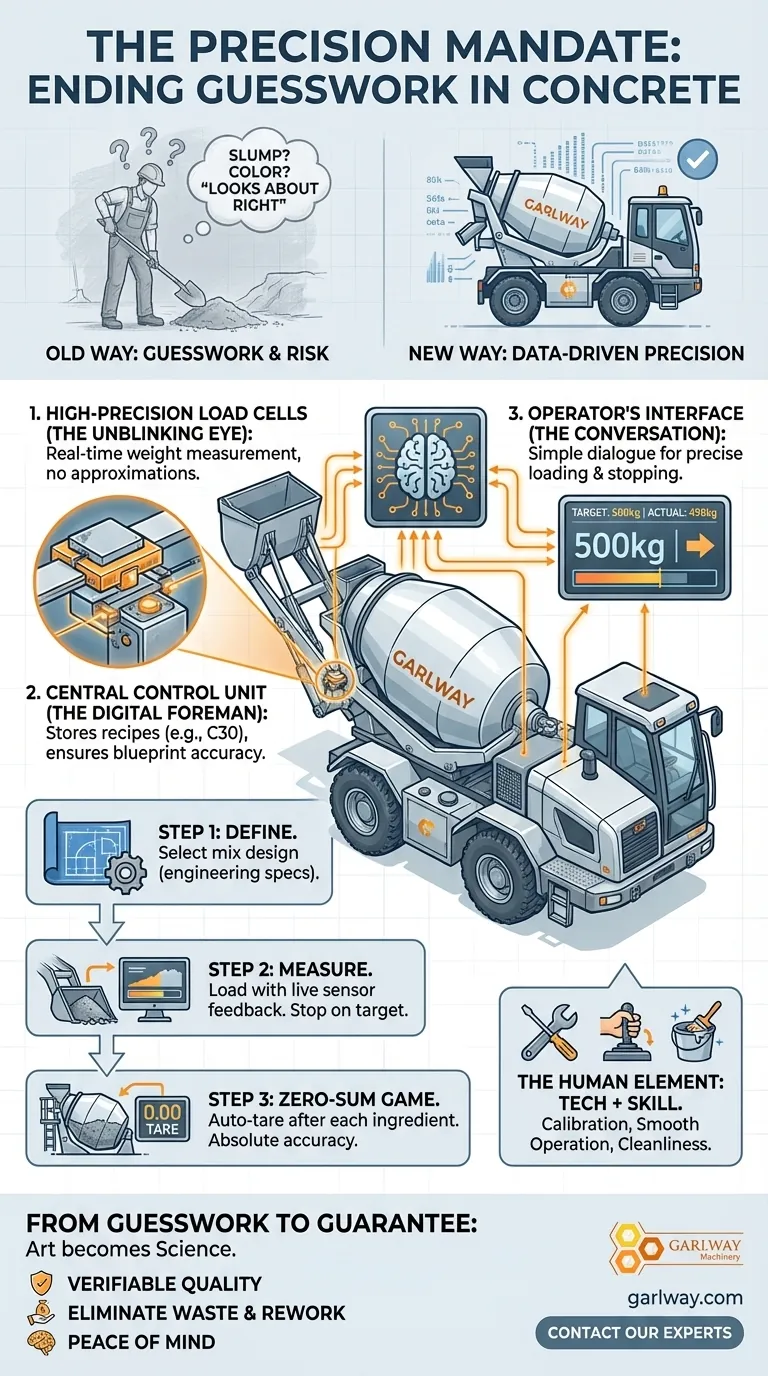
To close this gap, modern self-loading mixers don't just mix materials; they implement a system of trust. The automatic weighing system is this system, a feedback loop between machine and material that replaces guesswork with data.
It is built on three pillars.
The Unblinking Eye: High-Precision Load Cells
At the heart of the system are sensors—typically load cells—integrated into the loader's lifting arm. These are not mere switches; they are sensitive instruments that measure the real-time weight of the aggregate in the bucket. They don't get tired, they don't get distracted, and they don't approximate. They measure.
The Digital Foreman: The Central Control Unit
This onboard computer is the "brain." It stores the precise recipes—the DNA of C30 or C40 concrete. As the load cells report the live weight, the control unit compares it to the blueprint stored in its memory. It acts as a tireless digital foreman, ensuring the recipe is followed to the letter, every single time.
The Conversation: The Operator's Interface
The display in the cab is where the human and machine collaborate. It's a simple, clear dialogue. The screen shows the target weight and the current weight, translating complex sensor data into a single, actionable instruction for the operator: when to lift, and more importantly, when to stop.
The Choreography of a Perfect Batch
The weighing process isn't an extra step; it's woven into the natural workflow of the machine, transforming a manual task into a precise, repeatable sequence.
-
Defining the Standard: The process begins when the operator selects a mix design from the control unit. This is the moment a project's engineering specifications become an actionable command.
-
The Measured Scoop: The operator loads the first aggregate, like gravel. As the bucket lifts, the sensors feed live data to the screen. An alert signals as the target weight is approached, allowing for a precise stop.
-
The Zero-Sum Game: Once the correct weight is dumped into the drum, the system automatically tares, or zeros out the measurement. Its memory is wiped clean, ready for the next ingredient. This ensures it measures only the sand, and then only the cement, with absolute accuracy. This is where true precision lives.
The Human Element in a Digital World
This technology doesn't make the operator obsolete; it elevates their role from laborer to technician. But this synergy depends on acknowledging the realities of a construction site.
The Ritual of Calibration
The system's accuracy is only as good as its last calibration. An uncalibrated sensor tells confident lies. Regular calibration isn't a tedious maintenance task; it's a fundamental ritual, like a pilot running a pre-flight checklist. It ensures the data—the foundation of the entire process—is true.
The Operator as Conductor
The system provides the sheet music, but the operator is the conductor. A jerky, aggressive scooping motion can send shockwaves through the load cells, momentarily affecting their readings. Smooth, controlled operation is key to letting the system perform at its peak. The machine empowers skill, it doesn't replace it.
The Fight Against "Noise"
On a busy site, mud, water, and debris can cling to the bucket, adding phantom weight. This is "noise" that can interfere with the system's "signal." Keeping the loading mechanism clean isn't just about appearances; it's a critical part of maintaining measurement integrity.
From Guesswork to Guarantee
The automatic weighing system represents a fundamental shift in mindset. It moves on-site concrete production from a craft based on intuition to an engineering process based on verifiable data. This provides a powerful psychological payoff: it removes the cognitive load of estimation from the operator and the liability of inconsistent quality from the contractor.
This transition from art to science is the core principle behind GARLWAY's advanced self-loading mixers. Our machines are engineered not just to move and mix, but to guarantee the integrity of every single batch through reliable, precise automation. For site managers, this means peace of mind. For business owners, it means the elimination of material waste and the risk of costly rework.
Achieving this level of precision and consistency is no longer an aspiration; it's a system you can deploy directly on-site. Contact Our Experts
Visual Guide
Related Products
- Skid Steer Self Loading Concrete Mixers for Construction
- Belle Mixer Drum Self Loading Mortar Mixers JS3000
- Portable Cement Mixer with Lift Concrete Machine
- Portable Ready Mix Concrete Mixer Equipment
- Portable Concrete Mixer Machine Equipment for Mixing Concrete
Related Articles
- The Physics of a Faster Pour: Why Bucket Shape Defines Concrete Mixer Productivity
- Beyond Gravity: The Engineering of a Perfect Concrete Pour
- Beyond the Barrel: The Physics and Psychology of a Perfect Concrete Mix
- The Unseen Engine: How Integrated Mobility Solves Construction's Cognitive Load Problem
- The One-Machine Revolution: Deconstructing the Physics and Psychology of On-Site Concrete Production





