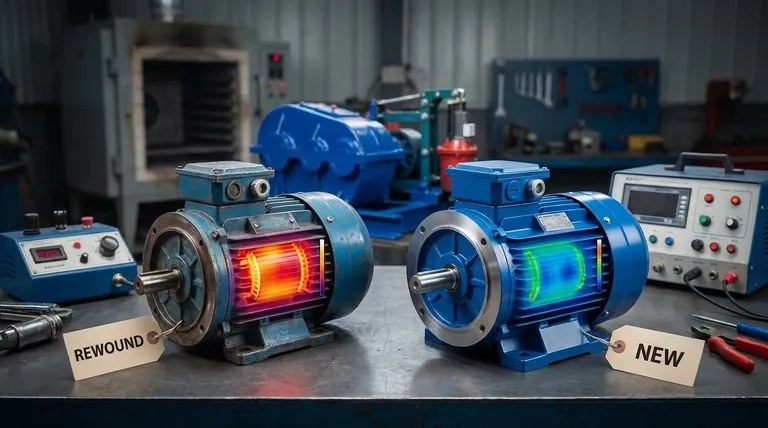
The Moment of Failure, The Illusion of a Simple Choice
A critical winch motor on a high-rise project grinds to a halt. The silence is deafening, and every minute of downtime costs thousands.
The project manager is presented with two options:
- Rewind: Get the motor repaired locally. It's fast and significantly cheaper upfront.
- Replace: Order a new motor. It costs more and has a longer lead time.
The pressure of the deadline and budget makes the choice seem obvious. The quick, cheap fix feels like the only responsible option.
But this decision is a classic psychological trap—pitting a tangible, immediate saving against an invisible, long-term cost. The truth is, the "repaired" motor may never be the same again.
The Anatomy of Efficiency
To understand why, we have to look inside the motor's heart: the stator core.
It's not a solid chunk of steel. Think of it as a tightly packed deck of incredibly thin, specially coated steel cards, known as laminations. This intricate design is a silent feat of engineering, built to solve a fundamental physics problem.
A Battle Against Invisible Currents
As a motor runs, its magnetic field is in constant flux. In a solid block of steel, this changing field would induce powerful stray electrical currents called eddy currents.
These currents are pure waste. They do no useful work. They only create heat, bleeding energy and efficiency from the system. They are the unseen friction that every motor designer fights against.
The Unsung Hero: Interlaminar Insulation
The genius of the laminated core is the thin, varnish-like layer of insulation on each steel plate.
This insulation acts as a firewall, preventing large eddy currents from forming. It forces them into microscopic, harmless pathways, preserving the motor's power for its intended job. The integrity of this delicate insulation is directly tied to the motor's designed efficiency.
The Repair That Can Break More Than It Fixes
When a motor's copper windings fail, they must be removed from the stator core. The most common method is a trial by fire.
The stator is placed in a burnout oven, which heats the entire assembly to vaporize the old winding insulation, allowing the copper to be easily pulled out. This is where the irreversible damage occurs.
The Point of No Return
The insulation separating the steel laminations is fragile. If the oven temperature rises above approximately 370°C (700°F), this critical insulation is destroyed.
A poorly calibrated or negligently operated oven can easily exceed this limit, permanently scarring the motor's core in the name of expediency.
A Permanent Wound on the Core
When the interlaminar insulation is damaged, it creates electrical bridges—or shorts—between the laminations. The perfectly separated deck of cards becomes partially glued together.
Eddy currents, once held in check, now have new highways to travel. The motor's internal "electrical friction" increases forever. This permanent rise in energy loss, known as "iron loss," means the motor will now require more electricity to do the same amount of work. Its efficiency is permanently degraded.
The Cognitive Bias of Upfront Cost
Our brains are wired to favor immediate, certain gains over abstract, future ones. The money saved on a rewind today feels more real than the money wasted on electricity over the next three years.
This efficiency loss is an invisible tax on your operations.
| Factor | Poorly Executed Rewind | New High-Efficiency Motor |
|---|---|---|
| Upfront Cost | Lower | Higher |
| Efficiency Drop | 1-3% (Permanent) | 0% |
| Long-Term Energy Cost | A continuous, hidden drain on profits. | Optimized and predictable. |
A 2% efficiency drop on a continuously running 100kW motor can waste over 17,500 kWh per year—an annual cost that can easily exceed the initial savings of the rewind.
A Smarter Framework for Decision-Making
The choice isn't just "repair vs. replace." It's "unquantified risk vs. engineered certainty."
-
When Rewinding Might Make Sense: For highly specialized, obsolete, or long-lead-time motors, rewinding may be the only practical choice. However, the burden is on you to vet the repair facility. Ask them directly: "How do you control oven temperatures, and do you perform a core-loss test before and after stripping?" A reputable shop will have confident answers.
-
When Replacement is King: For standard motors in critical, high-usage applications, replacement with a new, premium-efficiency model is an investment, not an expense. It protects against the dual risks of poor performance and future failure.
The most effective strategy, however, is to minimize the chance of failure in the first place. Investing in robust, high-quality machinery from the start is the ultimate defense against the costly dilemma of downtime. GARLWAY's construction machinery—from winches and concrete mixers to complete batching plants—is engineered for durability and reliability, designed for contractors who understand that long-term performance is the true measure of value.
The best way to manage failure is to invest in equipment designed to prevent it. To ensure your operations run at peak efficiency from day one, Contact Our Experts.
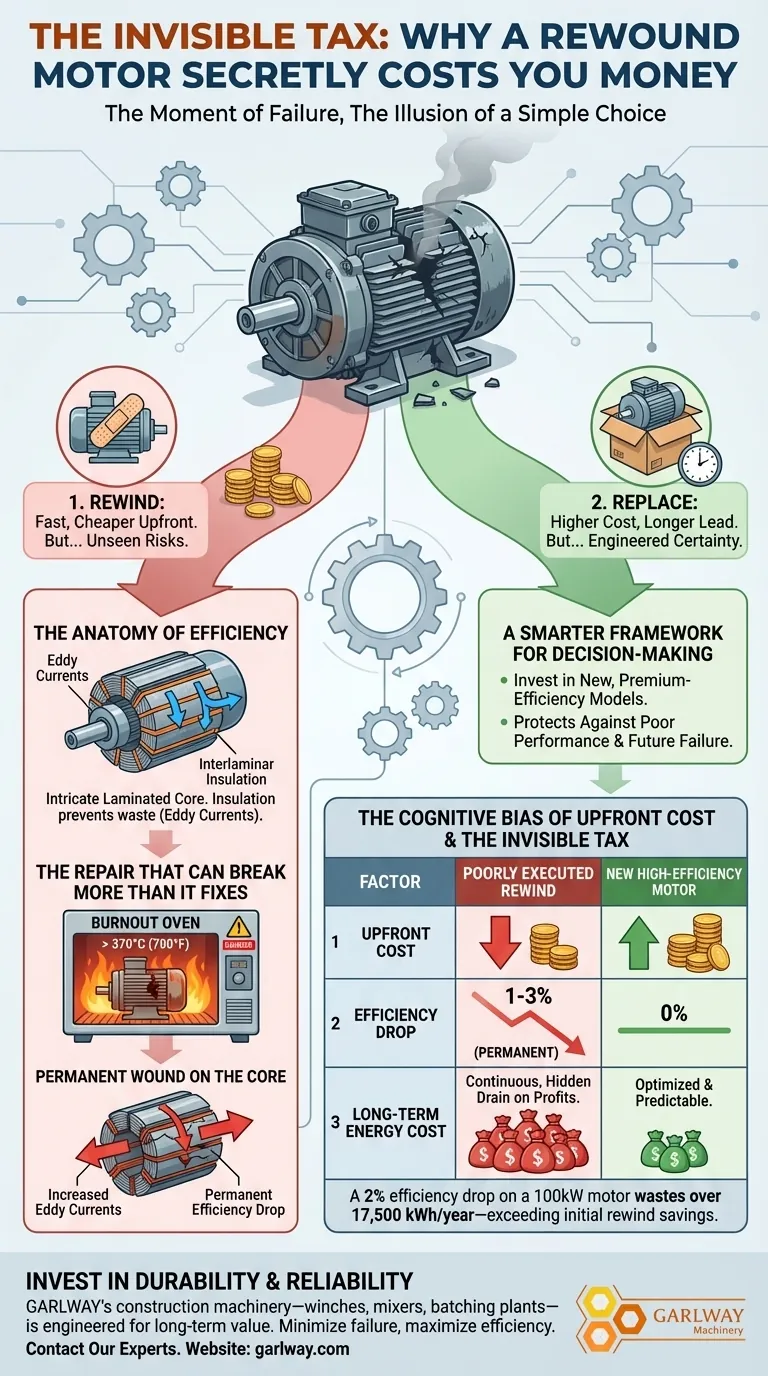
Visual Guide
Related Products
- Electric 120V Boat Winch by Badlands
- Commercial Electric Concrete Mixer Machine HZS 50 Small Batch Plant for Sale
- Small Electric Winch 120V and 240V for Compact Applications
- 12000 lb Electric Boat Trailer Winch with Windlass Anchor Warn
- Electric Hoist Winch Boat Anchor Windlass for Marine Applications
Related Articles
- How to Choose Between Reversible and Friction Electric Winches: A Transmission Guide
- The Unseen System: How an Electric Winch Manages Force and Eliminates Fear
- How to Choose Between Manual and Electric Winches for Your Project
- When Automation Fails: The Critical Role of Manual Override in Electric Winches
- Beyond Brute Force: The Calculated Power of the Electric Winch


