The Hidden Tax on Every Job Site
Watch any construction site for an hour. You will see a slow, expensive dance that has become so normal we no longer recognize it as a problem. A heavy concrete mixer inches forward, reverses, turns, and nudges itself into the perfect position for a pour. Ten minutes later, it repeats the entire process to pour concrete just a few meters away.
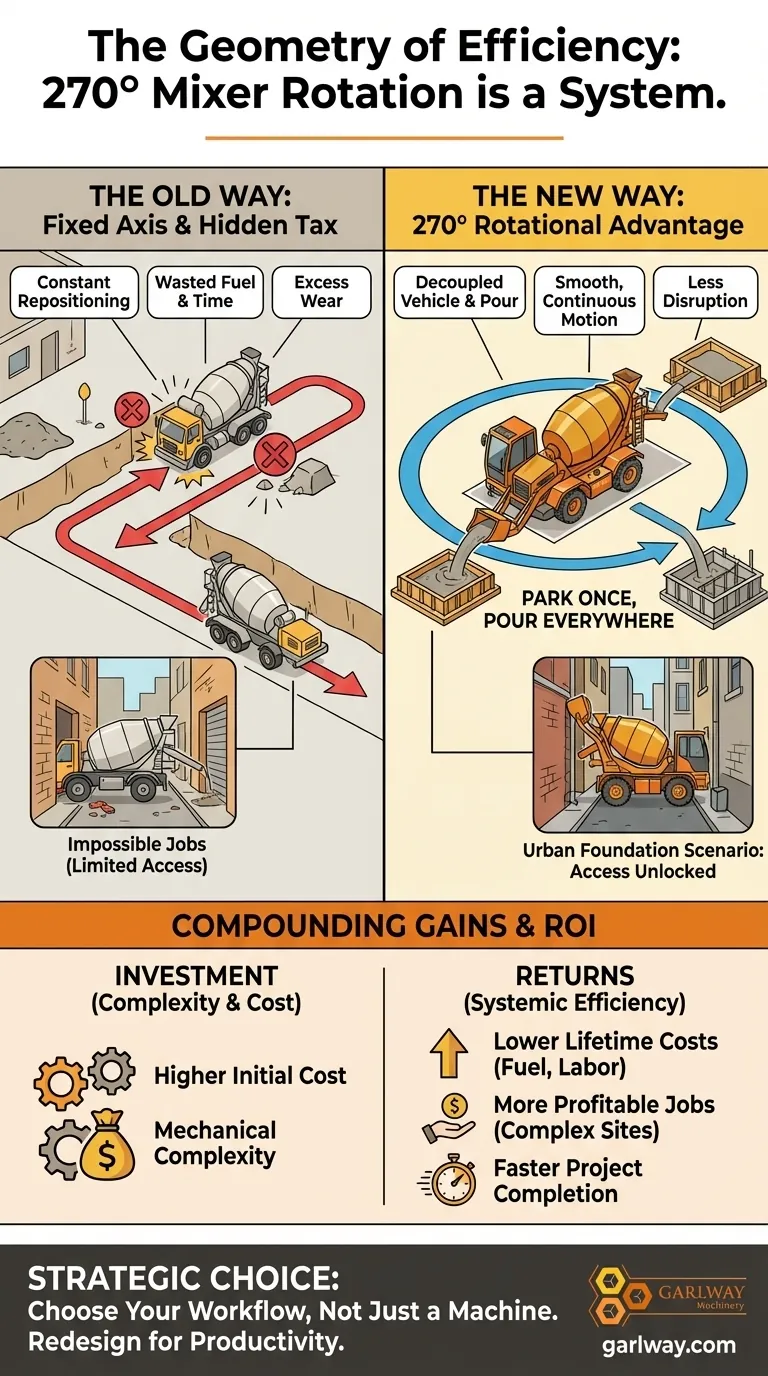
This isn't just "part of the job." It's a hidden tax paid in wasted time, excess fuel, and unnecessary machine wear. Psychologically, we've normalized this inefficiency. We see the machine, not the flawed workflow it's forced to follow.
The root of the problem isn't the operator or the site layout; it's the geometry of the machine itself.
The Tyranny of the Fixed Axis
A traditional mixer is a slave to its orientation. Its fixed discharge point dictates that the entire multi-ton vehicle must move if the target moves. This creates two fundamental and costly constraints.
The Constant Shuffle
Every repositioning is a micro-project. It requires the operator's full attention, burns diesel, and puts stress on the drivetrain, suspension, and tires. These small, repetitive actions compound into significant operational costs over the life of the machine. It's a classic case of death by a thousand cuts.
The Geometry of "Impossible"
Worse, this limitation dictates which jobs you can even take. On modern, constrained sites—urban infills, narrow access lanes, cluttered industrial renovations—perfectly aligning a large vehicle is often physically impossible.
This forces teams into inefficient workarounds: using wheelbarrows, renting concrete pumps, or simply passing on profitable but complex projects. The fixed-axis mixer doesn't just slow down the work; it shrinks the map of what's possible.
Liberating the Pour: The 270° Rotational Advantage
A self-loading mixer with a 270-degree rotating drum doesn't just add a feature; it introduces an entirely new operating philosophy. It fundamentally decouples the position of the vehicle from the location of the pour.
The machine ceases to be just a transporter and becomes a stable, centralized placement system.
One Position, Multiple Actions
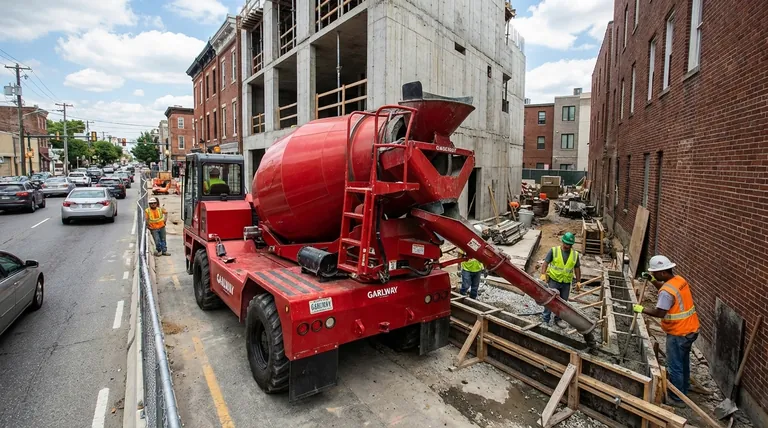
Imagine an operator parking a GARLWAY self-loading mixer in a single, strategic spot. From that fixed position, they can rotate the drum and chute to service foundations, pour into forms, and fill trenches across a wide semi-circle.
The slow, repetitive dance of repositioning is replaced by one smooth, continuous hydraulic motion. The workflow is no longer vehicle-move, pour, vehicle-move, pour. It becomes park once, pour everywhere.
A Scenario: The Urban Foundation
Consider a foundation pour in a tight alley. A standard mixer would have to reverse in, pour a section, drive out, and reverse in again at a new angle, blocking traffic each time.
A mixer with 270° rotation parks parallel to the street. The operator rotates the drum 90 degrees to the side and discharges concrete precisely along the entire length of the foundation form. The job is completed faster, with less disruption, and with a smaller, safer operational footprint.
The Compounding Gains of Focus
When operators aren't constantly maneuvering the vehicle, their mental energy is dedicated entirely to the pour. This leads to greater precision, less spillage, and a dramatic reduction in cleanup time. A stationary vehicle is also an inherently safer one, minimizing the risk of collision in a busy environment.
An Honest Look at the Engineering
This capability doesn't come from nowhere. It requires sophisticated engineering, which introduces trade-offs worth considering.
- Mechanical Complexity: A hydraulic slewing ring is more complex than a fixed mount. This requires a commitment to routine inspection and maintenance. Quality systems, however, are designed for durability and serviceability, making this a manageable part of ownership.
- Initial Cost: A machine with rotational capability carries a higher upfront investment. But framing this as a "cost" is a mistake. It is capital allocated toward unlocking systemic efficiency.
The real question is not what it costs, but what it returns.
| Investment Factor | Return on Investment (ROI) |
|---|---|
| Higher Purchase Price | Lower Lifetime Operating Costs (Fuel, Maintenance, Labor) |
| Mechanical System | Access to More Profitable Jobs (Complex & Constrained Sites) |
| New Capability | Faster Project Completion Times (Higher Throughput) |
Choose Your Workflow, Not Just Your Machine
The decision to invest in a 270° rotating mixer is a strategic one about the kind of work you want to do.
- For operations focused on large, wide-open sites, a fixed-drum mixer may be a cost-effective tool.
- For companies aiming for maximum versatility, bidding on urban, industrial, or complex residential projects, rotation is the key that unlocks the door to higher-margin work.
Ultimately, this technology transforms the machine from a simple tool that delivers concrete into a sophisticated system that places it with intelligence and efficiency. It allows you to redesign your workflow around productivity, not around the limitations of your equipment.
At GARLWAY, we engineer construction machinery that solves these deep, systemic challenges. Our self-loading concrete mixers with 270° rotation are built to give contractors a decisive competitive edge in efficiency, flexibility, and safety. If you're ready to stop paying the hidden tax of wasted motion, Contact Our Experts.
Visual Guide
Related Products
- Portable Cement Mixer with Lift Concrete Machine
- Portable Concrete Mixer Machine Equipment for Mixing Concrete
- JDY350 Electric Hydraulic Mortar Mud Concrete Mixer
- HZS90 Large Multiquip Concrete Mixers for Construction
- HZS25 Best Cement Mixer for Quick Mix Concrete at Bunnings
Related Articles
- How to Transform Your Cement Mixer into a High-Performance Art Tool
- How Component Engineering Elevates Cement Mixer Performance for Small Projects
- How to Repurpose Your Cement Mixer for Ammunition, Farming, and DIY Projects
- How to Repurpose Cement Mixers for High-Efficiency Farm Material Processing
- How Cement Mixers Solve Industrial Derusting Challenges Safely and Efficiently





