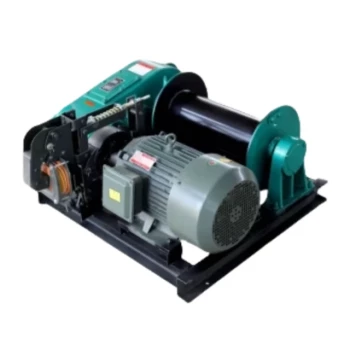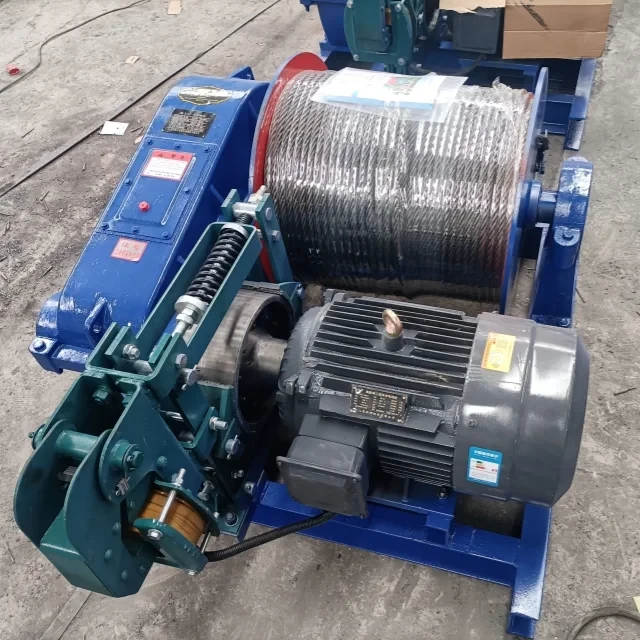
When lives and million-dollar loads hang from steel cables, ordinary brakes won't suffice. Weight-engaged electromagnetic brakes offer an engineering solution where safety isn't just added—it's built into fundamental physics. This guide examines how gravity-activated braking systems outperform conventional designs in heavy-load scenarios, with actionable insights for industrial operators.
How Electromagnetic Weight Brakes Achieve Intrinsic Safety
The Gravity Engagement Principle in Emergency Scenarios
Unlike spring-applied brakes that rely on mechanical force, weight-based systems use the load itself as the engagement mechanism. Here's why this matters:
- Automatic Engagement: When power fails, suspended weights (typically 1-5% of rated load) physically drop to engage brake discs—no external energy required
- Torque Scaling: Braking force increases proportionally with load weight, maintaining consistent stopping distances whether carrying 5 or 500 tons
- Redundancy: Even if electromagnetic components fail, gravitational engagement occurs passively
Ever wondered why offshore cranes prioritize this design? The answer lies in unpredictable environments where power fluctuations are common.
Electromagnetic Release Coordination with Motor Systems
Modern implementations synchronize three critical functions:
- Controlled Release: Electromagnets gradually counteract gravitational force during startup, preventing sudden load drops
- Torque Matching: Current regulators adjust brake release timing to match motor acceleration curves
- Feedback Integration: Sensors verify full disengagement before permitting movement
This coordination prevents the "slack cable" phenomenon responsible for 23% of crane-related incidents according to OSHA data.
Optimizing Brake Performance in Industrial Settings
Precision Adjustment Protocols for Torque Consistency
Field technicians follow a three-phase calibration process:
| Phase | Procedure | Tolerance |
|---|---|---|
| Initial | Verify weight engagement timing | ±0.5 seconds |
| Load Test | Confirm torque at 25/50/75/100% capacity | ±3% of target |
| Runtime | Monitor heat dissipation after 10 cycles |
Pro tip: Garlway's winch systems incorporate self-diagnostic modules that automate 80% of these checks through onboard sensors.
Wear Compensation Strategies for Long-Term Reliability
Friction surfaces degrade predictably when you monitor these indicators:
- Disc Thickness: Replace at 60% of original specification
- Air Gap: Maintain 0.2-0.5mm clearance for optimal magnetic efficiency
- Lubricant Analysis: Check for metallic particles quarterly
Case studies show proper maintenance extends service life from the typical 5 years to over 12 in port crane applications.
Industry Applications and Safety Validation
Crane-Specific Load Testing Standards
Weight-based brakes must exceed these certification requirements:
- EN 14492-2: Mandates holding capability for 200% of rated load
- ASME B30.7: Requires emergency stop within 1.5% of drop distance
- DNVGL-ST-0378: Offshore units test saltwater corrosion resistance
Did you know? These standards evolved after investigators found conventional brakes contributed to the 2008 Dubai crane collapse that killed 3 workers.
Case Study: Offshore Platform Winch Deployment
A North Sea drilling rig retrofit achieved:
- 98.7% Uptime despite 15m waves and −30°C temperatures
- 42% Faster emergency stops compared to hydraulic alternatives
- Zero unplanned maintenance events over 18 months
The secret? Dual weight cassettes that engage sequentially—first at 100% load, then a secondary set at 150% for catastrophic failures.
Implementing Fail-Safe Solutions
For operations where "good enough" isn't an option:
- Audit Existing Systems: Map all single-point failure risks in your braking chain
- Prioritize Load-Adaptive Designs: Gravity never loses power
- Demand Third-Party Certification: Look for EN 14492-2 compliance
Garlway's engineering team specializes in retrofitting legacy systems with weight-engaged safety without requiring full winch replacement—a cost-effective approach for aging infrastructure.
The next evolution? Smart brakes that predict engagement timing based on real-time load sway analytics, merging mechanical certainty with digital precision. Because when failure isn't an option, physics makes the best partner.
Related Products
- Small Electric Winch 120V and 240V for Compact Applications
- Electric Hoist Winch Boat Anchor Windlass for Marine Applications
- Electric 120V Boat Winch by Badlands
- 12000 lb Electric Boat Trailer Winch with Windlass Anchor Warn
- Heavy Duty Electric Boat Winch Windlass Anchor
Related Articles
- How to Maximize Electrical Winch Performance in Challenging Environments
- How Electric Winch Safety Features Prevent Catastrophic Industrial Accidents
- How to Choose Between Manual and Electric Winches for Your Project
- How Electric Winches Solve Industrial Safety and Cost Challenges
- How Electric Winches’ Engineering Enhances Efficiency and Safety in Heavy-Duty Applications