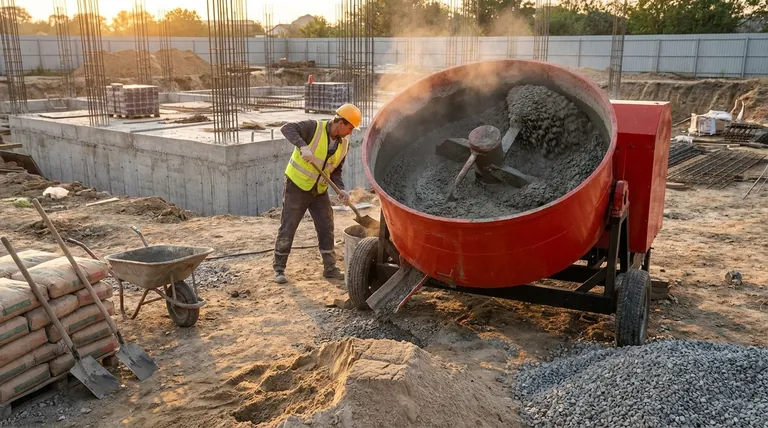
The Rhythm of the Job Site
On any construction site, before the walls rise and the structures take shape, there's a foundational sound: the rhythmic, grinding rumble of a concrete mixer.
It’s easy to dismiss this machine as a simple brute-force tool. But the humble drum mixer is a testament to elegant engineering. It harnesses one of nature's most powerful and predictable forces—gravity—to perform its task.
Understanding the physics behind its operation reveals a deeper story about the trade-offs every contractor must navigate. Choosing a mixer isn't just a technical decision; it's a psychological one about balancing cost, speed, and quality.
The Physics of Simplicity: A Controlled Fall
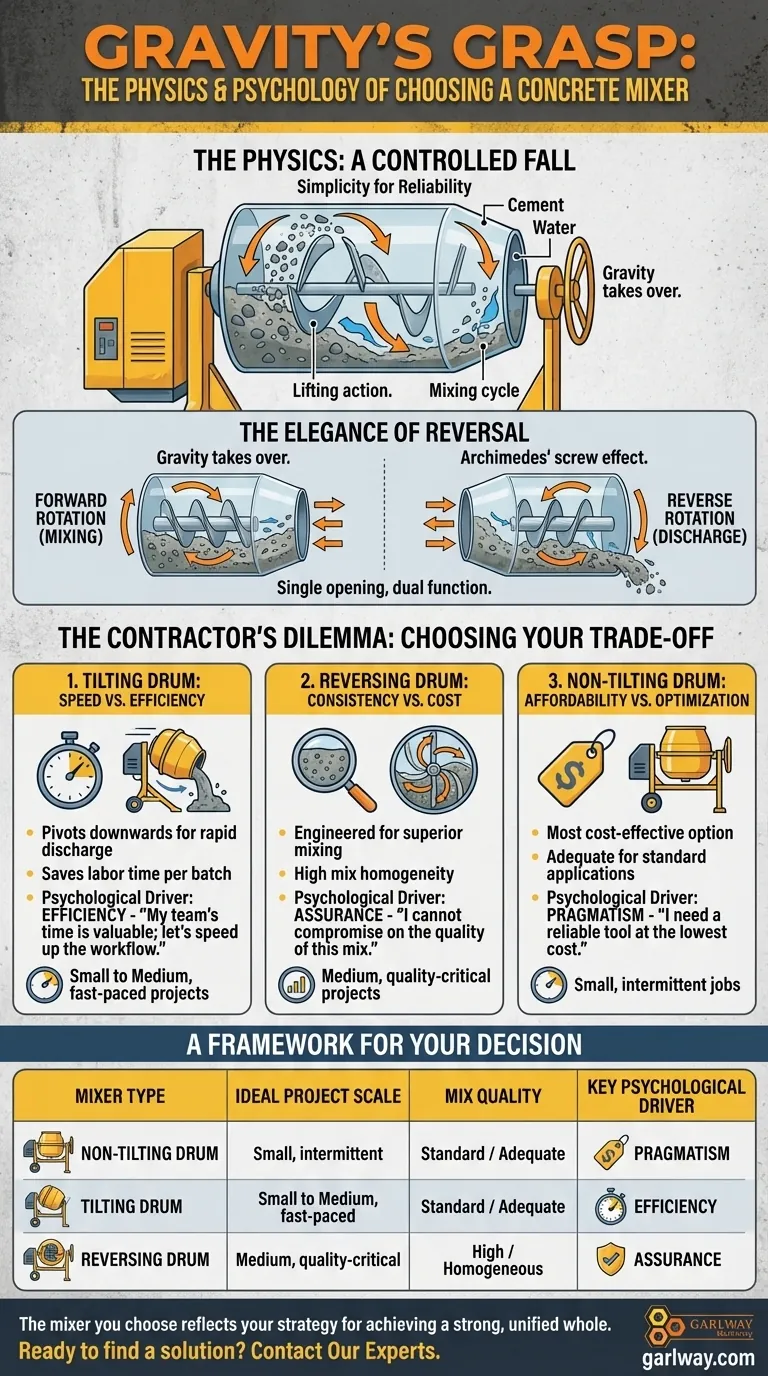
At its heart, a drum concrete mixer doesn't force materials to combine. It simply facilitates a continuous, controlled fall.
As the drum rotates, internal blades lift the cement, aggregate, and water. At the peak of their ascent, gravity takes over, and the materials tumble back down upon themselves. This repetitive cycle of lifting and falling is the core mixing action.
This "self-falling" method is brilliantly simple. With fewer complex mechanical parts, the machine is inherently more reliable, easier to maintain, and less expensive to produce. For a contractor, this translates to predictability—a priceless asset in an industry filled with variables.
The Elegance of Reversal
The design's cleverness extends to its discharge mechanism. Most drum mixers use a single opening for both loading and unloading.
- Forward Rotation: The blades are angled to scoop materials up and pull them deeper into the drum, promoting the tumbling action.
- Reverse Rotation: When the drum's direction is reversed, the same blades are engineered to act like an Archimedes' screw, efficiently pushing the finished concrete out.
This dual-function design minimizes complexity and potential points of failure.
The Contractor's Dilemma: Choosing Your Trade-Off
While all drum mixers rely on gravity, subtle design variations create a spectrum of choice. Selecting the right one is less about finding the "best" mixer and more about deciding which compromise best suits the economic reality of your project.
1. Speed vs. Efficiency: The Tilting Drum
A tilting drum mixer allows the entire drum to be pivoted downwards, pouring out its contents rapidly.
This isn't just about convenience. On a medium-sized project with multiple pours, saving a few minutes per batch can accumulate into hours of saved labor costs. The psychological choice here is investing a bit more capital upfront to maximize the efficiency of your most expensive asset: your team's time.
2. Consistency vs. Cost: The Reversing Drum
For projects demanding high-performance concrete—like structural beams or specialized precast elements—mix homogeneity is non-negotiable. The standard tumbling action might not be enough.
The reversing drum mixer is the solution. It features a more complex system of spiral blades engineered for superior mixing in one direction and rapid, clean discharge in reverse. It produces a remarkably uniform mix but comes at a higher price. The choice here is about risk management. You are paying a premium to guarantee quality and structural integrity.
3. Affordability vs. Optimization: The Standard Non-Tilting Drum
The basic non-tilting mixer is the quintessential workhorse. It's the most cost-effective option and perfectly adequate for countless applications, from foundations to sidewalks.
Opting for this model is a decision to prioritize access and minimize initial capital outlay. It's the right tool when "good enough" is truly good enough, and the budget is the primary constraint.
A Framework for Your Decision
Choosing the right machine requires aligning its capabilities with your project's unique demands. The decision is a balance of operational needs and financial priorities.
| Mixer Type | Ideal Project Scale | Mix Quality | Key Psychological Driver |
|---|---|---|---|
| Non-Tilting Drum | Small, intermittent jobs | Standard / Adequate | Pragmatism: "I need a reliable tool at the lowest cost." |
| Tilting Drum | Small to Medium, fast-paced | Standard / Adequate | Efficiency: "My team's time is valuable; let's speed up the workflow." |
| Reversing Drum | Medium, quality-critical | High / Homogeneous | Assurance: "I cannot compromise on the quality of this mix." |
Beyond the Machine Itself
The constant rotation of a concrete drum is more than just mechanical action; it’s a reflection of the core challenge in construction—turning raw, separate elements into a strong, unified whole. The mixer you choose reflects your strategy for achieving that goal.
At GARLWAY, we provide robust construction machinery, but our real value lies in understanding the context behind the equipment. We know that choosing a mixer is about balancing the physics of the machine with the economic and psychological realities of your work. We help you find the perfect tool that aligns with your project's definition of success.
If you're ready to find a solution that fits your specific needs, Contact Our Experts.
Visual Guide
Related Products
- Concrete Cement Mixer Machine Drum Mixer for Construction
- Belle Mixer Drum Self Loading Mortar Mixers JS3000
- Portable Concrete Mixer Machine Equipment for Mixing Concrete
- Portable Ready Mix Concrete Mixer Equipment
- JZC400 Mobile Small Concrete Mixer Cement Mixer Machine
Related Articles
- How to Optimize Feeding-Mixing-Discharging Coordination in Concrete Production
- More Than a Mixer: The Physics and Psychology of Concrete Agitation
- How to Minimize Downtime and Maximize Efficiency in Commercial Concrete Mixing
- How Improper Water Addition Compromises Concrete Strength and How to Fix It
- How to Transform Your Cement Mixer into a High-Performance Art Tool








