The Hidden Risk in Every Pour
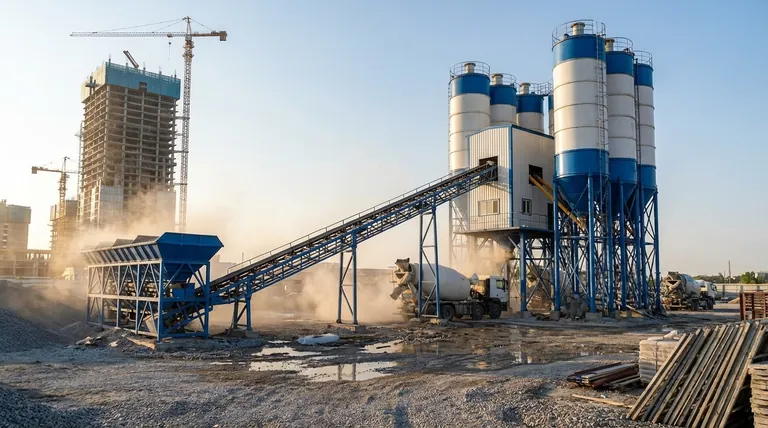
On a large construction site—the foundation of a skyscraper, a bridge pier rising from a river—the most significant risk isn't always the most visible. It is the silent, pervasive threat of inconsistency.
Every cubic meter of concrete is a promise of strength and durability. For engineers and contractors, this isn't an abstract concept; it's the basis of professional trust. But how do you guarantee that promise when you're producing thousands of cubic meters under immense time pressure? The answer lies not just in the recipe, but in the physics of how it's combined.
The Anatomy of a Perfect Mix: Forced vs. Gravity
At a fundamental level, there are two philosophies of mixing concrete.
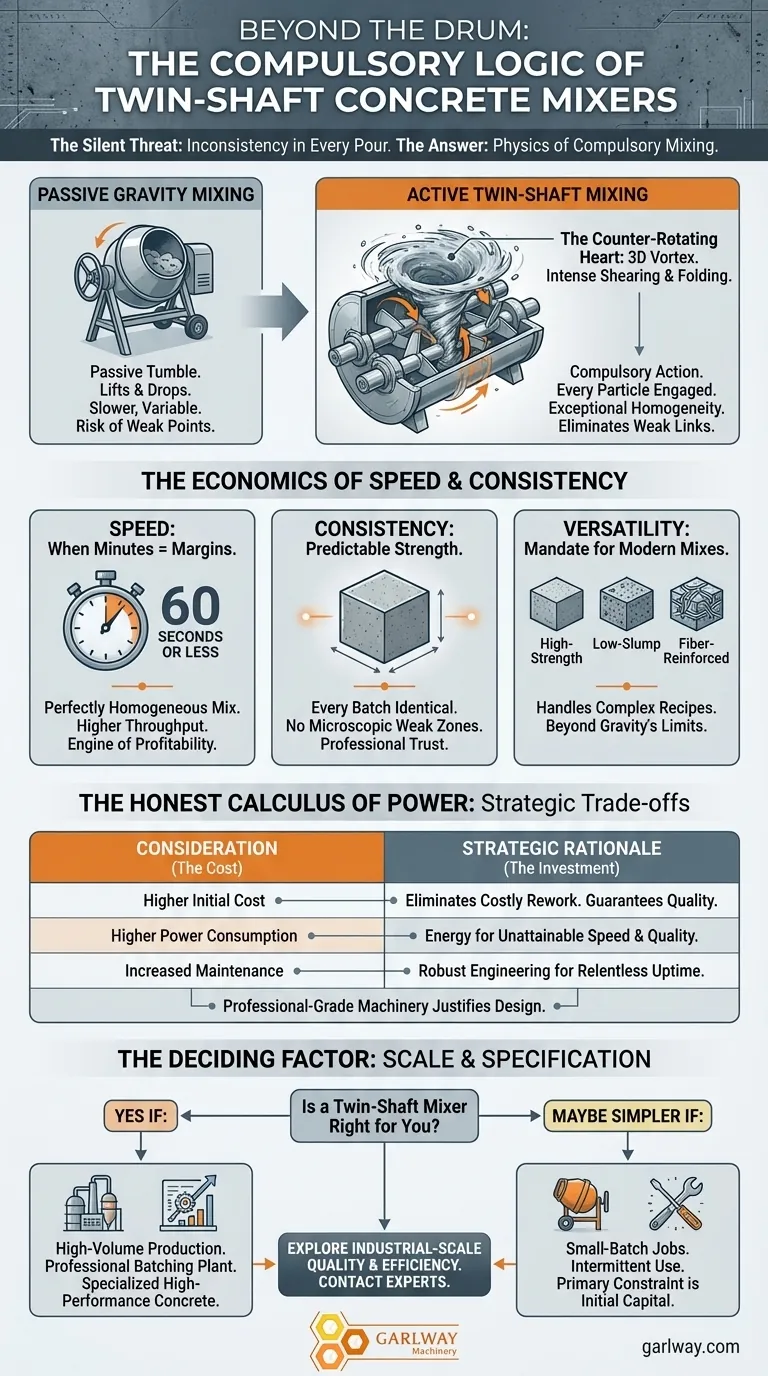
The most common is based on gravity. Think of a standard drum mixer, tilting and tumbling its contents. It lifts materials and lets them fall. This is a passive process, akin to tossing a salad. It works, but it can be slow and leaves room for statistical variance.
The second philosophy is about absolute control. This is the domain of the twin-shaft mixer.
The Counter-Rotating Heart
Imagine two powerful, parallel shafts lined with blades spinning into each other inside a chamber. This is the heart of a twin-shaft mixer.
They don't just tumble the material; they create a violent, controlled, three-dimensional vortex in the center of the drum. Aggregates, sand, cement, and water are sheared, folded, and forced to intersect at high velocity. This intense, compulsory action ensures that every single particle is actively engaged in the mix. It's the difference between a gentle tumble and a powerful knead.
Eliminating the "Weakest Link"
The result of this forced-mixing action is exceptional homogeneity. In a gravity-fed system, it's possible to have microscopic zones that are slightly wetter, drier, or cement-poor. These become potential weak points.
A twin-shaft mixer systematically eliminates this possibility. By ensuring every grain of sand is coated in cement paste and all admixtures are evenly dispersed, it produces a mix that is strong and predictable, batch after batch.
The Economics of Speed and Consistency
In a professional setting, the choice of mixer transcends engineering and becomes a critical business decision. The advantages of a twin-shaft system are measured in time and money.
When Minutes Equal Margins
The aggressive mixing process is incredibly fast, often achieving a perfectly homogeneous mix in 60 seconds or less.
For a precast concrete facility or a large-scale project with a tight schedule, this speed is not a minor convenience—it's the engine of profitability. Higher throughput means more output per hour and better asset utilization. For operations where uptime is paramount, industrial-grade systems like GARLWAY's twin-shaft mixers are not a luxury; they are a core component of a lean production strategy.
The Versatility Mandate
Modern construction demands more than just standard concrete. High-strength, low-slump (hard-dry), and fiber-reinforced concrete have complex recipes that resist easy mixing.
A gravity mixer struggles to achieve the consistency required for these demanding applications. The raw power of a twin-shaft mixer is what makes these advanced materials practical, providing the versatility to handle any specification a project requires.
The Honest Calculus of Power
The superiority of the twin-shaft mixer comes with a clear set of trade-offs. Pretending they don't exist is poor engineering.
| Consideration | The Strategic Rationale |
|---|---|
| Higher Initial Cost | An investment in eliminating the risk of costly bad batches and rework. |
| Higher Power Consumption | The energy required to guarantee speed and a level of quality unattainable otherwise. |
| Increased Maintenance | The necessary upkeep for a more complex machine designed for relentless, heavy-duty cycles. |
This is where professional-grade machinery, such as that engineered by GARLWAY, justifies its design. The engineering focuses on robust gearboxes, wear-resistant liners, and reliable seals, because the true cost of a mixer isn't its price tag, but the cost of its downtime.
The Deciding Factor: Scale and Specification
Is a twin-shaft mixer right for you? The choice depends entirely on the demands of your operation.
-
You need a twin-shaft mixer if: Your business is high-volume production, you're running a professional concrete batching plant, or your projects demand specialized, high-performance concrete where consistency is non-negotiable.
-
A simpler mixer may suffice if: Your work consists of small-batch jobs, intermittent use is the norm, and your primary constraint is the initial capital investment for standard-spec concrete.
Ultimately, the twin-shaft mixer represents a commitment to industrial-scale quality and efficiency. It’s about taking control of the mixing process to build a foundation of absolute certainty.
If your projects demand speed, consistency, and the power to handle any mix design, exploring this technology is the logical next step. Contact Our Experts
Visual Guide
Related Products
- JS500 Electric Cement Concrete Mixer for Sale
- Shaft Mixer Machine for Cement and Regular Concrete Mixing
- Portable Cement Mixer with Lift Concrete Machine
- HZS90 Large Multiquip Concrete Mixers for Construction
- HZS25 Best Cement Mixer for Quick Mix Concrete at Bunnings
Related Articles
- How to Optimize Feeding-Mixing-Discharging Coordination in Concrete Production
- How to Minimize Downtime and Maximize Efficiency in Commercial Concrete Mixing
- How Improper Water Addition Compromises Concrete Strength and How to Fix It
- More Than a Mixer: The Physics and Psychology of Concrete Agitation
- The Tether and the Titan: Choosing a Concrete Mixer is About More Than Power