The Unseen Engine of Structural Integrity
Every monumental structure—a soaring skyscraper, a sprawling bridge—is a testament to trust. We trust the materials, the design, and the execution. But this trust isn't abstract; it's built upon countless physical certainties.
One of the most fundamental of these is the microscopic consistency of the concrete itself. Before a single drop is poured, its ultimate strength and durability have already been decided inside a machine.
This is the story of that machine: the twin-shaft mixer. It is not merely a container for blending ingredients. It is the quality-control engine at the heart of modern construction, engineered to solve the psychological problem of uncertainty.
The Tyranny of Inconsistency
The ultimate enemy in structural concrete is not a visible crack or a design flaw; it is the invisible weak spot. It is the small pocket of poorly mixed material that compromises the integrity of the whole.
What Homogeneity Truly Means
Homogeneity in concrete means that every sample, no matter how small, has the exact same composition. The water-to-cement ratio is uniform, and every particle of sand and aggregate is perfectly coated in cement paste.
This isn’t just about appearance. It’s about creating predictable, reliable performance. It means the strength specified in the blueprint is the strength delivered in reality, across every single cubic meter.
The Psychological Cost of a Weak Spot
A batch of concrete is only as strong as its weakest point. A single poorly-mixed batch can introduce a vulnerability that undermines an entire project. The goal of mixing, therefore, is not simply to combine materials—it is to eliminate doubt.
The aggressive action of a twin-shaft mixer is engineered to attack this doubt at its source.
Engineering Certainty: The Mechanics of Compulsory Mixing
The design of a twin-shaft mixer is a direct response to the limitations of simpler designs. It replaces passive chance with active, mechanical certainty.
From Passive Tumbling to Active Forcing
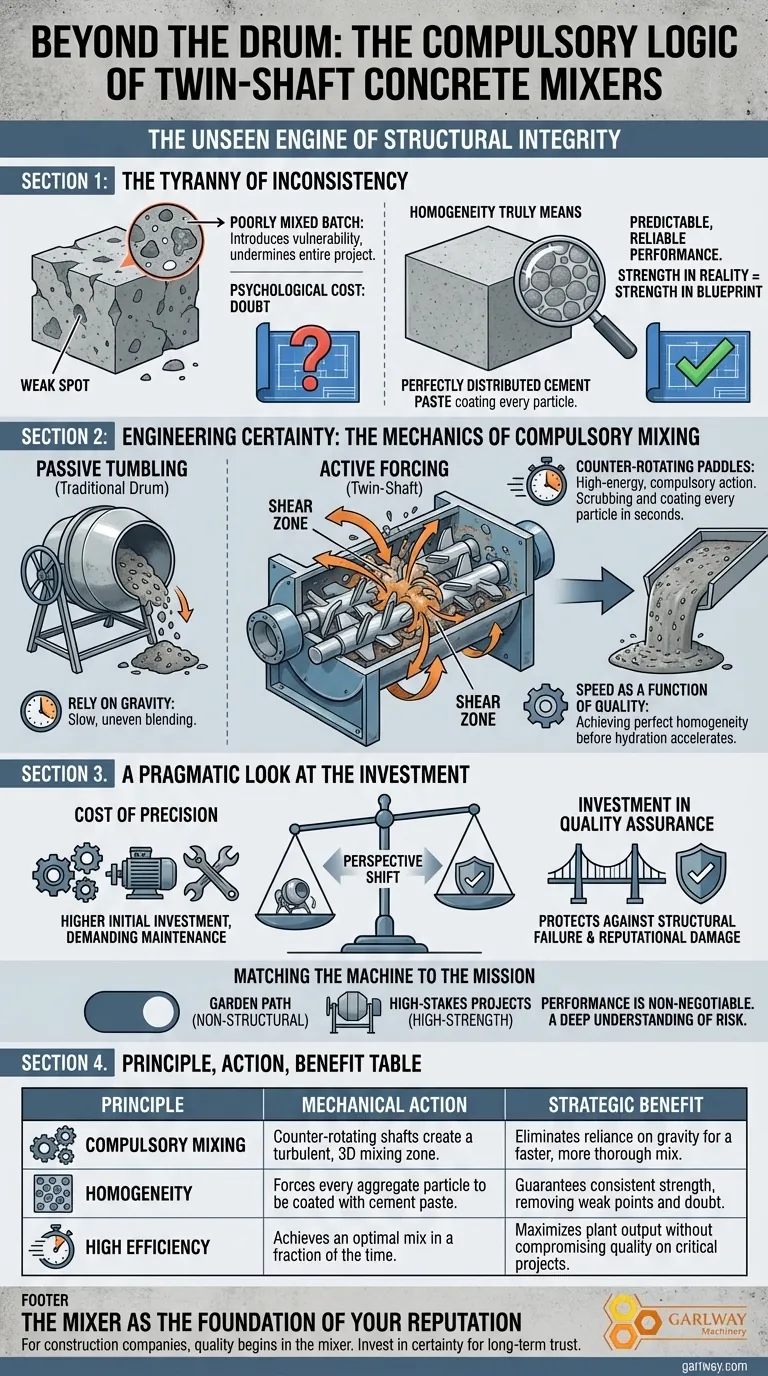
Traditional drum mixers rely on gravity. They lift and drop materials, hoping they combine evenly over time. This is a passive process, akin to gently shaking a jar of layered sand and pebbles.
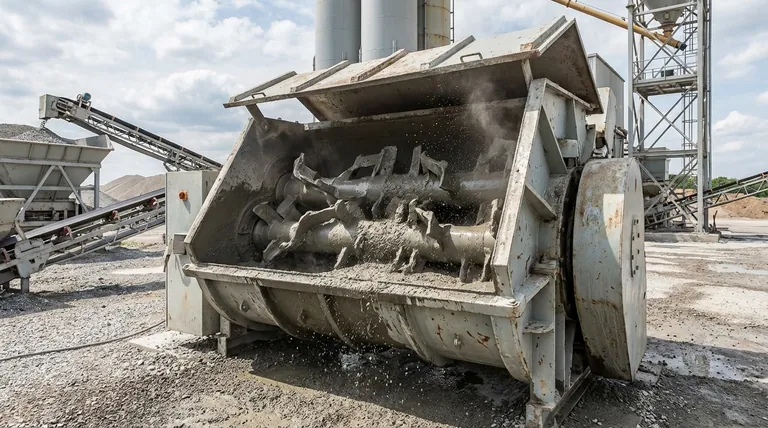
A twin-shaft mixer operates on a principle of compulsory mixing. Two powerful, parallel shafts with interlocking paddles spin in opposite directions. This isn't tumbling; it's a high-energy, mechanical action that forces the materials to interact.
The Violent Ballet of Counter-Rotation
The overlapping paths of the counter-rotating paddles create an intense, three-dimensional shear zone in the center of the mixer. Materials are folded, sheared, and thrown against each other with engineered precision.
This "violent ballet" ensures that every particle is scrubbed and coated in cement paste in seconds. It guarantees a level of uniformity that gravity-based systems can never reliably achieve.
Speed as a Function of Quality
This process is incredibly fast, but speed here is not just about productivity. It is about achieving perfect homogeneity before the concrete’s chemical hydration process begins to accelerate, locking in the quality of the mix.
A Pragmatic Look at the Investment
While its performance is superior, the twin-shaft mixer represents a specific engineering choice with clear trade-offs.
The Cost of Precision
The robust gearboxes, powerful motors, and durable wear parts needed for compulsory mixing result in a higher initial investment and a more demanding maintenance schedule compared to simpler mixers.
However, framing this as a "cost" is a matter of perspective. It is more accurately an investment in a quality assurance system—a system that protects against the far greater cost of structural failure or reputational damage.
Matching the Machine to the Mission
For non-structural applications like a garden path, the precision of a twin-shaft mixer may be unnecessary. But for high-strength, high-stakes projects, its performance is non-negotiable. The choice reflects a deep understanding of risk and a commitment to quality.
| Principle | Mechanical Action | Strategic Benefit |
|---|---|---|
| Compulsory Mixing | Counter-rotating shafts create a turbulent, 3D mixing zone. | Eliminates reliance on gravity for a faster, more thorough mix. |
| Homogeneity | Forces every aggregate particle to be coated with cement paste. | Guarantees consistent strength, removing weak points and doubt. |
| High Efficiency | Achieves an optimal mix in a fraction of the time. | Maximizes plant output without compromising quality on critical projects. |
The Mixer as the Foundation of Your Reputation
For construction companies and contractors, reputation is built on the enduring quality of their work. That quality begins with the concrete, and the quality of the concrete begins in the mixer.
At GARLWAY, we understand that our clients aren't just buying machinery; they are investing in certainty. Our concrete batching plants are engineered around the uncompromising performance of twin-shaft mixers because we know that long-term trust is built one perfectly mixed, completely homogeneous batch at a time.
To ensure your projects are built on a foundation of absolute certainty, the right equipment is paramount. Contact Our Experts to discuss how our concrete batching solutions can elevate the quality and efficiency of your operations.
Visual Guide
Related Products
- JS500 Electric Cement Concrete Mixer for Sale
- Shaft Mixer Machine for Cement and Regular Concrete Mixing
- Portable Cement Mixer with Lift Concrete Machine
- Portable Concrete Mixer Machine Equipment for Mixing Concrete
- Construction Products Concrete Plant Machine Mixing Concrete Mixer
Related Articles
- How to Optimize Feeding-Mixing-Discharging Coordination in Concrete Production
- How to Minimize Downtime and Maximize Efficiency in Commercial Concrete Mixing
- How Improper Water Addition Compromises Concrete Strength and How to Fix It
- More Than a Mixer: The Physics and Psychology of Concrete Agitation
- The Tether and the Titan: Choosing a Concrete Mixer is About More Than Power