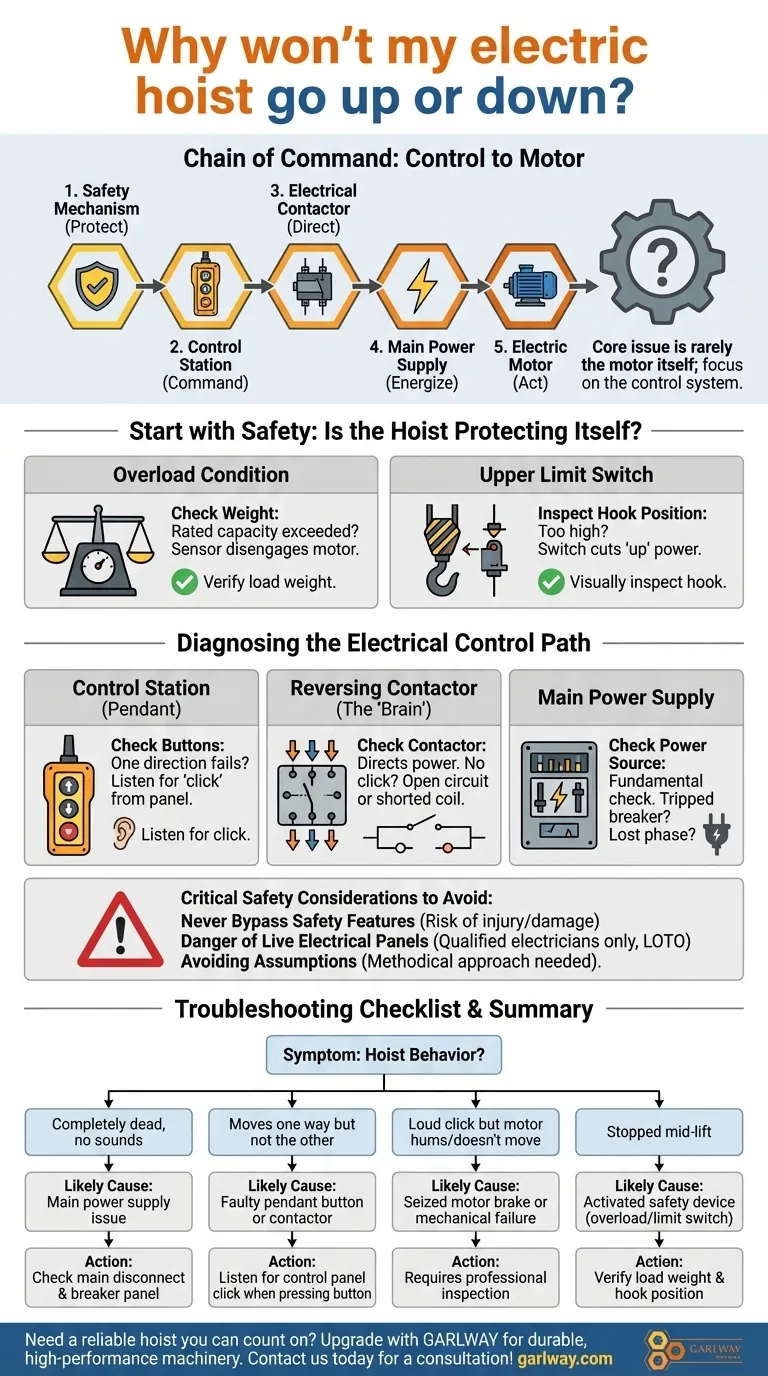
An unresponsive electric hoist is almost always caused by one of four primary issues: a tripped safety mechanism, a faulty control station, a failure in the electrical contactor, or a disruption in the main power supply. These components form a chain of command, and a break anywhere along that chain will prevent movement.
The core issue is rarely the motor itself. Instead, the problem lies within the control system designed to operate and protect it. A systematic check of the safety switches and the electrical path from the control pendant to the motor is the key to a fast and accurate diagnosis.
Start with Safety: Is the Hoist Protecting Itself?
Before assuming a component is broken, first verify that a safety feature has not been activated. These systems are designed to lock out hoist operations to prevent catastrophic failure or damage.
Checking for an Overload Condition
The most common reason a hoist stops is that it has been loaded beyond its rated capacity. An internal overload clutch or sensor will disengage the motor to protect it.
Your first action should always be to verify the weight of the load. If it exceeds the hoist's limit, the hoist is functioning correctly by refusing to lift.
Inspecting the Upper Limit Switch
The upper limit switch is a safety device that prevents the hook block from crashing into the hoist body. If the hook is raised too high, it physically triggers this switch, cutting power to the "up" motor circuit.
Visually inspect the hook's position. If it is touching or has recently touched the limit switch, the hoist will not go up, but it should still be able to go down.
Diagnosing the Electrical Control Path
If safety devices are not the cause, the issue lies in the electrical pathway that delivers the command from your finger to the motor. This requires a logical, step-by-step investigation.
The Control Station (Pendant)
The handheld control pendant is the most frequently used part of the hoist and is susceptible to wear and physical damage. Internal contacts can wear out, or wires can fray.
If the hoist moves in one direction but not the other, the corresponding button in the pendant is a likely culprit. Listen carefully for a "click" from the main control panel when you press the button; if you hear one, the pendant is likely working.
The Reversing Contactor (The Hoist's Brain)
The reversing contactor is a heavy-duty electrical switch inside the hoist's main control panel. It directs the flow of high-voltage power to the motor windings to make it turn clockwise (up) or counter-clockwise (down).
A "click" sound when you press a button usually means the contactor is trying to engage. A failure here could be an open circuit (power isn't getting through the switch) or a shorted coil (the electromagnet that closes the switch is burnt out).
The Main Power Supply
This is the most fundamental check. An issue with the power source will disable the entire unit.
Confirm that the main circuit breaker for the hoist has not tripped. For three-phase hoists, ensure all three phases of power are present, as the hoist will not operate if one is lost.
Critical Safety Considerations to Avoid
Troubleshooting industrial equipment carries inherent risks. Rushing the process or taking shortcuts can lead to injury or further equipment damage.
Never Bypass a Safety Feature
Overload clutches and limit switches are there for a reason. Bypassing them to complete a lift is a dangerous practice that can lead to dropped loads, damaged equipment, and severe injury.
The Danger of Live Electrical Panels
Diagnosing a faulty contactor or internal wiring requires opening an electrical panel. This task should only be performed by a qualified electrician following proper Lockout/Tagout (LOTO) procedures.
Assuming a Single Point of Failure
One problem can sometimes cause another. For instance, a short circuit in a pendant wire could cause the main breaker to trip. A methodical approach prevents you from fixing one symptom while ignoring the root cause.
A Systematic Troubleshooting Checklist
Use this goal-oriented process to efficiently locate the source of the problem.
- If the hoist is completely dead with no sounds: Your focus should be on the main power supply. Check the emergency stop button, the main disconnect, and the circuit breaker panel first.
- If the hoist moves one direction but not the other: This strongly indicates a fault in either the pendant button for the non-working direction or the corresponding side of the reversing contactor.
- If you hear a loud click but the motor only hums or doesn't move: This often points to a problem after the contactor. The motor may be receiving power but is unable to move due to a seized motor brake or a major mechanical failure.
- If the hoist stopped working in the middle of a lift: Immediately suspect that a safety device has been triggered. Check for a load that is over capacity or a tripped upper limit switch.
By methodically checking each system from the simplest cause to the most complex, you can ensure a safe and effective repair.
Summary Table:
| Symptom | Likely Cause | Action |
|---|---|---|
| Hoist is completely dead, no sounds | Main power supply issue (tripped breaker, E-stop) | Check main disconnect and circuit breaker panel. |
| Moves one way but not the other | Faulty pendant button or reversing contactor | Listen for a click from the control panel when pressing the button. |
| Loud click but motor hums/doesn't move | Seized motor brake or mechanical failure | Requires professional inspection. |
| Stopped mid-lift | Activated safety device (overload, limit switch) | Verify load weight and hook position. |
Need a reliable hoist you can count on?
If your current equipment is causing frequent downtime, it's time for an upgrade. GARLWAY specializes in durable and high-performance construction machinery, including electric hoists, winches, and concrete mixers, trusted by construction companies and contractors globally.
Let our experts help you select the right equipment to keep your projects moving safely and efficiently.
Contact GARLWAY today for a consultation and quote!
Visual Guide
Related Products
- Electric Hoist Winch Boat Anchor Windlass for Marine Applications
- Electric and Hydraulic Winch for Heavy Duty Applications
- Hydraulic Winding Engine Harbor Freight Winch
- Heavy Duty Electric Boat Winch Windlass Anchor
- 12000 lb Electric Boat Trailer Winch with Windlass Anchor Warn
People Also Ask
- How does an electric anchor winch work? Power, Safety, and Reliable Operation Explained
- What are the advantages of installing an electric anchor winch on a boat? Boost Safety & Ease for Boaters
- What are the operational differences between electric hoists and winches? A Guide to Safe Lifting vs. Pulling
- What are the main benefits of a boat anchor winch? Boost Safety & Efficiency for Your Vessel
- How does a boat anchor winch work? A Guide to Reliable Anchor Handling