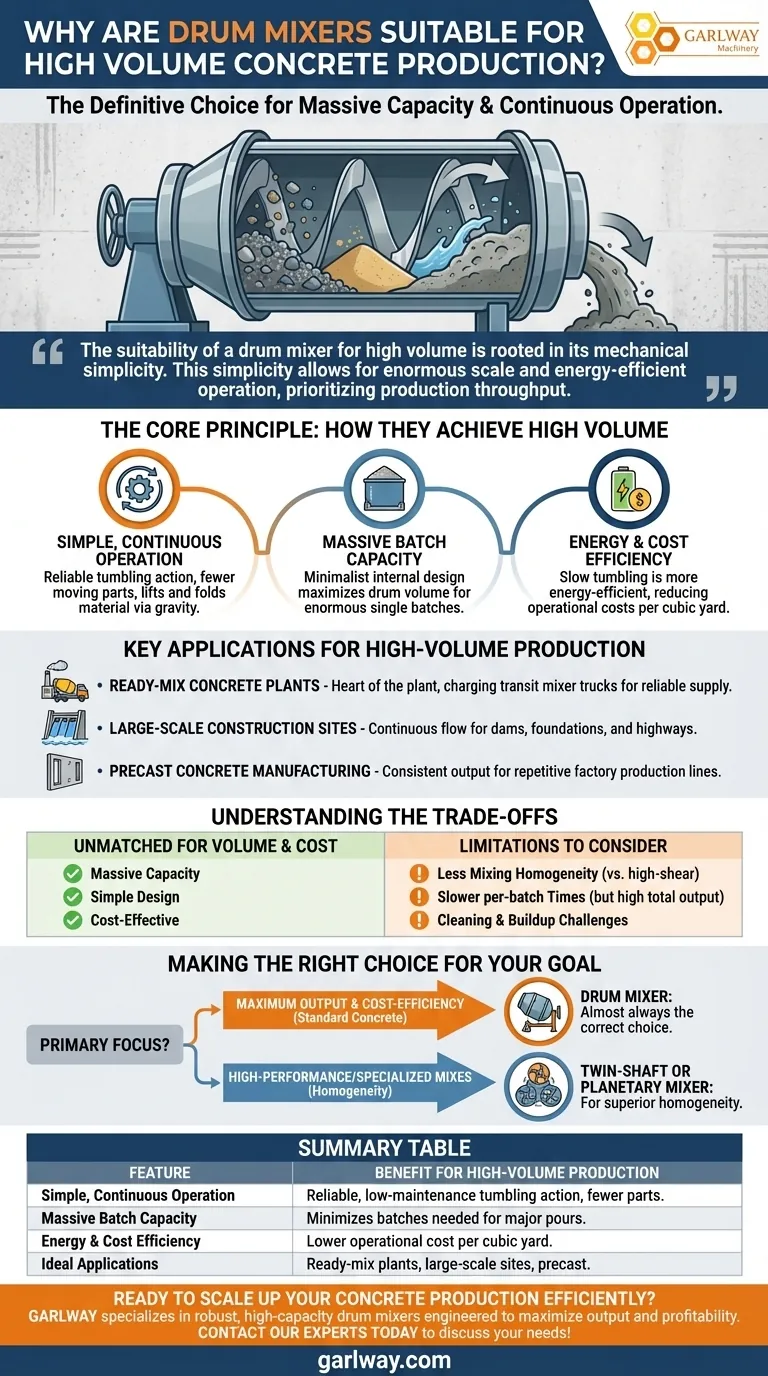
Drum mixers are the definitive choice for high-volume concrete production because their design prioritizes massive capacity and continuous operation. By leveraging a simple, gravity-based tumbling action, these machines can efficiently process large batches, making them the most cost-effective solution for major construction projects and precast manufacturing where quantity is paramount.
The suitability of a drum mixer for high volume is rooted in its mechanical simplicity. This simplicity allows for enormous scale and energy-efficient operation, prioritizing production throughput over the high-intensity, specialized mixing found in more complex systems.
The Core Principle: How Drum Mixers Achieve High Volume
The effectiveness of a drum mixer lies in its fundamental design. It's not one single feature but the combination of several factors that enables its impressive output.
Simple, Continuous Operation
A drum mixer consists of a rotating vessel with fixed internal fins or blades. As the drum turns, it lifts the aggregate, sand, cement, and water, which then tumble back down under gravity.
This continuous, gentle folding action is simple, reliable, and requires fewer moving parts than other mixer types.
Massive Batch Capacity
The minimalist internal design means that nearly the entire volume of the drum can be used for material. This allows them to be scaled to enormous sizes, capable of mixing many cubic yards or meters of concrete in a single batch.
This sheer size is the most direct contributor to their high-volume output, drastically reducing the number of batches needed for a large pour.
Energy and Cost Efficiency
The slow tumbling motion is significantly more energy-efficient than the high-shear, forced-action mixing of planetary or twin-shaft mixers.
For large-scale production, this lower energy consumption translates directly into reduced operational costs per cubic yard of concrete produced, enhancing overall project profitability.
Key Applications for High-Volume Production
The drum mixer's capabilities make it the standard in industries where consistent, large-scale output is a daily requirement.
Ready-Mix Concrete Plants
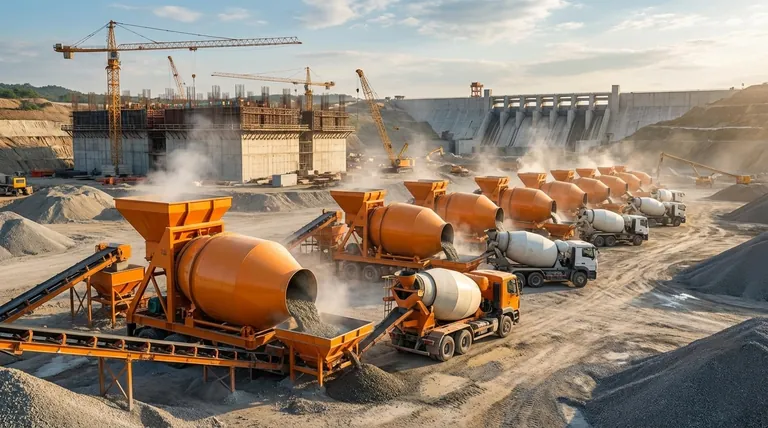
Drum mixers are the heart of most ready-mix plants. They are used to charge transit mixer trucks that deliver concrete to various construction sites, ensuring a steady and reliable supply chain.
Large-Scale Construction Sites
For massive infrastructure projects like dams, foundations for high-rise buildings, or highway construction, large stationary drum mixers are often set up on-site to provide a continuous flow of concrete.
Precast Concrete Manufacturing
Factories producing precast products like concrete blocks, pipes, and structural panels rely on drum mixers. The consistent, high-volume output is perfectly suited for the repetitive nature of factory production lines.
Understanding the Trade-offs
While unmatched for volume, the drum mixer's design comes with specific limitations. Objectivity requires acknowledging where other designs may be superior.
Mixing Homogeneity
The gravity-based tumbling action is less aggressive than forced-action mixing. For standard concrete mixes, this is perfectly adequate.
However, for high-performance or specialized concretes (like Self-Consolidating Concrete), it may not provide the intense shear force needed to achieve perfect dispersion of admixtures and binders.
Slower Mixing Times
A single batch in a large drum mixer can take longer to reach full homogeneity compared to a high-intensity mixer. The overall output is high due to batch size, not batch speed.
Cleaning and Buildup
The vast internal surface area can be challenging to clean thoroughly. Inadequate cleaning can lead to hardened concrete buildup, which reduces mixing efficiency and capacity over time.
Making the Right Choice for Your Goal
Selecting the correct mixer technology depends entirely on your project's specific requirements for volume, mix complexity, and cost.
- If your primary focus is maximum output and cost-efficiency for standard concrete: A drum mixer is almost always the correct choice due to its massive capacity and simple, reliable design.
- If your primary focus is producing high-performance or specialized concrete mixes: You should consider a twin-shaft or planetary mixer, which provides the necessary shear force for superior homogeneity.
- If your primary focus is mobility and a series of smaller, on-demand pours: A smaller portable drum mixer or a volumetric mixer would be a more suitable and flexible solution.
Understanding these core principles allows you to select the right mixing technology to match your project's scale and quality demands.
Summary Table:
| Feature | Benefit for High-Volume Production |
|---|---|
| Simple, Continuous Operation | Reliable, low-maintenance tumbling action with fewer moving parts. |
| Massive Batch Capacity | Large drum size minimizes batches needed for major pours. |
| Energy & Cost Efficiency | Lower operational cost per cubic yard of concrete produced. |
| Ideal Applications | Ready-mix plants, large-scale construction sites, precast manufacturing. |
Ready to scale up your concrete production efficiently?
GARLWAY specializes in construction machinery, offering robust and high-capacity drum mixers designed for construction companies and contractors globally. Our solutions are engineered to maximize your project's output and profitability.
Contact our experts today to discuss your high-volume concrete production needs!
Visual Guide
Related Products
- Belle Mixer Drum Self Loading Mortar Mixers JS3000
- Concrete Cement Mixer Machine Drum Mixer for Construction
- JDY350 Electric Hydraulic Mortar Mud Concrete Mixer
- Construction Products Concrete Plant Machine Mixing Concrete Mixer
- Harbor Freight JS1500 On Site Concrete Mixing Volumetric Cement Mixer
People Also Ask
- What are the features of mobile transporting in a self loading mixer? Boost On-Site Efficiency
- Why is timely cleaning important for a self loading mixer? Prevent Costly Downtime and Mix Failure
- How is discharging accomplished in a self loading mixer? Master Precise Concrete Placement
- What is the purpose of keeping the drum rotating during transportation in a self loading concrete mixer? Ensure Quality & Consistency
- What components are involved in the loading process of a self loading concrete mixer? A Guide to the Key Systems