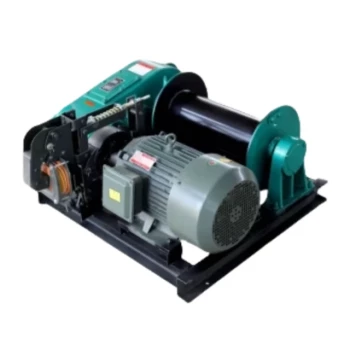
The fundamental reason air winches are suitable for flammable environments is that their pneumatic motors are inherently spark-resistant. Unlike electric winches that rely on electrical components prone to arcing, air winches are powered by compressed air, eliminating a primary ignition source from their core operation.
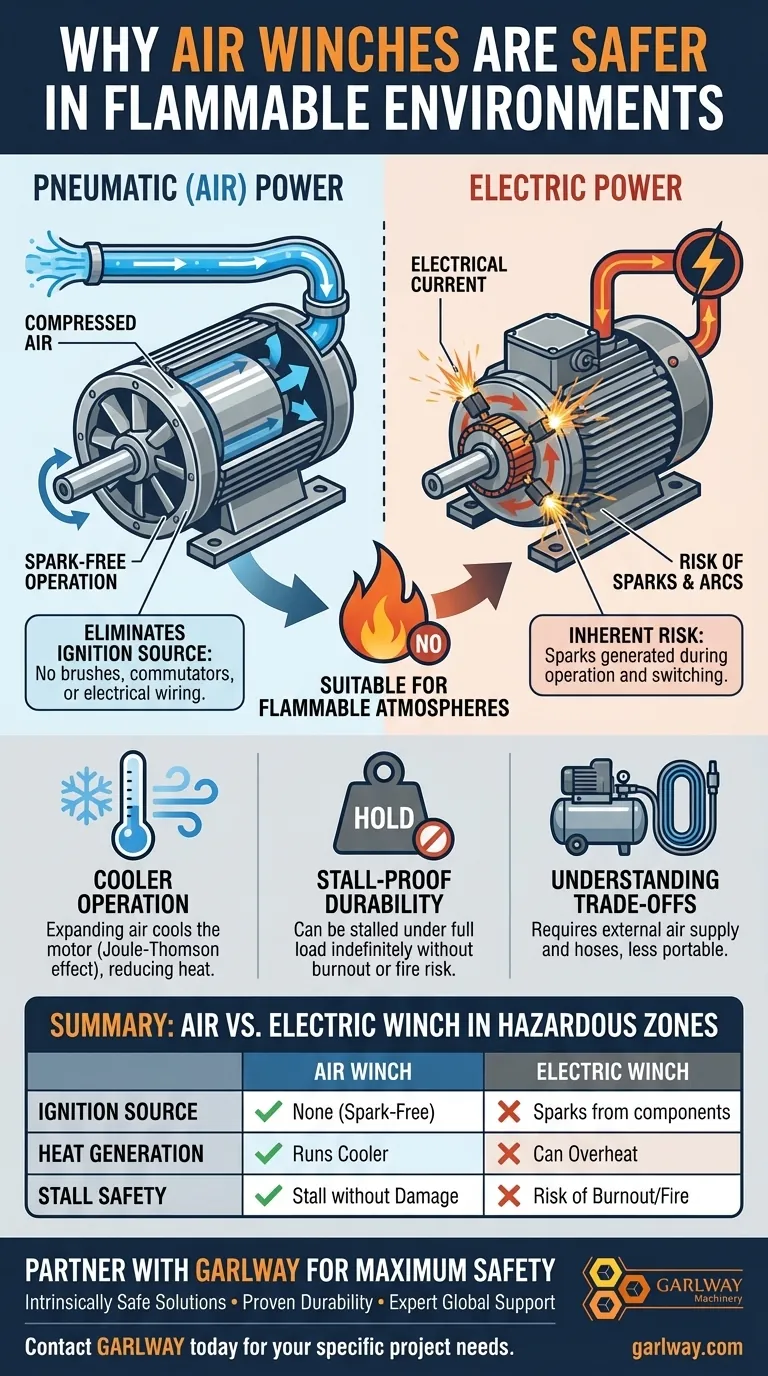
The critical distinction is the power source. Air winches use inert, compressed air to generate mechanical force, whereas electric winches require electrical currents that create an inherent risk of sparks and heat—two key elements of an ignition triangle in hazardous locations.
The Core Principle: Pneumatic vs. Electric Power
To understand the safety advantage, it's essential to compare how these two types of winches function. The difference in their operating principles is the source of their suitability for different environments.
How Air Winches Operate
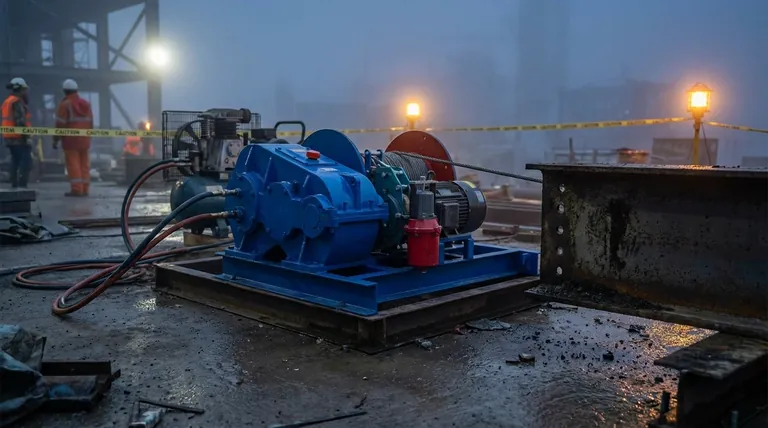
An air winch, or pneumatic winch, uses compressed air to drive a motor. The air expands inside the motor, pushing against vanes or pistons to create rotational force. This entire process is mechanical and does not involve any electrical circuitry within the motor itself.
The Inherent Risk of Electric Motors
Many traditional electric winches use brushed DC motors. In these motors, carbon brushes make physical contact with a spinning commutator to deliver electricity. This contact and the switching of the current naturally produce small sparks.
In a normal environment, these sparks are harmless. However, in an atmosphere containing flammable gas, vapor, or dust, a single spark can be catastrophic.
Eliminating the Ignition Source
By using compressed air, the air winch design removes the need for brushes, commutators, and internal electrical wiring. This effectively eliminates the most common source of operational sparks, making the winch intrinsically safer for explosive atmospheres.
Beyond Spark Resistance: Other Safety Factors
The safety benefits of air winches in hazardous locations extend beyond just being spark-free. Their pneumatic nature provides additional advantages.
Cooler Operation
Electric motors generate significant heat under load, which can be another potential ignition source. In contrast, the expanding compressed air inside a pneumatic motor has a cooling effect (a principle known as the Joule-Thomson effect), helping the winch run cooler and further reducing risk.
Stall-Proof Durability
If an electric motor is overloaded to the point of stalling, it will continue to draw current, rapidly overheat, and can burn out, creating a serious fire hazard. An air motor, however, can be stalled under full load indefinitely without damage or overheating. It simply holds the load until the air pressure is released.
Understanding the Trade-offs
While unparalleled in safety for hazardous zones, air winches are not the universal solution. Their primary drawback is their reliance on external infrastructure.
The Need for a Robust Air Supply
An air winch is only a motor; it requires a separate, powerful air compressor to function. This compressor, which is typically electric or diesel-powered, must be located a safe distance away from the hazardous area.
Hoses and Portability
The winch is tethered to the compressor by air hoses. These hoses can be heavy, limit the operational range, and create potential trip hazards on a busy worksite. This makes the overall system less portable than a self-contained electric winch.
Making the Right Choice for Your Goal
Selecting the correct winch is a critical safety decision based entirely on the operational environment.
- If your primary focus is maximum safety in a flammable or explosive environment: The air winch is the non-negotiable, correct choice due to its spark-free, cool-running, and stall-proof design.
- If your primary focus is convenience and mobility in a standard, non-hazardous environment: An electric winch is often the more practical and efficient option.
Ultimately, matching the tool's inherent characteristics to the environment's specific risks is the foundation of a safe and effective operation.
Summary Table:
| Feature | Air Winch | Electric Winch (Brushed) |
|---|---|---|
| Ignition Source | None (Spark-Free) | Sparks from brushes/commutator |
| Heat Generation | Runs cooler | Can overheat under load |
| Stall Safety | Can stall without damage | Risk of burnout and fire |
| Ideal Environment | Flammable/Explosive | Standard, non-hazardous |
Ensure Maximum Safety on Your Hazardous Worksite
Choosing the right equipment is critical for safety and efficiency in flammable or explosive environments. GARLWAY specializes in providing robust and intrinsically safe construction machinery, including air winches, designed specifically for high-risk applications.
Partner with GARLWAY to get:
- Intrinsically Safe Solutions: Our air winches eliminate ignition risks, protecting your team and assets.
- Proven Durability: Built for demanding conditions, ensuring reliable performance when it matters most.
- Expert Support: We help construction companies and contractors globally select the perfect equipment for their specific operational hazards.
Don't compromise on safety. Contact GARLWAY today to find the perfect air winch for your project's needs.
Visual Guide
Related Products
- Small Electric Winch 120V and 240V for Compact Applications
- Portable Small Trailer Winch
- Electric and Hydraulic Winch for Heavy Duty Applications
- Quick Windlass Portable Winch for Truck and Boat Best Boat Winch
- Electric Hoist Winch Boat Anchor Windlass for Marine Applications
People Also Ask
- What makes electric winches suitable for off-road use? Key Features for Reliable Vehicle Recovery
- What are the common applications of electric winches? Power Your Lifting & Pulling Tasks
- What are the common uses of an electric winch? A Guide to Safe and Efficient Heavy Lifting
- What are the uses of electric winches in mining and tunneling? Enhance Safety and Efficiency Underground
- How do electric winches contribute to energy savings? Maximize Efficiency and Lower Costs