
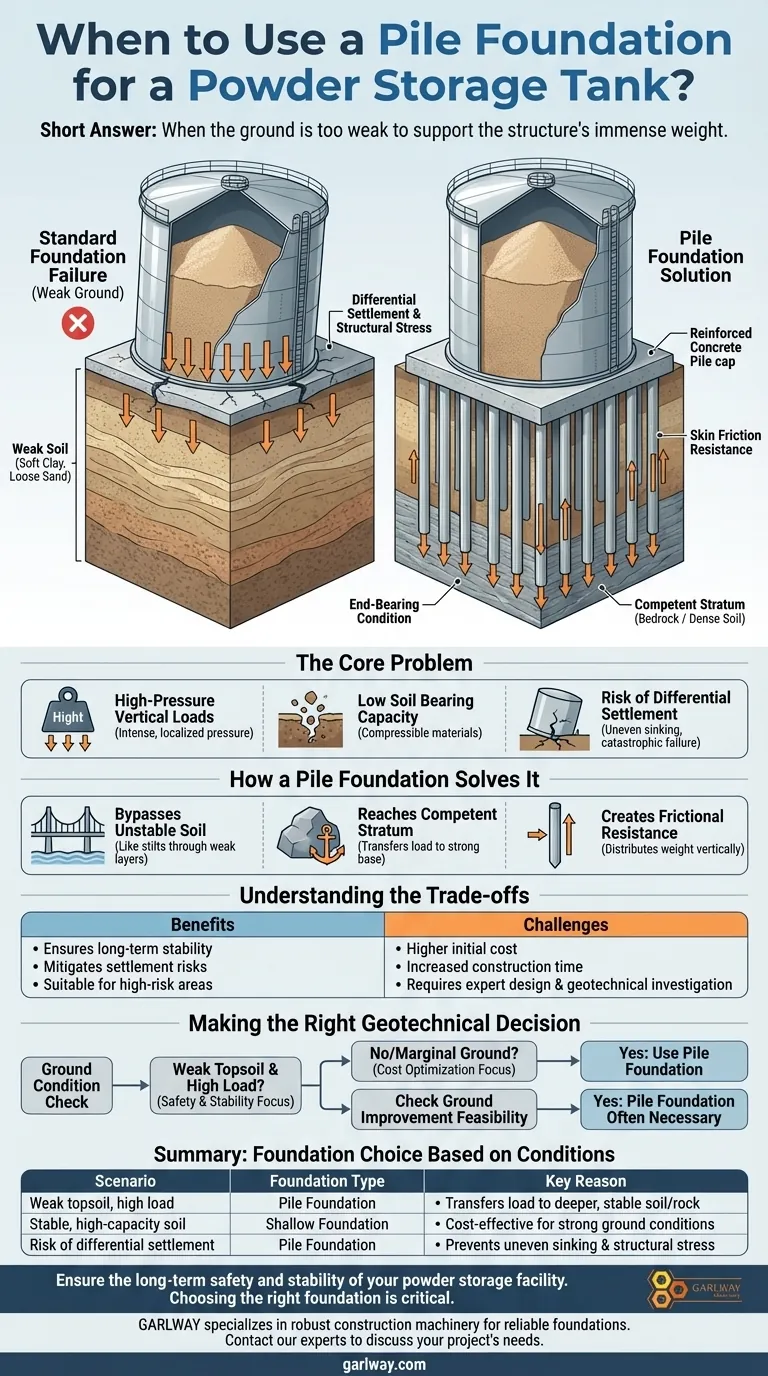
In short, a pile foundation is used for a powder storage tank when the ground directly beneath it is too weak to support the structure's immense weight. This solution becomes necessary when the shallow soil layers cannot meet the required bearing capacity and settlement criteria, and alternative ground improvement techniques are not viable.
A powder storage tank concentrates a massive load onto a relatively small footprint. When the upper soil is weak, a pile foundation acts as a critical structural bridge, bypassing the unstable layers to transfer that load safely to a stronger, deeper stratum of soil or rock.
The Core Problem: Why Standard Foundations Can Fail
A powder storage tank presents a unique challenge for foundation design. Unlike a typical building that distributes its weight over a wide area, a tank creates intense, localized pressure on the soil beneath it.
High-Pressure Vertical Loads
Powder storage tanks are exceptionally heavy for their size. This creates a high-pressure load that can easily exceed the natural strength, or bearing capacity, of the topsoil layers.
Low Soil Bearing Capacity
Many construction sites have shallow soil composed of soft clay, loose sand, or undocumented fill. These materials are compressible and weak, making them incapable of supporting heavy, concentrated loads without significant risk.
The Risk of Differential Settlement
The most critical risk is differential settlement, where one side of the foundation sinks more than the other. This uneven movement can induce catastrophic stress on the tank's shell, attached piping, and support equipment, leading to structural failure.
How a Pile Foundation Solves the Problem
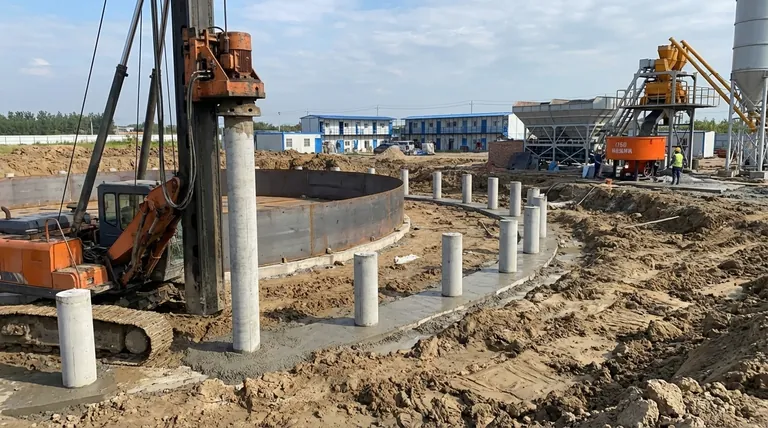
A pile foundation is an engineering solution designed to completely bypass weak surface soils. It functions by creating deep, column-like supports that transfer the tank's weight to a competent geological layer far below the surface.
Bypassing Unstable Soil
Piles are long, slender elements driven or drilled deep into the ground. They effectively act like stilts, passing through the weak upper layers of clay or sand that would otherwise cause settlement issues.
Reaching a Competent Stratum
The primary goal is for the piles to reach a layer of dense soil or solid bedrock. The load from the tank travels down the piles and is supported by this strong layer, known as an end-bearing condition. This provides a solid and unyielding base.
Creating Frictional Resistance
In cases where bedrock is extremely deep, piles can also derive support from the friction between the sides of the pile and the surrounding soil. This skin friction along the length of the piles helps to hold the load, distributing the weight vertically into the ground.
Understanding the Trade-offs
While effective, a pile foundation is not a default solution. It represents a significant investment and introduces complexity that must be carefully weighed.
Higher Initial Cost
Pile foundations are substantially more expensive than simple shallow foundations. The cost includes specialized labor, heavy machinery for driving or drilling, and the material cost of the piles themselves.
Increased Construction Time
The process of installing piles is time-consuming and can add significant time to the overall project schedule. It requires careful planning and coordination.
The Need for Expert Design
The design of a pile foundation is highly technical and depends entirely on the accuracy of the site's geotechnical investigation (soil report). An error in calculating pile depth, spacing, or capacity can lead to a costly and dangerous failure.
Making the Right Geotechnical Decision
The choice of foundation is a critical engineering decision based on a thorough analysis of the ground conditions and structural requirements.
- If your primary focus is absolute safety and long-term stability: Use a pile foundation whenever the geotechnical report indicates weak, compressible, or variable soil conditions in the upper layers.
- If your primary focus is cost optimization on marginal ground: First, investigate if ground improvement techniques (like dynamic compaction or aggregate piers) are technically feasible and more cost-effective than a deep pile system.
- If your project is in a high-risk area (e.g., seismic zones or areas with a high water table): A pile foundation is often the only viable option, as it can be designed to resist lateral loads and hydrostatic uplift forces that would compromise a shallow foundation.
Ultimately, choosing the right foundation is a non-negotiable investment in the safety and operational integrity of your facility.
Summary Table:
| Scenario | Foundation Type | Key Reason |
|---|---|---|
| Weak topsoil, high load | Pile Foundation | Transfers load to deeper, stable soil/rock |
| Stable, high-capacity soil | Shallow Foundation | Cost-effective for strong ground conditions |
| Risk of differential settlement | Pile Foundation | Prevents uneven sinking and structural stress |
Ensure the long-term safety and stability of your powder storage facility. Choosing the right foundation is critical for preventing costly failures. GARLWAY specializes in providing robust construction machinery, including concrete batching plants and mixers, to support the construction of reliable industrial foundations. Our expertise helps global construction companies and contractors build with confidence on challenging sites. Contact our engineering experts today to discuss your project's specific needs and secure a stable foundation solution.
Visual Guide
Related Products
- Commercial Electric Concrete Mixer Machine HZS 50 Small Batch Plant for Sale
- Harbor Freight JS1500 On Site Concrete Mixing Volumetric Cement Mixer
- HZS35 Small Cement Concrete Mixing Batch Plant
- Concrete Cement Mixer Machine Drum Mixer for Construction
- Belle Cement Mixer JS2000 Volumetric Concrete Mixer for Harbor Freight
People Also Ask
- What are the types of concrete mixers used in batching plants? Choose the Right Mixer for Your Project
- What is the core component of a concrete batching plant? The Mixer Unit Defines Your Concrete Quality
- Why is proper maintenance important for a concrete batch mix plant? Maximize Uptime & Profitability
- Why buy concrete batch plant parts only from the manufacturer? Protect Your Investment and Maximize Uptime
- What are the two main types of concrete batch mixers? Choose the Right Mixer for Your Project







