The anchor type exclusively recommended for only the smallest, most lightweight boats is the mushroom anchor. Its unique design is intended for personal watercraft, small aluminum fishing boats, and dinghies, where holding requirements are minimal and conditions are generally calm.
The core principle of anchoring is matching the anchor's design to the boat's size and the seabed conditions. A mushroom anchor relies on suction in soft bottoms, making it fundamentally unsuitable and unsafe for larger vessels that require an anchor to physically dig in and "set" for reliable holding power.
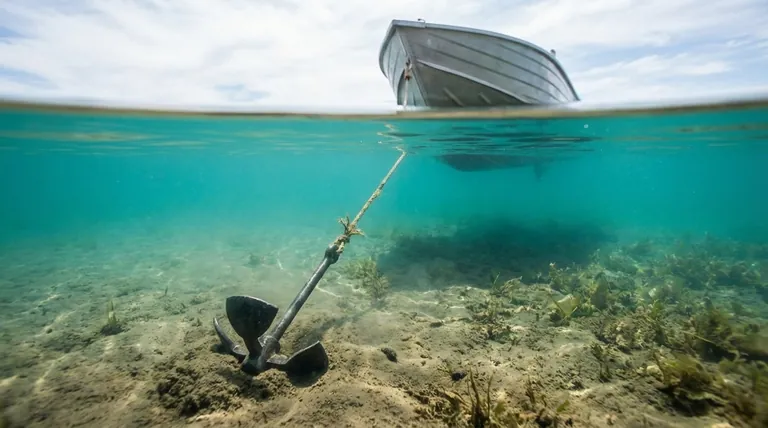
How a Mushroom Anchor Works (and Where It Fails)
The Principle of Suction
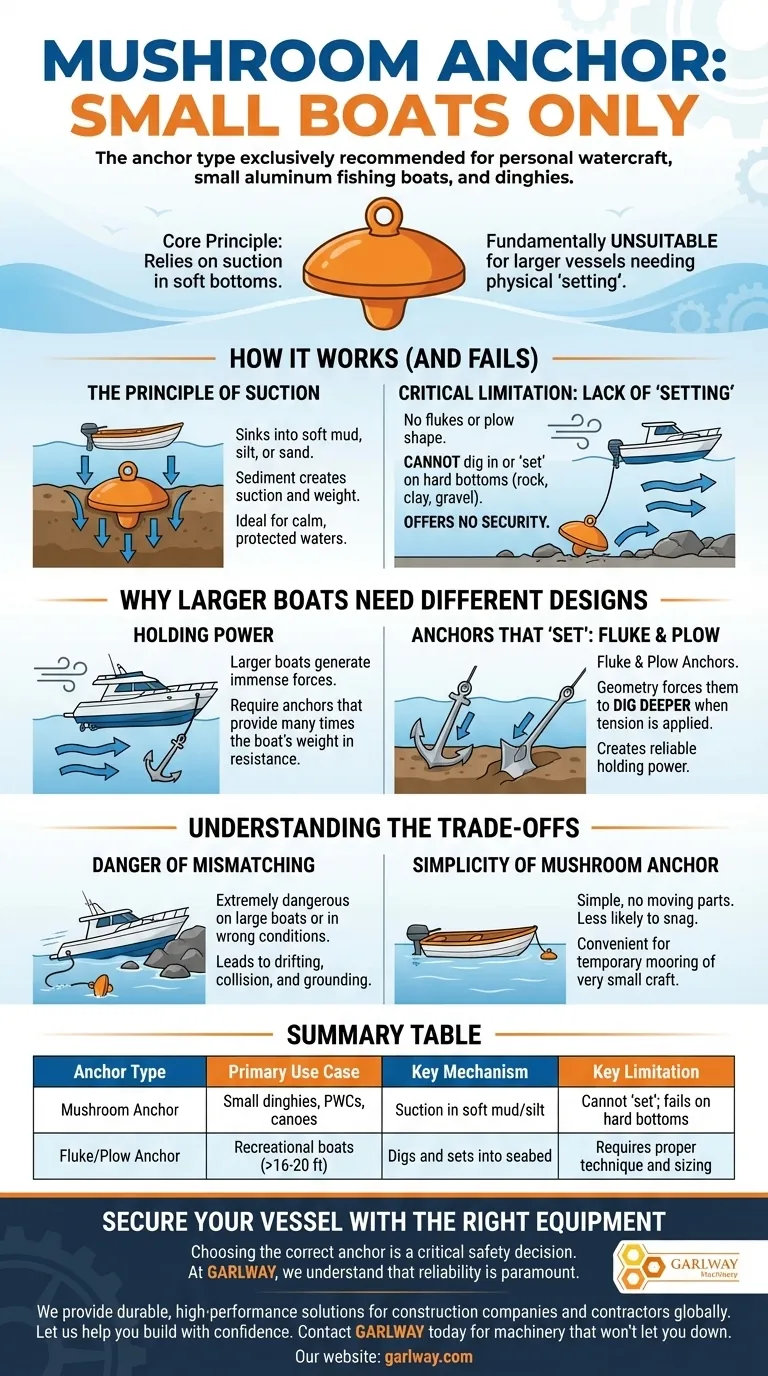
A mushroom anchor functions less like a hook and more like a suction cup. It is shaped like an inverted mushroom, designed to sink into soft mud, silt, or sand.
Over time, sediment settles on top of the "cap," creating suction and weight that helps hold it in place. This is its primary holding mechanism.
Ideal Conditions: Soft Bottoms and Calm Waters
This design is effective only under very specific circumstances. It requires a soft, consistent bottom where it can bury itself completely.
It is also intended for use in calm, protected waters where the boat will not be subjected to significant wind or current.
The Critical Limitation: Lack of "Setting"
The mushroom anchor's greatest weakness is its inability to "set." Unlike modern anchor designs, it does not have flukes or a plow shape to dig into the seabed when pulled horizontally.
On hard bottoms like rock, clay, or gravel, it has virtually no holding power. It will simply skip along the bottom, offering no security for your vessel.
Why Larger Boats Need a Different Design
The Concept of Holding Power
Holding power is the measure of an anchor's ability to resist being dragged. For any vessel larger than a dinghy, this is the most critical factor in anchor selection.
Larger, heavier boats generate immense forces from wind and current. They require an anchor that can generate many times the boat's own weight in resistance.
Anchors That "Set": Fluke and Plow Designs
The vast majority of recreational boats use anchors designed to set. When tension is applied to the anchor line, their geometry forces them to dig deeper into the seabed.
Common examples include the fluke anchor (like a Danforth), which excels in sand and mud, and the plow anchor (like a Delta), which is a versatile performer in various bottom types. This digging action is what creates reliable holding power.
Understanding the Trade-offs
The Danger of Mismatching Your Anchor
Using a mushroom anchor on a boat that is too large or in the wrong conditions is extremely dangerous. An anchor that cannot set will drag.
This can lead to your boat drifting into hazards, onto shore, or into other vessels, particularly if the weather changes unexpectedly. Safety is the primary reason for this strict size limitation.
The Simplicity of the Mushroom Anchor
The mushroom anchor does have advantages for its intended purpose. It is simple, with no moving parts to jam or break.
Its smooth shape is less likely to snag on underwater debris or foul on its own line, making it a convenient option for temporary mooring of a very small craft.
Making the Right Choice for Your Vessel
Choosing an anchor isn't about finding the single "best" one; it's about understanding the demands your boat will place on it.
- If your primary focus is a personal watercraft, dinghy, or canoe: A mushroom anchor is a suitable and simple choice for temporary use in calm, soft-bottom locations.
- If your primary focus is a recreational boat over 16-20 feet: You must use an anchor designed to set, such as a fluke, plow, or claw style anchor, sized appropriately for your vessel's length and displacement.
- If your primary focus is anchoring with maximum security: Always choose a modern, setting-style anchor and learn the proper technique for deploying it to ensure it digs in securely.
Selecting the right anchor is a critical safety decision based on a clear understanding of your boat and the environments you will face.
Summary Table:
| Anchor Type | Primary Use Case | Key Mechanism | Key Limitation |
|---|---|---|---|
| Mushroom Anchor | Small dinghies, PWCs, canoes | Suction in soft mud/silt | Cannot "set" or dig in; fails on hard bottoms |
| Fluke/Plow Anchor | Recreational boats (>16-20 ft) | Digs and sets into seabed | Requires proper technique and sizing for boat |
Secure Your Vessel with the Right Equipment
Choosing the correct anchor is a critical safety decision. At GARLWAY, we understand that reliability is paramount, whether on water or a construction site. Just as a mushroom anchor is purpose-built for a small dinghy, our construction machinery—including robust winches, efficient concrete mixers, and high-capacity batching plants—is engineered to meet the specific demands of your projects.
We provide durable, high-performance solutions for construction companies and contractors globally. Let us help you build with confidence.
Contact GARLWAY today for a consultation on machinery that won't let you down.
Visual Guide
Related Products
- Electric Hoist Winch Boat Anchor Windlass for Marine Applications
- 12000 lb Electric Boat Trailer Winch with Windlass Anchor Warn
- Best 18000 Pound Drum Anchor Trailer Winch
- Heavy Duty Electric Boat Winch Windlass Anchor
- Small Electric Winch 120V and 240V for Compact Applications
People Also Ask
- How does an electric anchor winch work? Power, Safety, and Reliable Operation Explained
- What are the advantages of installing an electric anchor winch on a boat? Boost Safety & Ease for Boaters
- What are the operational differences between electric hoists and winches? A Guide to Safe Lifting vs. Pulling
- What are the main benefits of a boat anchor winch? Boost Safety & Efficiency for Your Vessel
- How does a boat anchor winch work? A Guide to Reliable Anchor Handling