
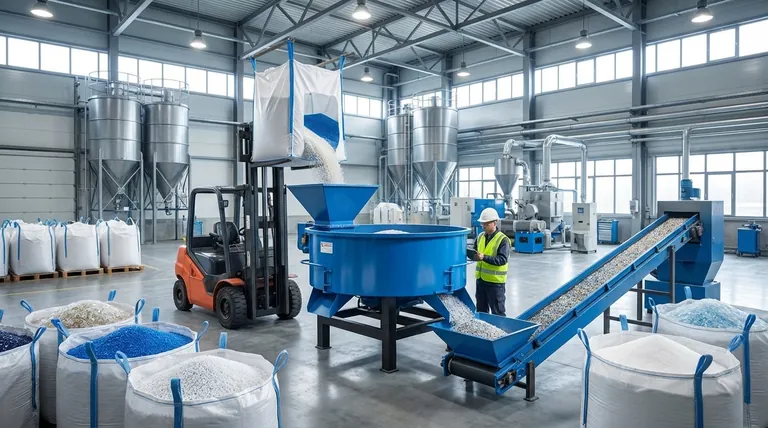
In large-scale industrial applications, drum blenders are primarily used for mixing a specific class of solid, free-flowing materials. These typically include pellets, granules, and powders commonly found in the plastics, petrochemical, and agrochemical sectors. Key examples are fluoropolymers, plastic additives, specialty compounds, and granulated agricultural products.
The core principle is gentle, low-shear mixing. Drum blenders excel where the primary goal is to achieve a consistent, homogeneous batch without breaking down or altering the physical structure of the materials being combined.
The Principle: Why Drum Blenders Excel with Solids
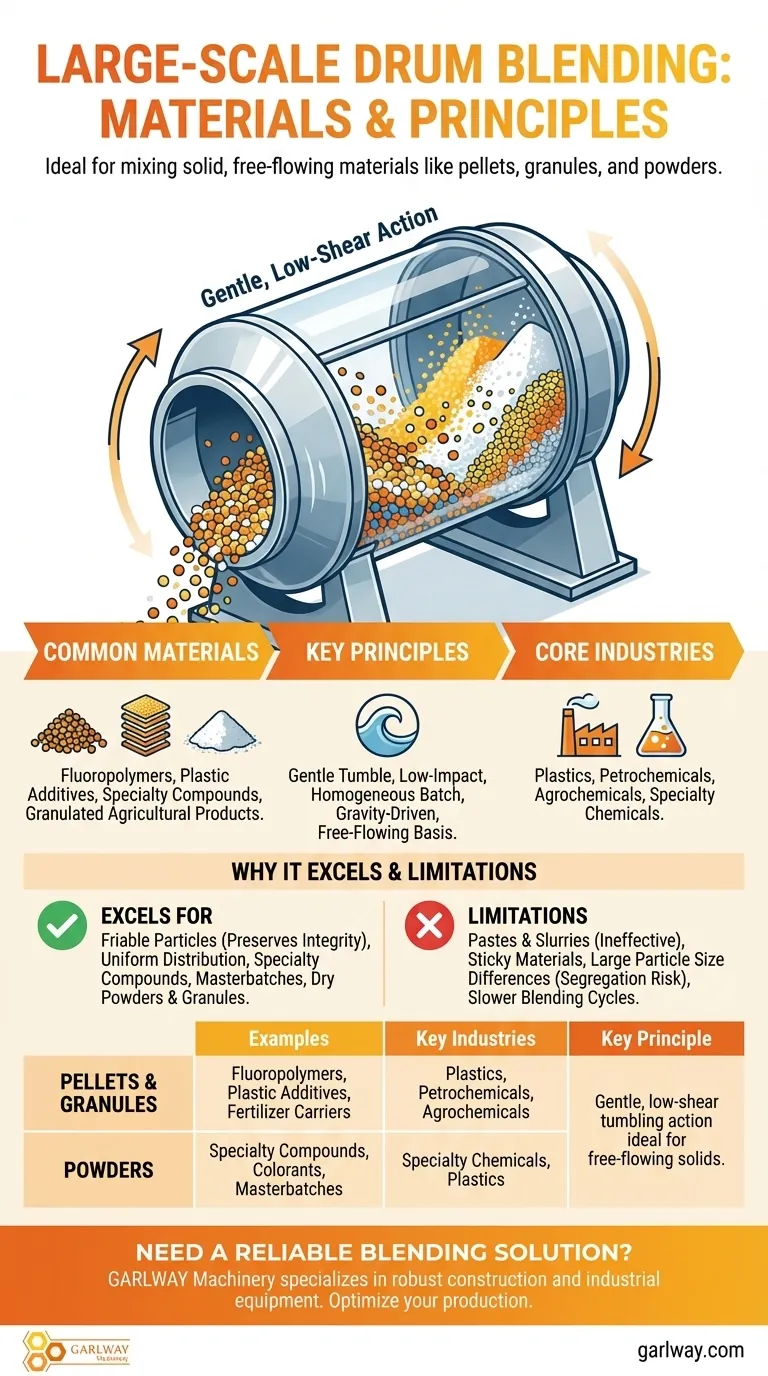
Drum blenders, also known as tumble blenders, operate on a simple yet highly effective mechanism. The rotation of the drum lifts the material until the angle of repose is exceeded, causing the top layer to cascade or tumble down. This process is repeated, creating a gentle yet thorough mixing action.
Gentle, Low-Shear Action
The tumbling motion is inherently low-impact. This is critical for friable materials—those that are brittle or easily crumbled—such as plastic pellets or coated granules.
High-shear mixers could fracture these particles, creating unwanted dust and altering the material's bulk density and flow characteristics.
Homogeneous Batch Mixing
Drum blenders are ideal for creating a uniform mixture within a contained batch. Every rotation contributes to the even distribution of all components.
This is essential for specialty compounds or plastic masterbatches, where precise and consistent ratios of additives, colorants, and base polymers are required for the final product's quality.
Handling Free-Flowing Materials
The entire process relies on gravity and the ability of the materials to flow and tumble over one another. This makes drum blenders perfectly suited for dry powders, granules, and pellets that do not clump or stick together.
A Closer Look at Common Applications
The suitability of drum blenders becomes clear when examining their use cases in major industries.
Plastics and Petrochemicals
This is the most common application area. Materials like fluoropolymers, vinyl composite cubes, and plastic additives are frequently blended.
The goal is often to uniformly distribute small amounts of critical additives (like UV stabilizers, colorants, or flame retardants) throughout a large volume of a base polymer resin without damaging the pellets.
Specialty and Agrochemical Compounds
In agrochemical production, drum blenders ensure that active ingredients are evenly mixed into a carrier granule, such as in fertilizers or pesticides.
For other specialty compounds, the repeatable, contained process guarantees that each batch meets exact formulation specifications, which is crucial for high-value products.
Understanding the Trade-offs and Limitations
While effective, drum blenders are not a universal solution. Their specific design creates clear operational boundaries.
Not for Pastes or Slurries
The tumbling action is completely ineffective for liquids, thick pastes, or sticky materials. These require high-shear forces to combine, which a drum blender cannot generate.
Difficulty with Vastly Different Particles
Mixing materials with significant differences in particle size, shape, or density can be challenging. Lighter, smaller particles may not distribute evenly among much heavier, larger ones, a phenomenon known as segregation.
Slower Blending Cycles
Compared to high-intensity ribbon or paddle mixers, the gentle action of a drum blender can result in longer mixing times to achieve the desired level of homogeneity. This is the direct trade-off for preserving particle integrity.
Making the Right Choice for Your Goal
The decision to use a drum blender should be driven by the properties of your materials and the non-negotiable requirements of your final product.
- If your primary focus is preserving particle integrity: A drum blender is an excellent choice for friable pellets, coated granules, or delicate crystalline powders.
- If your primary focus is achieving batch-to-batch consistency for dry formulas: The contained, repeatable action of a drum blender ensures high uniformity for specialty compounds and masterbatches.
- If your primary focus is speed or mixing sticky/liquid components: You must explore high-shear alternatives like ribbon blenders, paddle mixers, or intensive mixers.
Ultimately, understanding the gentle, low-impact nature of drum blending is the key to leveraging it effectively for the right application.
Summary Table:
| Material Type | Common Examples | Key Industries |
|---|---|---|
| Pellets & Granules | Fluoropolymers, Plastic Additives, Fertilizer Carriers | Plastics, Petrochemicals, Agrochemicals |
| Powders | Specialty Compounds, Colorants, Masterbatches | Specialty Chemicals, Plastics |
| Key Principle | Gentle, low-shear tumbling action ideal for free-flowing solids. |
Need a reliable blending solution for your large-scale operations?
GARLWAY specializes in providing robust construction and industrial machinery. For construction companies and contractors globally who require dependable equipment for material handling and processing, our range of products—including winches, concrete mixers, and concrete batching plants—is engineered for performance and durability.
Let us help you optimize your production process. Contact our experts today to discuss your specific needs and discover the right machinery for your project.
Visual Guide
Related Products
- Concrete Cement Mixer Machine Drum Mixer for Construction
- Belle Mixer Drum Self Loading Mortar Mixers JS3000
People Also Ask
- What are the key advantages of using drum mixers in concrete mixing? Boost Volume & Efficiency on Your Site
- What are the key components that maintain concrete mix consistency in the drum? Ensure Uniform Quality from Plant to Site
- How do cement mixers enhance safety on construction sites? Reduce Strain, Hazards, and Accidents
- When was the first concrete mixer developed and by whom? Discover the 1900 Breakthrough
- What is the average lifespan of a concrete mixer? Maximize Your Equipment's Lifespan & ROI

