
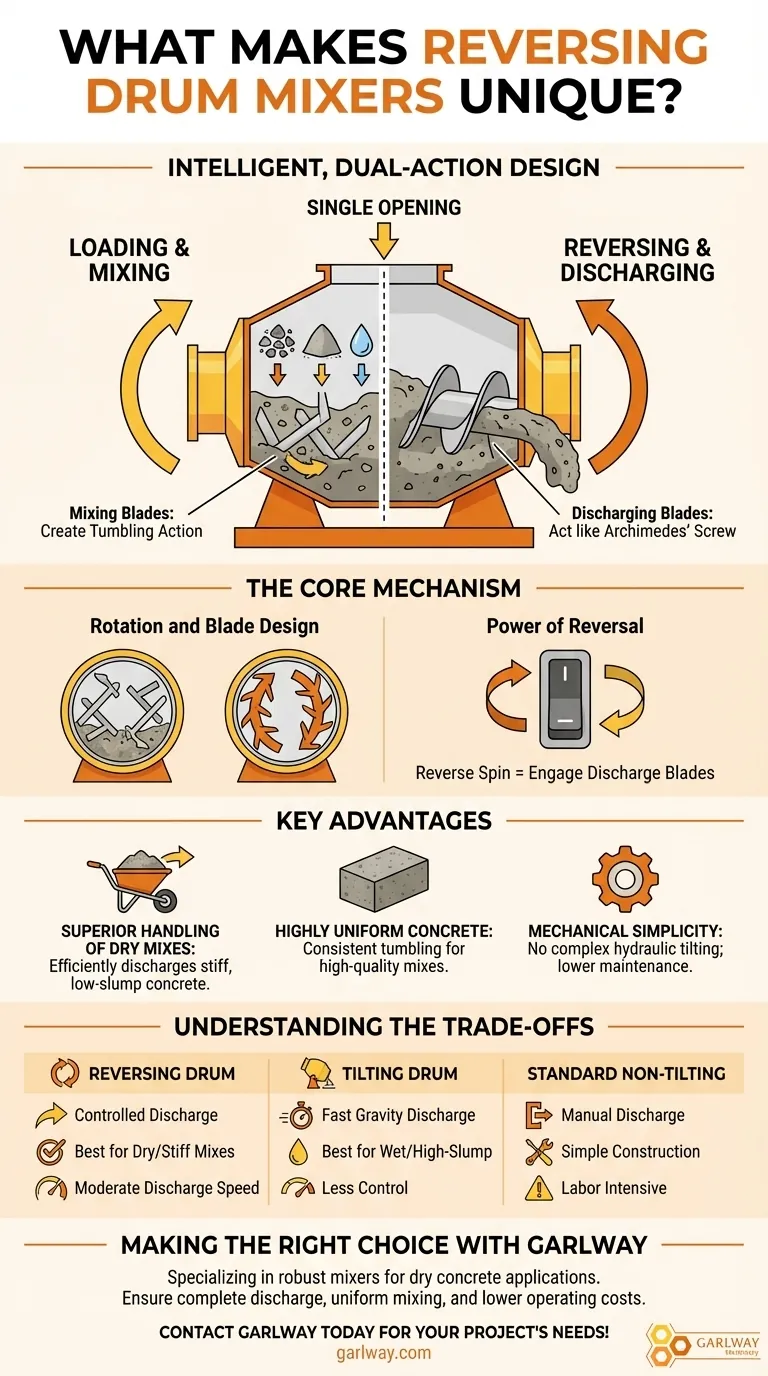
At its core, a reversing drum mixer is unique because of its intelligent, dual-action design. It uses a single opening for both loading materials and discharging the final mix, differentiating itself by changing the direction of the drum's rotation to switch between these two functions.
The crucial innovation of the reversing drum mixer is its ability to provide automated, controlled discharge without a separate tilting mechanism. It achieves this by using two sets of internal blades—one for mixing and one for discharging—activated simply by reversing the drum's spin.
The Core Mechanism: Rotation and Blade Design
To grasp what makes this mixer effective, you must understand how its components work together. The design prioritizes mechanical simplicity to solve the challenge of getting concrete out of the drum efficiently.
A Single Opening for Dual Functions
Unlike some other designs, the reversing drum mixer uses the same aperture for charging and discharging. All raw materials (cement, aggregate, water) go in, and the finished concrete comes out, all through one opening. This streamlines the overall construction of the machine.
The Power of Reversal
The operational principle is straightforward. When the drum rotates in one direction (typically clockwise), a set of mixing blades lifts and tumbles the materials to create a homogenous concrete mix.
When the mixing is complete, the direction of rotation is simply reversed. This change in direction engages a second set of blades, initiating the discharge process.
Two Sets of Blades, Two Distinct Jobs
The internal architecture is key. Reversing drum mixers contain two distinct sets of helical blades engineered for different tasks:
- Mixing Blades: These are designed to lift material up the side of the drum and let it fall, creating the necessary tumbling action for thorough mixing.
- Discharging Blades: These blades are angled in the opposite direction. When the drum reverses, they catch the concrete and act like an Archimedes' screw, pushing the mix out of the opening in a controlled, steady flow.
Why This Design Matters: Key Advantages
The reversing mechanism isn't just a clever feature; it provides tangible benefits that make it the ideal choice for specific applications, particularly those involving less workable concrete.
Superior Handling of Dry Mixes
This is the reversing drum's most significant advantage. Dry, stiff, or low-slump concrete mixes do not flow easily. A simple tilting mixer can struggle to empty completely, leaving material behind.
The screw-like action of the reversing drum's discharge blades actively forces the material out, ensuring a complete and efficient discharge even with the driest mixes.
Producing Highly Uniform Concrete
The blade design and consistent tumbling action are highly effective at creating an extremely uniform and consistent concrete mix. This holds true for both wet and dry formulations, making the mixer a versatile tool for producing high-quality concrete.
Mechanical Simplicity
By eliminating the need for a heavy and complex hydraulic tilting system, the reversing drum mixer maintains a relatively simple and robust design. As with other drum mixers, this generally leads to lower operating costs, easier maintenance, and fewer potential points of failure.
Understanding the Trade-offs
No single design is perfect for every job. The reversing drum mixer's strengths define its ideal use cases, but it's important to understand its context compared to other mixers.
vs. Tilting Drum Mixers
A tilting drum mixer discharges its contents quickly by gravity. This can be very fast for high-slump, wet mixes. However, it offers less control than a reversing drum, and as mentioned, can be less effective for stiff mixes. The reversing drum offers a more controlled and predictable flow rate during discharge.
vs. Standard Non-Tilting Mixers
A basic non-tilting mixer without a reversing function is simpler but far less efficient. Discharging it often requires significant manual labor to shovel the concrete out. The reversing drum is a major upgrade, automating the unloading process entirely.
Making the Right Choice for Your Project
Selecting the correct mixer depends entirely on the type of concrete you produce and the scale of your operation.
- If your primary focus is dry, stiff, or low-slump concrete: The reversing drum mixer is the ideal choice due to its superior, powered discharge capability.
- If your primary focus is high-volume, wet concrete batches: A large tilting drum mixer might offer faster discharge cycles.
- If your primary focus is maximum simplicity for small jobs: A basic non-tilting mixer is the simplest but requires manual unloading.
Ultimately, the reversing drum mixer offers a sophisticated solution that combines design simplicity with highly effective, controlled material handling.
Summary Table:
| Feature | Advantage |
|---|---|
| Dual-Action Blades | One set for mixing, one for discharging by reversing drum rotation. |
| Single Opening Design | Streamlined charging and discharging through the same aperture. |
| Superior for Dry Mixes | Powered discharge ensures complete emptying of stiff, low-slump concrete. |
| Mechanical Simplicity | No complex hydraulics; robust design for easier maintenance. |
| Uniform Mix Quality | Consistent tumbling action produces high-quality, homogenous concrete. |
Need a reliable mixer for demanding dry concrete applications?
GARLWAY specializes in construction machinery, offering robust and efficient reversing drum concrete mixers designed for construction companies and contractors who require superior performance with low-slump mixes. Our mixers ensure complete discharge, uniform mixing, and lower operating costs.
Contact GARLWAY today to find the perfect mixing solution for your project's needs!
Visual Guide
Related Products
- Belle Mixer Drum Self Loading Mortar Mixers JS3000
- Concrete Cement Mixer Machine Drum Mixer for Construction
- Portable Cement Mixer with Lift Concrete Machine
People Also Ask
- What are the features of mobile transporting in a self loading mixer? Boost On-Site Efficiency
- Why is timely cleaning important for a self loading mixer? Prevent Costly Downtime and Mix Failure
- How is discharging accomplished in a self loading mixer? Master Precise Concrete Placement
- What is the purpose of keeping the drum rotating during transportation in a self loading concrete mixer? Ensure Quality & Consistency
- What components are involved in the loading process of a self loading concrete mixer? A Guide to the Key Systems


