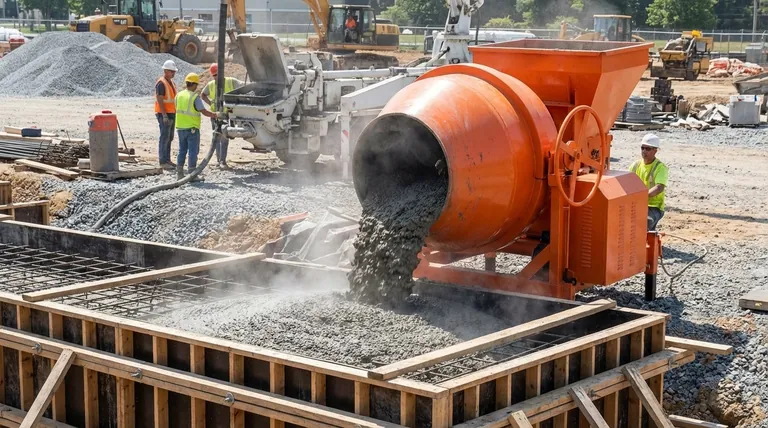
The primary purpose of a tilting drum concrete mixer is to provide the fastest and most complete method of discharging concrete. Its entire design is centered around rapidly emptying the drum by tilting it downwards, using gravity to ensure the entire batch is deployed quickly and without the materials separating.
The key advantage of a tilting drum mixer isn't just about mixing; it's about the discharge. By using gravity for a rapid, wholesale pour, it minimizes discharge time and prevents the segregation of materials, ensuring a high-quality, uniform concrete mix is delivered where it's needed.
The Core Mechanism: How Tilting Achieves Its Purpose
A tilting mixer's value is best understood by looking at its fundamental design, which directly contrasts with non-tilting (or reversing) models.
Gravity-Assisted Discharge
The defining feature is the pivoting drum. After the concrete is homogeneously mixed, the entire drum is tilted downwards.
This simple mechanical action allows gravity to do all the work, causing the mixed concrete to pour out of the single opening at the front.
Speed and Efficiency
This method is exceptionally fast and efficient. Discharging a full batch can be done in a matter of seconds.
This speed is critical on job sites where time is a key factor, such as for larger or continuous pours where a steady supply of concrete is required.
Preserving Mix Quality
A rapid, wholesale discharge prevents segregation. Segregation occurs when heavier aggregates separate from the cement paste, compromising the concrete's strength and consistency.
By emptying the entire load at once, the tilting mixer ensures the concrete remains a uniform mixture from the drum to the formwork.
Key Operational Advantages
The design of a tilting drum mixer leads to several practical benefits during operation on a construction site.
Handling Diverse and Difficult Mixes
Tilting mixers are highly effective for blending plastic and semi-dry concrete.
Their powerful discharge action also makes them well-suited for mixes containing large-sized aggregates, which can be difficult to empty from other types of mixers.
Simplified Operation and Cleaning
The tilting mechanism requires less manual effort to unload compared to other designs, making the process simpler for the operator.
Furthermore, the wide opening and ability to tilt the drum to various angles make it significantly easier to clean out residual concrete, which is crucial for long-term maintenance.
Understanding the Trade-offs and Applications
No single piece of equipment is perfect for every job. Understanding where a tilting mixer excels—and where another type might be better—is crucial.
Tilting vs. Non-Tilting (Reversing) Mixers
The primary alternative is the non-tilting or reversing drum mixer. This type discharges concrete more slowly by reversing the direction of the drum's rotation.
While a reversing mixer can offer more controlled, partial discharge, it is slower and less effective for stiff or large aggregate mixes. The tilting mixer's strength lies in its speed and complete evacuation.
Small vs. Large Projects
You will see tilting mixers on both small and large-scale projects, which can seem contradictory. The key is not the project size, but the type of pour.
For large, continuous pours, the rapid discharge is essential. For smaller projects, the mechanical simplicity and efficiency of smaller tilting models make them a popular and reliable choice.
Making the Right Choice for Your Project
Selecting the correct mixer depends entirely on the demands of your specific application.
- If your primary focus is speed and high volume: The tilting drum mixer is the superior choice for its rapid, full-batch discharge capability.
- If your primary focus is handling stiff, low-slump, or large-aggregate concrete: The forceful, gravity-assisted discharge of a tilting mixer ensures a complete and clean evacuation.
- If your primary focus is a slow, highly controlled partial pour: A non-tilting (reversing) drum mixer may offer more precision for smaller, incremental applications.
Understanding this core principle of discharge is the key to selecting the most effective mixer for your construction goals.
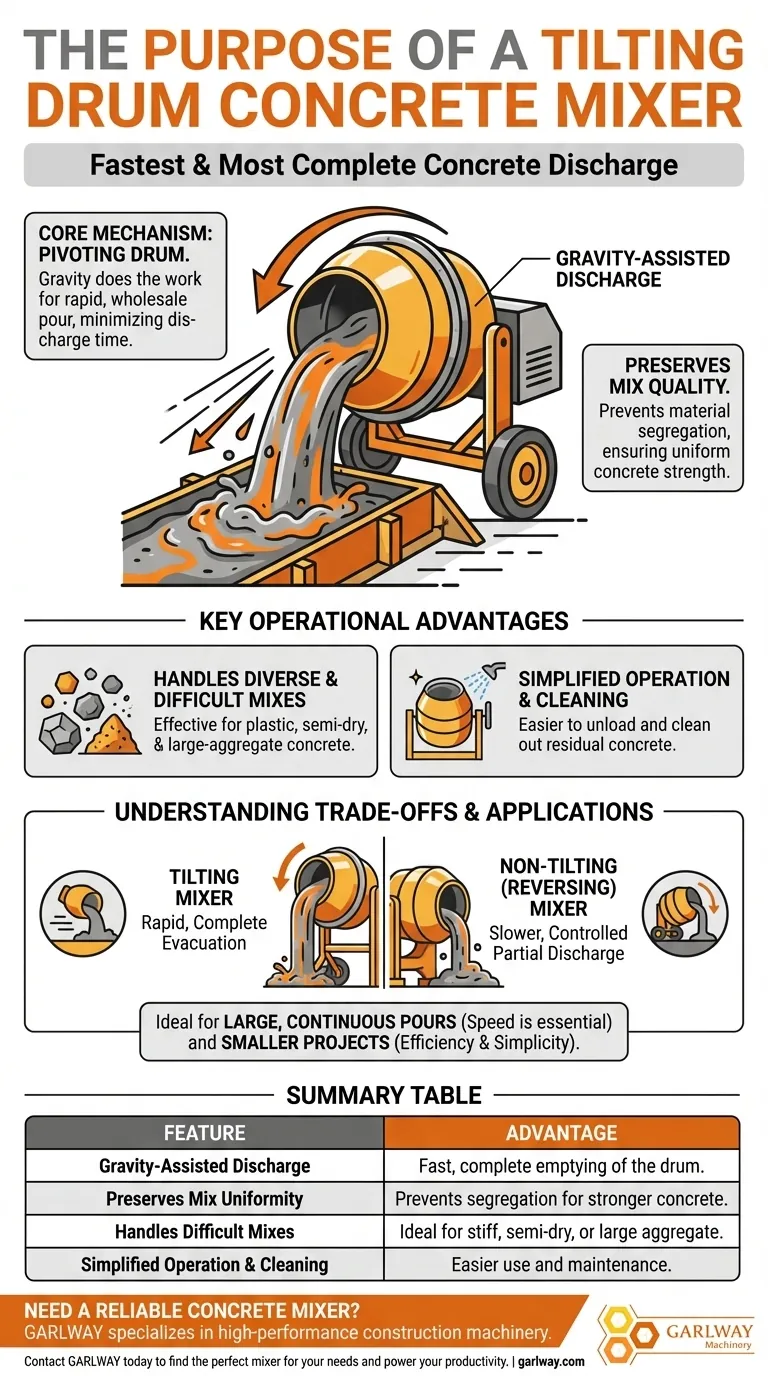
Summary Table:
| Feature | Advantage |
|---|---|
| Gravity-Assisted Discharge | Fast, complete emptying of the drum. |
| Preserves Mix Uniformity | Prevents material segregation for stronger concrete. |
| Handles Difficult Mixes | Ideal for stiff, semi-dry, or large-aggregate concrete. |
| Simplified Operation & Cleaning | Easier to use and maintain on the job site. |
Need a reliable concrete mixer for your next project?
GARLWAY specializes in high-performance construction machinery, including robust tilting drum concrete mixers designed for contractors and construction companies worldwide. Our equipment ensures efficient, high-quality concrete production, helping you complete projects faster and to a higher standard.
Contact GARLWAY today to find the perfect mixer for your specific needs and discover how we can power your productivity.
Visual Guide
Related Products
- Concrete Cement Mixer Machine Drum Mixer for Construction
- Belle Mixer Drum Self Loading Mortar Mixers JS3000
- Portable Cement Mixer with Lift Concrete Machine
- Portable Concrete Mixer Machine Equipment for Mixing Concrete
- Skid Steer Self Loading Concrete Mixers for Construction
People Also Ask
- What are the key advantages of using drum mixers in concrete mixing? Boost Volume & Efficiency on Your Site
- What are the key components that maintain concrete mix consistency in the drum? Ensure Uniform Quality from Plant to Site
- How do cement mixers enhance safety on construction sites? Reduce Strain, Hazards, and Accidents
- When was the first concrete mixer developed and by whom? Discover the 1900 Breakthrough
- What is the average lifespan of a concrete mixer? Maximize Your Equipment's Lifespan & ROI