
At its core, a limit switch in a wire rope hoist is a critical safety and operational control device. It automatically cuts power to the hoist's motor when the hook reaches a pre-set upper or lower boundary. This action prevents the wire rope from traveling too far in either direction, which protects the hoist from damage and the rope from tangling or snapping.
The function of a limit switch is to define the safe vertical travel range of a hoist. By automatically halting the motor at the top and bottom limits, it serves as the primary defense against over-hoisting and over-lowering failures.
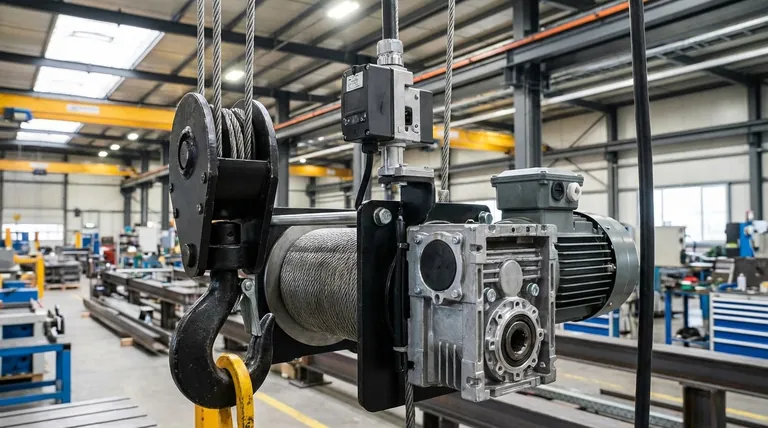
How a Hoist's Design Demands Limit Switches
To understand why limit switches are indispensable, it's helpful to look at the basic mechanics of a wire rope hoist.
The Core Mechanical Drive
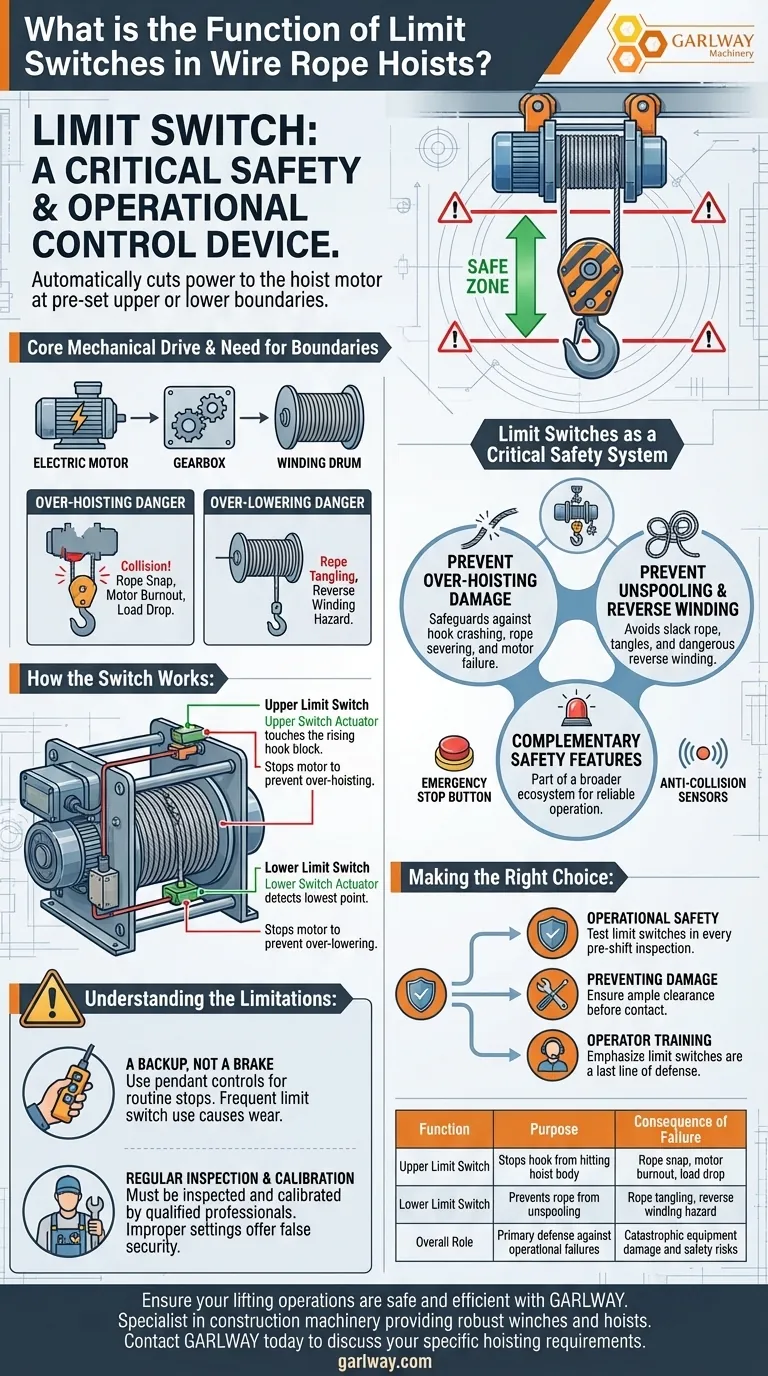
An electric motor provides the power, but its high speed and low torque are not suitable for heavy lifting. A gearbox amplifies this torque, driving a shaft that turns the winding drum. The wire rope wraps around this drum to lift or lower the load.
The Need for Boundaries
Without an automatic stop, an operator could accidentally continue hoisting until the hook block collides with the hoist body. This is known as over-hoisting.
Conversely, an operator could lower the load until the rope completely unwinds from the drum, a dangerous condition called over-lowering. Limit switches are designed to prevent both scenarios.
How the Switch Works
The hoist is configured with an upper and a lower limit switch. When the rising hook block makes contact with the upper switch's actuator, the electrical circuit to the motor is broken, and the hoist stops. The same process occurs when the hook reaches the pre-defined lowest point, triggering the lower limit switch.
Limit Switches as a Critical Safety System
While simple in function, limit switches are part of a broader ecosystem of safety features that ensure reliable operation in demanding environments like construction, manufacturing, and mining.
Preventing Over-Hoisting Damage
If a hoist travels too high, the hook block can crash into the drum or hoist frame. This can fray or sever the wire rope, damage the drum, and potentially cause the motor to burn out, leading to catastrophic failure and load drop. The upper limit switch is the essential safeguard against this event.
Preventing Unspooling and Reverse Winding
If a hoist travels too low, the wire rope can completely unspool from the drum. This can cause the rope to become slack and tangled. More dangerously, it could lead to the rope winding back onto the drum in the wrong direction, creating a severe operational hazard. The lower limit switch prevents this.
Complementary Safety Features
Limit switches do not work in isolation. They are complemented by other devices like an emergency stop button, which allows an operator to halt all motion immediately in an unforeseen circumstance. Many systems also use anti-collision sensors to prevent hoists on the same track from hitting each other.
Understanding the Limitations
While crucial, limit switches are not foolproof. Their effectiveness depends entirely on proper maintenance and operation.
A Backup, Not a Brake
Limit switches should be treated as an emergency backup, not a routine method for stopping the hoist. Operators should always use the standard pendant controls to stop the lift. Regularly hitting the limit switches can cause premature wear on the components.
The Need for Regular Inspection
Like any mechanical or electrical component, limit switches can fail due to wear, damage, or environmental factors. They must be included in regular pre-use inspections and preventative maintenance schedules to ensure they are functioning correctly.
Proper Configuration is Key
An improperly set limit switch offers a false sense of security. If the upper limit is set too high or the lower limit too low, the switch will not be able to prevent equipment damage. Calibration should only be performed by a qualified technician.
Making the Right Choice for Your Goal
Understanding the role of limit switches is fundamental to ensuring a safe and efficient lifting environment.
- If your primary focus is operational safety: Treat the testing of upper and lower limit switches as a non-negotiable step in every pre-shift hoist inspection.
- If your primary focus is preventing equipment damage: Ensure your limit switches are calibrated to stop the hook with ample clearance before it can contact the hoist body or before the last few wraps of rope leave the drum.
- If your primary focus is operator training: Emphasize that limit switches are a last line of defense, and reliance on them for normal operation is a sign of improper hoist use.
Ultimately, viewing the limit switch as an integral part of the hoist's control system is key to maximizing both safety and equipment longevity.
Summary Table:
| Function | Purpose | Consequence of Failure |
|---|---|---|
| Upper Limit Switch | Stops hook from hitting hoist body | Rope snap, motor burnout, load drop |
| Lower Limit Switch | Prevents rope from unspooling | Rope tangling, reverse winding hazard |
| Overall Role | Primary defense against operational failures | Catastrophic equipment damage and safety risks |
Ensure your lifting operations are safe and efficient with GARLWAY.
As a specialist in construction machinery, we provide robust winches and hoists equipped with critical safety systems like limit switches. Our equipment is designed for the demanding needs of construction companies and contractors globally, helping you prevent costly downtime and accidents.
Contact GARLWAY today to discuss your specific hoisting requirements and learn how our solutions can protect your investment and your team.
Visual Guide
Related Products
People Also Ask
- How does an electric anchor winch work? Power, Safety, and Reliable Operation Explained
- What are the advantages of installing an electric anchor winch on a boat? Boost Safety & Ease for Boaters
- What are the operational differences between electric hoists and winches? A Guide to Safe Lifting vs. Pulling
- What are the main benefits of a boat anchor winch? Boost Safety & Efficiency for Your Vessel
- How does a boat anchor winch work? A Guide to Reliable Anchor Handling
