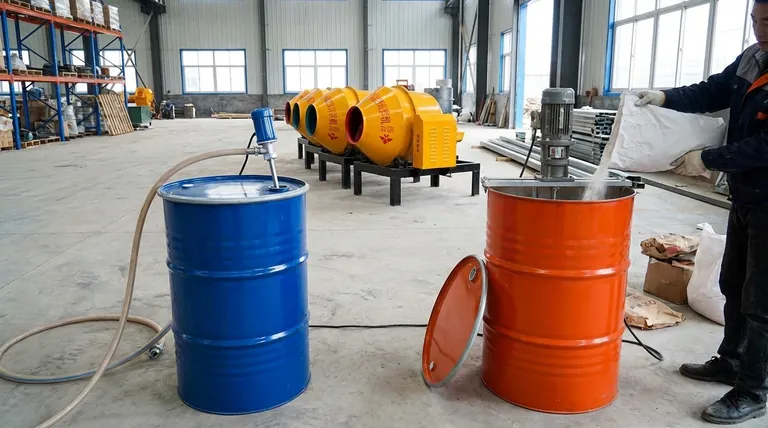
At its core, the difference between a closed head and an open head drum mixer comes down to how it accesses the drum's contents. Closed head mixers operate through the small, threaded bunghole of a sealed drum, while open head mixers require removing the entire lid and mount across the top of the drum.
The choice is a direct trade-off between containment and power. Closed head mixers prioritize a sealed environment for low-viscosity fluids, while open head mixers provide the power and access needed for more demanding mixing tasks.
The Core Design Difference: Access Point
The fundamental distinction between these two mixer types dictates their design, capabilities, and ideal use cases.
Closed Head Mixers: The "Bunghole" Approach
A closed head mixer is designed to work with a sealed 55-gallon drum.
Its impeller is small and often collapsible or foldable, allowing it to pass through the standard 2-inch bung opening. The mixer then mounts securely into the bung threads, keeping the drum sealed during operation.
Open Head Mixers: The "Full-Access" Method
An open head mixer is used with drums that have a removable lid.
The entire lid is taken off, and the mixer assembly, which often includes a mounting bracket or its own integrated lid, is placed directly on the drum's rim. This design allows for significantly larger and more robust impellers.
How Design Impacts Mixing Capability
The access method directly influences the mixer's performance and flexibility.
Mixing Power and Viscosity
Closed head mixers, with their smaller impellers, are ideal for low-to-medium viscosity liquids. They excel at maintaining a product's suspension or gently blending fluids.
Open head mixers deliver far more torque and shear force due to their larger impellers. This makes them necessary for mixing high-viscosity materials, thick pastes, or incorporating powders and solids into a liquid.
Process Flexibility
The sealed nature of closed head mixing is perfect for "closed-loop" processes. You can receive, mix, and dispense from a drum without ever exposing the contents to the air.
Open head mixers provide the flexibility to add ingredients during the mixing process. Because the top is accessible, you can easily introduce powders, aggregates, or other liquids as needed.
Understanding the Trade-offs
Choosing the right mixer means understanding the inherent compromises of each design.
Containment vs. Power
Closed head mixers offer superior containment. They are the clear choice for volatile, hazardous, or sensitive materials because they minimize vapor release, prevent contamination, and reduce operator exposure.
Open head mixers sacrifice containment for power. The open top allows for powerful mixing but also introduces the possibility of splashing, vapor release, and contamination if not managed properly.
Convenience and Setup
For a ready-to-go sealed drum, a closed head mixer is typically faster to set up. You simply screw the unit into the bung opening.
An open head mixer requires the extra steps of removing the drum's lid and ring, then securing the mixer assembly to the drum. This can be a more involved process.
Making the Right Choice for Your Application
Your specific material and process goals will determine the correct mixer.
- If your primary focus is safety and preventing contamination: A closed head mixer is the only choice for mixing in a sealed environment.
- If your primary focus is mixing thick materials or adding solids: The power and accessibility of an open head mixer are essential for the job.
- If your primary focus is re-blending settled, low-viscosity fluids in a sealed drum: A closed head mixer provides the most efficient and direct solution.
Ultimately, selecting the right drum mixer begins with identifying whether you need to prioritize the integrity of a sealed container or the raw power of an open one.
Summary Table:
| Feature | Closed Head Mixer | Open Head Mixer |
|---|---|---|
| Access Point | Through the 2-inch bunghole | Removes the entire drum lid |
| Primary Advantage | Superior containment, sealed environment | High mixing power, full access |
| Ideal for Viscosity | Low to medium | Medium to high, thick pastes |
| Best Use Case | Closed-loop processes, hazardous materials | Adding solids, demanding mixing tasks |
Need a Reliable Drum Mixer for Your Construction Site?
Choosing the right equipment is critical for project efficiency and material quality. GARLWAY specializes in robust construction machinery, including industrial-grade mixers perfect for handling everything from concrete additives to sealants and adhesives on-site.
Let us provide the right mixing solution for your needs:
- For sealed, safe mixing of chemicals or low-viscosity fluids.
- For powerful, high-torque mixing of thick materials, mortars, or grouts.
Contact GARLWAY today to discuss your requirements and discover how our durable equipment can enhance your operations. Get in touch with our experts now!
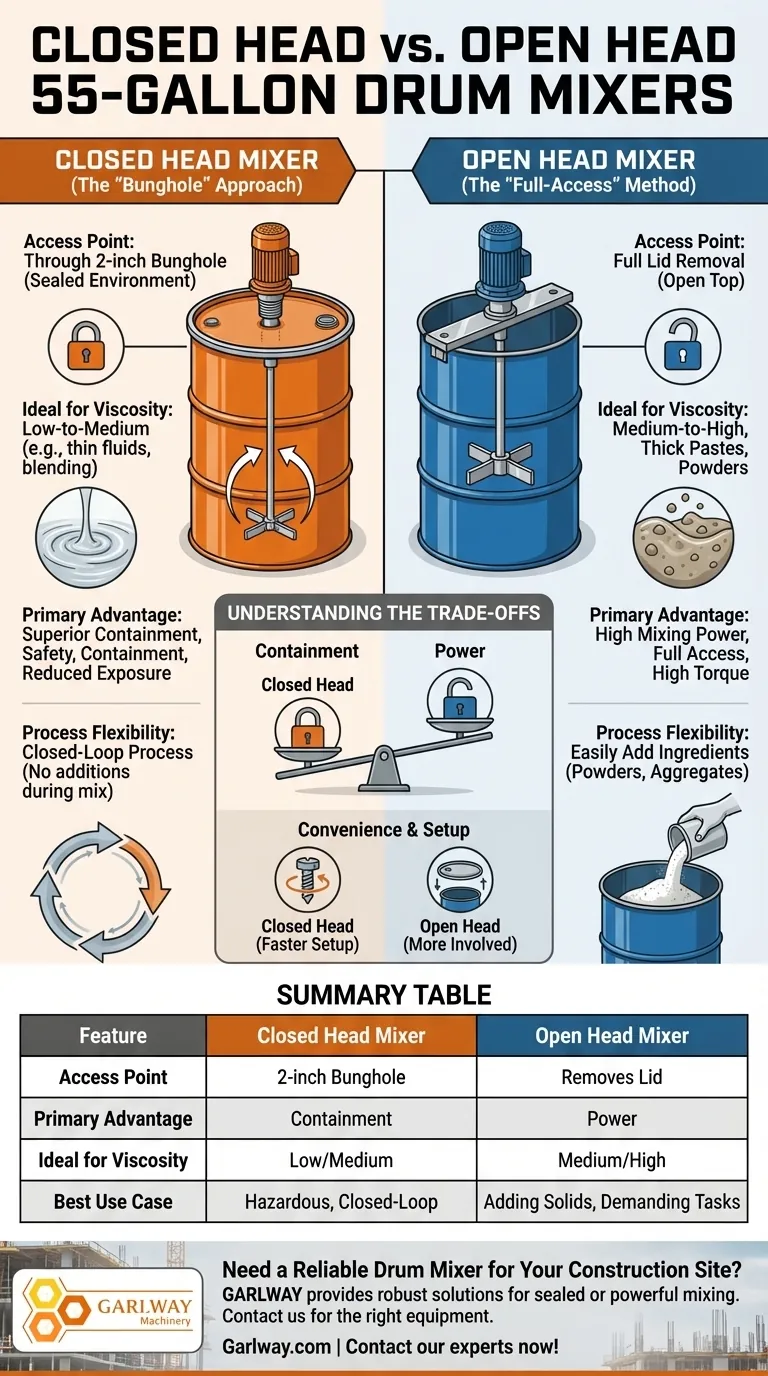
Visual Guide
Related Products
- Belle Mixer Drum Self Loading Mortar Mixers JS3000
- Concrete Cement Mixer Machine Drum Mixer for Construction
- JDY350 Electric Hydraulic Mortar Mud Concrete Mixer
- JS1000 Volumetric Concrete Mortar Mixer for Sale Skid Steer Cement Mixer
- JDC350 Small Cement Concrete Mortar Mixer
People Also Ask
- What are the features of mobile transporting in a self loading mixer? Boost On-Site Efficiency
- Why is timely cleaning important for a self loading mixer? Prevent Costly Downtime and Mix Failure
- How is discharging accomplished in a self loading mixer? Master Precise Concrete Placement
- What is the purpose of keeping the drum rotating during transportation in a self loading concrete mixer? Ensure Quality & Consistency
- What components are involved in the loading process of a self loading concrete mixer? A Guide to the Key Systems