
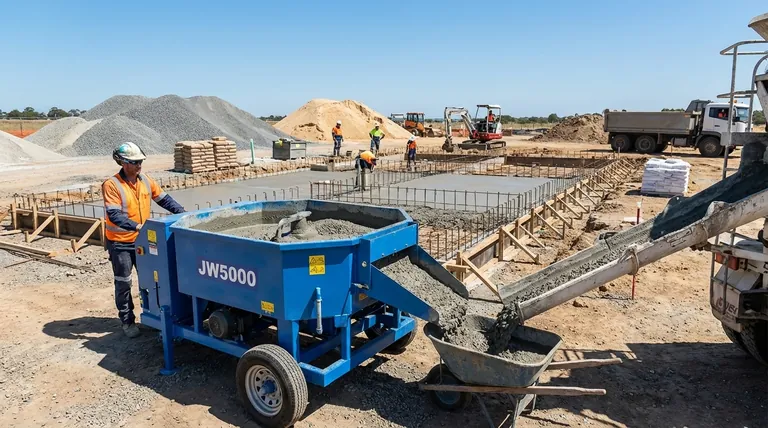
For any project larger than a simple patch, the best tool for mixing cement is a mechanical cement mixer. These machines automate the strenuous process of combining cement, aggregate, and water, ensuring a far more consistent and high-quality concrete than is achievable by hand.
The core issue with mixing concrete is achieving a perfectly uniform, or "homogeneous," mixture. Manual methods are physically demanding and often result in weak spots, whereas a mechanical mixer guarantees a high-quality, properly blended concrete with minimal effort.
Why Mechanical Mixing is the Standard
Relying on a shovel and wheelbarrow is a common starting point, but it introduces significant risk and effort into a project. Understanding the advantages of a machine clarifies why it's the professional standard.
The Problem with Manual Mixing
Manually mixing concrete is exhausting and notoriously difficult to get right. It's challenging to ensure every grain of sand and piece of gravel is evenly coated with cement paste, often leading to an inconsistent final product.
This lack of uniformity can create pockets of weakness in the cured concrete, compromising the structural integrity and longevity of your entire project.
The Advantage of Consistent Automation
A portable cement mixer uses a rotating drum to continuously tumble the materials. This process automates the blending, ensuring a thoroughly homogeneous mixture.
This consistency is critical because it results in superior quality concrete that cures evenly and provides predictable strength, free from the weak spots common in hand-mixed batches.
Speed and Capacity for Larger Jobs
Mechanical mixers are designed to handle significant volumes, often 12 cubic feet or more in larger models. This allows you to produce a large amount of high-quality concrete quickly.
For projects like a patio slab, foundation, or multiple fence posts, a mixer is not a luxury—it is a necessity for completing the work efficiently before the concrete begins to set.
Understanding the Trade-offs
While a mechanical mixer is superior, it's not always the required solution. The primary considerations are the scale of your project and your budget.
Cost vs. Benefit
The initial purchase of a cement mixer is a significant investment compared to a shovel. However, for contractors or serious DIYers, the time saved and the superior quality of the work quickly justify the cost. For one-off projects, renting a mixer is an excellent, cost-effective option.
The Scale Mismatch
Using a large-capacity drum mixer to blend a single bag of post-hole mix is inefficient. The tool must match the job. For extremely small repairs, hand mixing in a wheelbarrow or bucket remains a viable, if less ideal, method.
Cleanup and Maintenance
Any cement mixing tool requires immediate and thorough cleaning. Hardened concrete is extremely difficult to remove and can ruin a mixer. This is a non-negotiable step in the process, regardless of the tool you choose.
Making the Right Choice for Your Project
Selecting the best tool comes down to matching its capability to the scale and demands of your specific task.
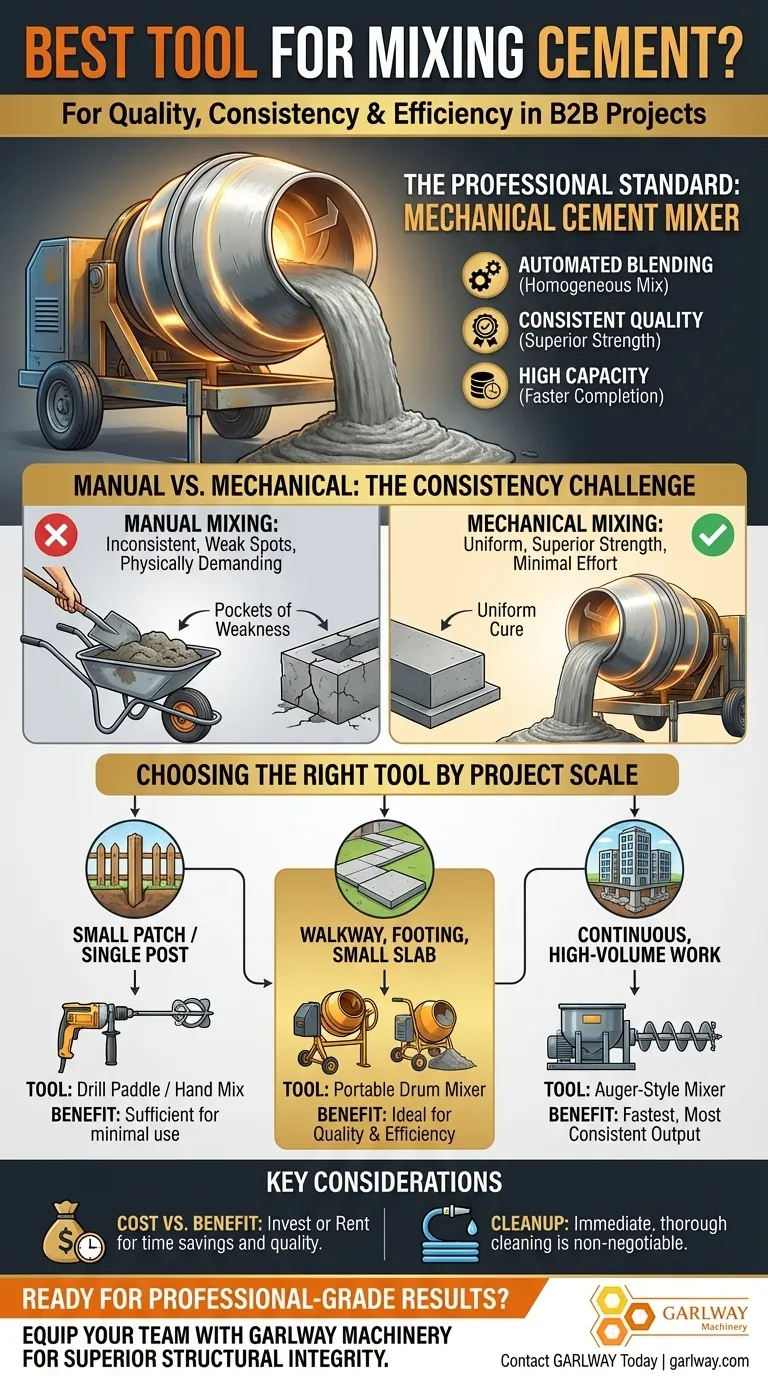
- If your primary focus is a small patch or setting a single post: Hand mixing with a shovel or using a paddle mixer attachment on a heavy-duty drill is sufficient.
- If your primary focus is a small-to-medium project like a walkway, footing, or small slab: A portable drum-style cement mixer is the ideal choice for quality and efficiency.
- If your primary focus is continuous, high-volume professional work: A specialized, high-capacity system like an auger-style mixer provides the fastest and most consistent output.
Ultimately, choosing the right tool is the first step to ensuring your concrete work is strong, durable, and successful.
Summary Table:
| Project Scale | Recommended Tool | Key Benefit |
|---|---|---|
| Small Patch / Single Post | Hand Mixing / Drill Paddle | Sufficient for minimal use |
| Walkway, Footing, Small Slab | Portable Drum Mixer | Ideal for quality & efficiency |
| Continuous, High-Volume Work | Auger-Style Mixer | Fastest, most consistent output |
Ready to achieve professional-grade concrete results?
For contractors and construction companies working on foundations, slabs, and other significant projects, a reliable cement mixer is essential. GARLWAY specializes in durable, high-performance construction machinery, including concrete mixers and batching plants designed to deliver consistent, homogeneous concrete mix for superior structural integrity.
Let us help you equip your team with the right tools for efficiency and quality. Contact GARLWAY today to discuss your project needs and find the perfect mixing solution!
Visual Guide
Related Products
- Auto Concrete Cement Mixer Machine New
- Hydraulic Concrete Mixer Machine Cement Mixing Equipment for Mixture Concrete
- Portable Electric Concrete Mixer Machine for Cement Mixing
- Portable Electric Small Cement Mixer Concrete Machine
- JS500 Electric Cement Concrete Mixer for Sale
People Also Ask
- What are the four factors to consider when selecting a concrete mixer? Optimize Your Construction Project
- What are the two main types of concrete mixers and their uses? Choose the Right Mixer for Your Project
- What is a concrete mixer and what does it do? Achieve Consistent, High-Strength Concrete
- What are the benefits of using a concrete mixer on construction sites? Boost Efficiency and Quality
- How should water be added when mixing concrete? A Guide to Achieving Perfect Strength & Workability






