The fundamental benefit of a tilting drum mixer is its ability to discharge material rapidly and with exceptional control. By simply tipping the entire drum downward, it uses gravity to pour out the mix quickly and completely. This mechanism is significantly faster and more effective than non-tilting designs, which must reverse their blade direction to slowly spiral the contents out of a fixed opening.
The core advantage of the tilting mechanism is not just speed, but its ability to handle difficult materials. It is the preferred design for discharging stiff, low-workability concrete or mixes with large aggregates that would otherwise resist unloading.
The Core Advantage: Rapid and Controlled Discharge
How Tilting Works
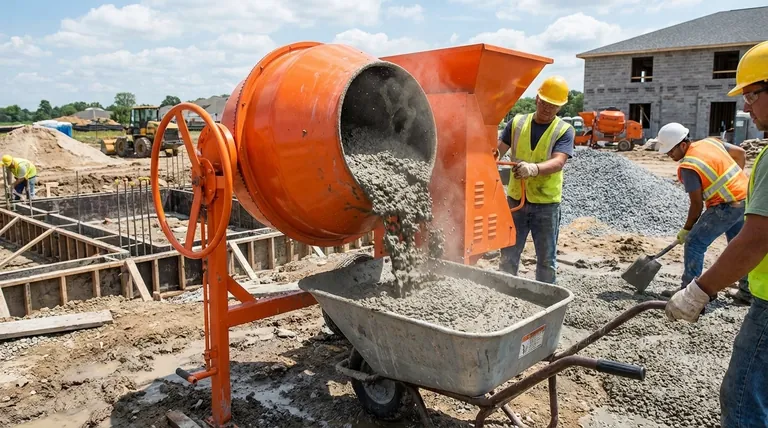
The design is straightforward. After the mixing cycle is complete, the entire drum pivots on a frame, tilting downward to pour its contents.
This simple, gravity-assisted action ensures a swift and thorough discharge directly where it is needed.
Speed and Efficiency
The ability to quickly unload a full batch is a major advantage in time-sensitive projects.
This rapid cycle time—mixing followed by a quick pour—maximizes the machine's productivity throughout the day.
Precision and Waste Reduction
The tilting action allows the operator to precisely control the flow of the mix.
This is especially useful for pouring concrete into forms or wheelbarrows at lower levels, ensuring material goes exactly where it's intended and minimizing costly spillage and waste.
Why This Matters: Optimal Use Cases
For Low-Workability Mixes
Stiff or "low-slump" concrete does not flow easily. A tilting mixer effectively forces this type of material out.
Non-tilting mixers struggle to discharge these mixes, often leaving a significant amount of material behind.
For Mixes with Large Aggregates
Concrete containing large stones or coarse aggregate can jam the smaller discharge chutes of non-tilting mixers.
The wide opening of a tilting drum allows large materials to pour out unimpeded, preventing blockages and delays.
For High-Volume Production
The combination of efficient mixing and fast unloading makes tilting drum mixers ideal for projects requiring large quantities of concrete in a short amount of time.
They are valued for their simplicity, high output, and relatively low labor requirements.
Understanding the Trade-offs
Potential for Material Sticking
One notable disadvantage is that sticky concrete or mortar can adhere to the bottom of the drum, away from the main action of the mixing blades.
This can result in a less-than-perfectly-uniform first batch if the mixer is not prepared.
The Standard Mitigation: "Buttering"
This issue is easily managed by a process called buttering the mixer.
Before mixing the first structural batch, a small amount of sand, cement, and water is mixed and discharged. This mortar coats the interior surfaces, ensuring subsequent batches mix uniformly and do not stick.
How to Make the Right Choice
Choosing the right mixer depends entirely on the demands of your project and the type of materials you use.
- If your primary focus is speed and high-volume production: The rapid discharge of a tilting drum mixer is a significant advantage for improving project efficiency.
- If your primary focus is working with stiff or coarse mixes: The tilting action is essential for ensuring complete and effective discharge of these challenging materials.
- If your primary focus is general-purpose, highly flowable concrete: While still effective, the unique advantages of the tilting feature are less critical, and a simpler non-tilting model may suffice.
Ultimately, understanding your material's properties is the key to selecting the most effective and efficient mixer for the job.
Summary Table:
| Benefit | Key Advantage |
|---|---|
| Rapid Discharge | Gravity-assisted tilting unloads mix faster than reversing blade designs. |
| Handles Stiff Mixes | Effectively discharges low-slump concrete that resists unloading. |
| Manages Large Aggregates | Wide opening prevents jams from stones or coarse materials. |
| High-Volume Efficiency | Quick cycle times maximize productivity for large projects. |
| Precision & Waste Reduction | Controlled pouring minimizes spillage when filling forms or wheelbarrows. |
Ready to Boost Your Project's Efficiency with the Right Mixer?
GARLWAY specializes in durable construction machinery, offering a range of tilting drum concrete mixers designed for contractors and construction companies who need reliable, high-performance equipment.
We can help you select the perfect mixer to handle your specific materials—whether it's stiff concrete, large aggregates, or high-volume production—ensuring faster cycle times and less waste on your job site.
Contact GARLWAY today for a consultation and discover how our mixers can deliver superior performance and value for your business.
Visual Guide
Related Products
- Concrete Cement Mixer Machine Drum Mixer for Construction
- Belle Mixer Drum Self Loading Mortar Mixers JS3000
- Portable Cement Mixer with Lift Concrete Machine
- Skid Steer Self Loading Concrete Mixers for Construction
- Shaft Mixer Machine for Cement and Regular Concrete Mixing
People Also Ask
- What are the key advantages of using drum mixers in concrete mixing? Boost Volume & Efficiency on Your Site
- What are the key components that maintain concrete mix consistency in the drum? Ensure Uniform Quality from Plant to Site
- How do cement mixers enhance safety on construction sites? Reduce Strain, Hazards, and Accidents
- When was the first concrete mixer developed and by whom? Discover the 1900 Breakthrough
- What is the average lifespan of a concrete mixer? Maximize Your Equipment's Lifespan & ROI