
Selecting the right electric winch is a critical decision that balances power, safety, and the specific demands of your task. The most important factors to consider are the winch's load capacity, its power source, the type of rope it uses, and the environment in which you'll be operating.
Your goal is not simply to buy the strongest winch, but to select a precise tool that perfectly matches your real-world working conditions. A mismatched winch is inefficient at best and a serious safety hazard at worst.
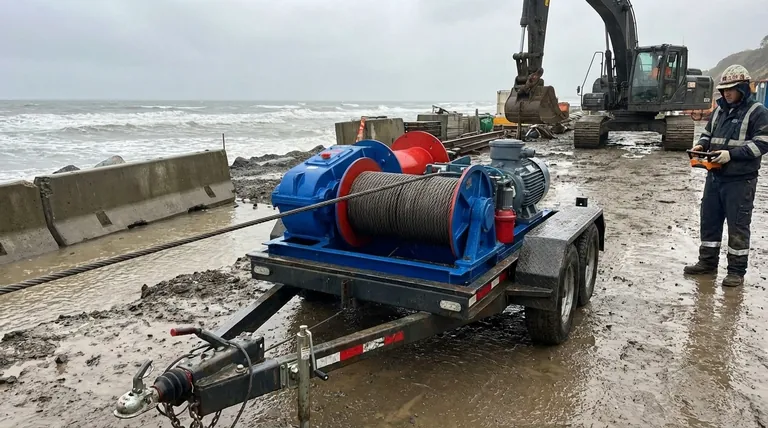
First, Define Your Mission: Application and Environment
Before you can evaluate specifications, you must have a crystal-clear understanding of the job your winch will perform. This context dictates every subsequent choice.
Horizontal Pulling vs. Vertical Lifting
The fundamental purpose of the tool is the first distinction. An electric winch is primarily designed for horizontal pulling, such as recovering a vehicle or moving heavy equipment across the ground.
In contrast, an electric hoist is specifically engineered for vertical lifting. Hoists incorporate more precise braking systems and safety factors essential for safely suspending loads overhead.
The Impact of Your Operating Environment
Consider where the winch will live and work. A winch used in a clean, dry workshop has very different needs from one mounted on a vehicle and exposed to the elements.
Look for ratings that indicate resistance to dust and water (IP ratings). For marine or coastal use, materials resistant to salt-water corrosion are essential.
Matching the Power Source to Your Setup
Electric winches are typically powered in one of two ways. DC-powered winches run off a vehicle's battery, making them ideal for mobile applications like off-roading.
AC-powered winches plug into a standard electrical outlet, offering consistent power for fixed locations like workshops, construction sites, and factories.
Decoding the Core Performance Metrics
With your mission defined, you can now translate your needs into technical specifications. These numbers are the language of the winch.
Calculating Your Required Load Capacity
Load capacity is the single most important safety factor. A common, reliable rule for vehicle recovery is to choose a winch with a capacity of at least 1.5 times the gross vehicle weight (GVW).
For other applications, carefully calculate the maximum weight you will ever need to pull. Always include a significant safety margin to avoid overloading the motor and drivetrain.
Line Speed: The Balance of Power and Time
Line speed, measured in feet per minute (FPM), tells you how quickly the winch can pull in its rope. This is often listed under both a "full load" and a "no load" condition.
A faster line speed is more efficient for long pulls, but power and capacity should never be sacrificed for speed.
The Drivetrain and Brake
The motor's power is transferred through a series of gears known as the drivetrain. A reliable drivetrain ensures smooth power delivery.
Equally important is the automatic brake. This mechanism engages the instant you stop pulling, preventing the load from slipping backward. This is a non-negotiable safety feature.
Understanding the Trade-offs: Key Component Choices
Two winches with the same capacity can perform very differently based on their components. Understanding these choices is key to selecting the right tool.
Rope Type: Steel vs. Synthetic
This is a critical decision with significant trade-offs. Steel rope is extremely durable, abrasion-resistant, and less expensive. However, it is heavy, can develop sharp burrs, and stores a tremendous amount of kinetic energy if it snaps, making it dangerous.
Synthetic rope is lightweight, flexible, and much safer if it breaks, as it stores less energy. Its downsides are a higher cost and a vulnerability to abrasion and UV damage if not properly cared for.
The Control System: Wired vs. Wireless
A wired remote provides a foolproof connection directly to the winch, eliminating concerns about battery life or interference.
A wireless remote offers superior flexibility, allowing you to operate the winch from a safer distance with a better vantage point of the entire operation.
Essential Safety Features
Beyond the brake, look for features like overload protection, which can prevent motor burnout, and an accessible emergency stop function. These are crucial for preventing accidents and equipment damage.
Making the Right Choice for Your Goal
Ultimately, your choice should be a direct reflection of your primary objective. Use these guidelines to finalize your decision.
- If your primary focus is vehicle recovery: Choose a DC-powered winch with a capacity of at least 1.5x your vehicle's weight, and carefully weigh the safety benefits of synthetic rope against the durability of steel.
- If your primary focus is workshop or industrial pulling: An AC-powered winch with a high-quality drivetrain, reliable brake, and wired remote for dependability is your best choice.
- If your primary focus is vertical lifting: Do not use a winch. You must purchase an electric hoist specifically designed and rated for overhead loads.
By aligning these technical factors with your specific mission, you ensure your winch is a reliable tool, not a potential liability.
Summary Table:
| Key Factor | Why It Matters | Quick Guide |
|---|---|---|
| Load Capacity | Determines safe working limits; prevents overloading. | Choose at least 1.5x your vehicle's GVW for recovery. |
| Power Source | Matches your setup: mobile (DC) or fixed (AC). | DC for vehicles; AC for workshops/construction sites. |
| Rope Type | Balances durability, safety, and weight. | Steel for abrasion resistance; synthetic for safety & lightness. |
| Operating Environment | Ensures longevity and reliability. | Check IP ratings for dust/water resistance; use corrosion-resistant materials. |
| Safety Features | Protects operators and equipment. | Look for automatic brakes, overload protection, and emergency stops. |
Ready to select the perfect electric winch for your project?
At GARLWAY, we specialize in providing robust construction machinery, including electric winches, concrete mixers, and batching plants, tailored for construction companies and contractors worldwide. Our experts can help you match the right winch to your specific needs—ensuring safety, efficiency, and reliability on every job.
Contact us today for a personalized consultation and discover how GARLWAY can power your success!
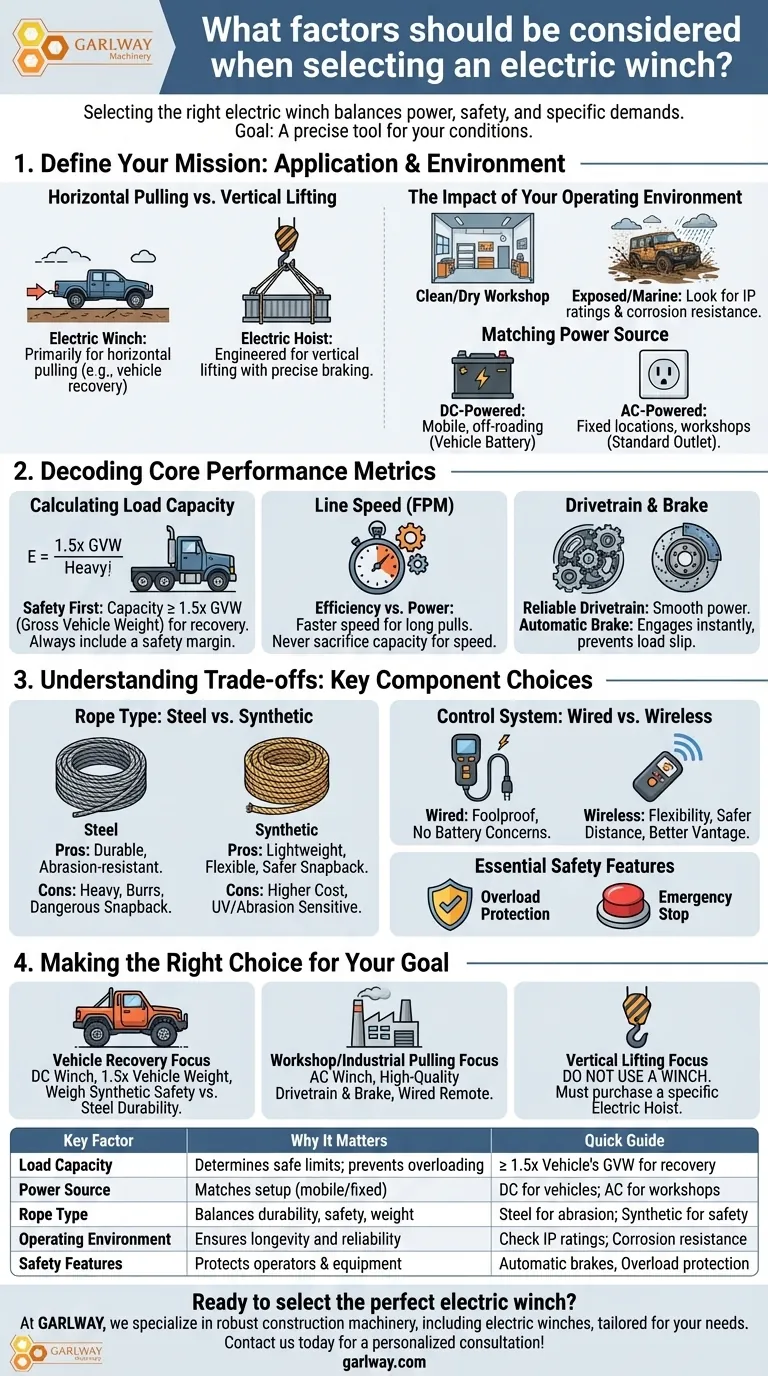
Visual Guide
Related Products
- Electric 120V Boat Winch by Badlands
- Electric and Hydraulic Winch for Heavy Duty Applications
- Small Electric Winch 120V and 240V for Compact Applications
- 12000 lb Electric Boat Trailer Winch with Windlass Anchor Warn
- Electric Hoist Winch Boat Anchor Windlass for Marine Applications
People Also Ask
- How do electric boat winches work? Unlock Effortless Launching & Retrieval
- How much current does an electric boat winch draw? Plan Your Electrical System for Peak Performance
- Can I run a winch straight from a battery? Essential Power Setup for Safe Operation
- What are the types of electric winches available? Choose the Right Winch for Your Job
- What are the uses of electric winches in mining and tunneling? Enhance Safety and Efficiency Underground





