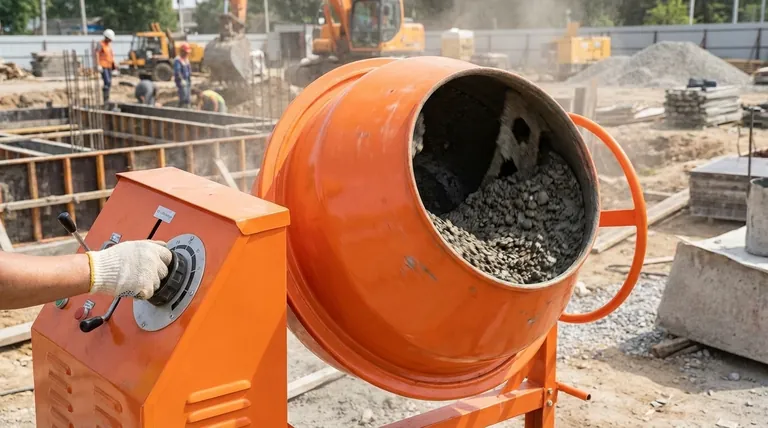
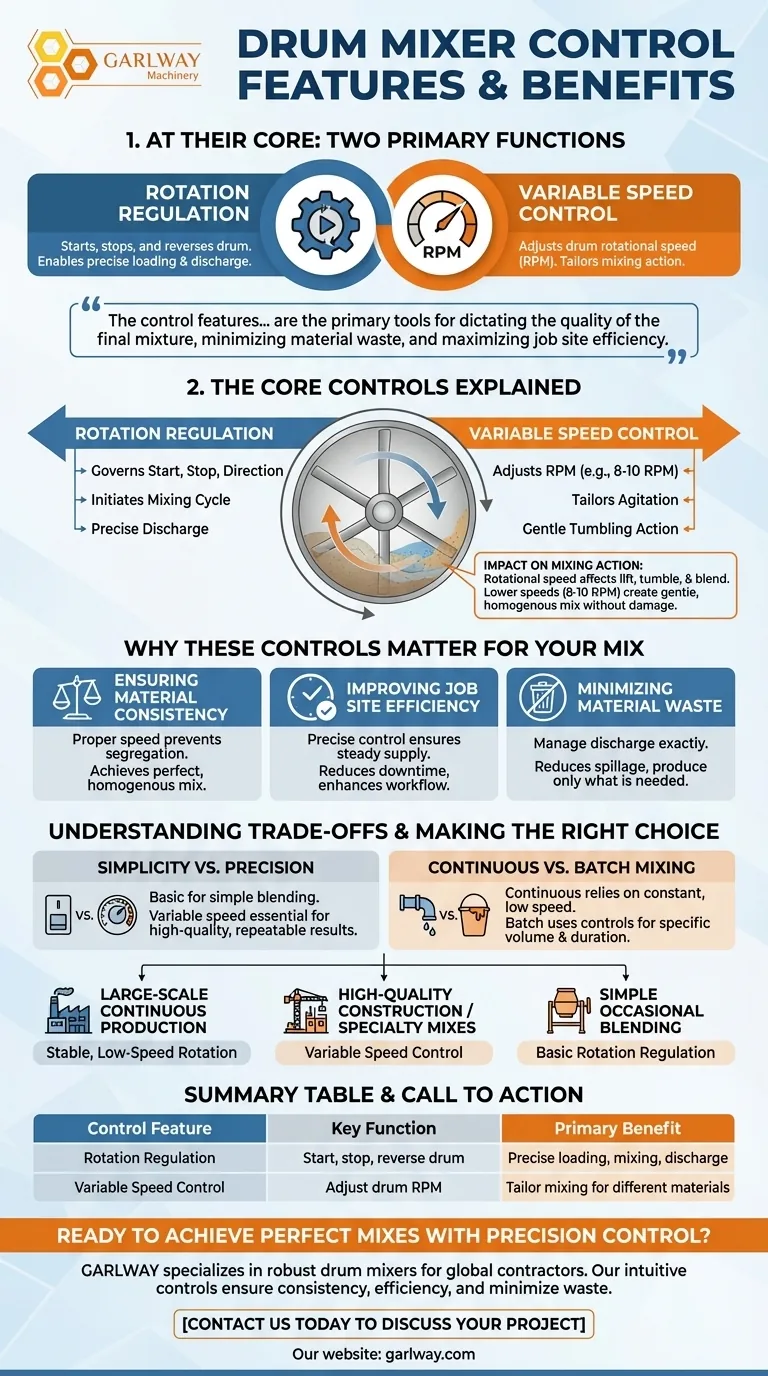
At their core, drum mixers are equipped with a control panel that provides two primary functions: rotation regulation (starting, stopping, and sometimes reversing the drum) and variable speed control (adjusting the rotational speed in revolutions per minute). These features are fundamental to managing the mixing process.
The control features on a drum mixer are not merely operational switches; they are the primary tools for dictating the quality of the final mixture, minimizing material waste, and maximizing job site efficiency.
The Core Controls Explained
Understanding how each control function influences the mixing process is key to achieving a consistent and high-quality result. While seemingly simple, their impact is significant.
Rotation Regulation
This is the most fundamental control. It governs the start, stop, and sometimes the direction of the drum's rotation. This allows the operator to load ingredients, initiate the mixing cycle, and discharge the finished material precisely when needed.
Variable Speed Control
This feature allows the operator to adjust the Revolutions Per Minute (RPM) of the drum. Different materials and mix designs require different levels of agitation. The ability to change the speed is critical for tailoring the process to the specific requirements of the job.
The Impact on Mixing Action
The drum's interior is fitted with mixing flights (blades or fins). The rotational speed directly affects how these flights lift, tumble, and blend the materials. A slower speed, often around 8-10 RPM, creates a gentle tumbling action suitable for many applications, ensuring a homogenous mix without damaging the ingredients.
Why These Controls Matter for Your Mix
Effective control moves beyond simple operation and directly contributes to the quality of the final product and the efficiency of the entire workflow.
Ensuring Material Consistency
Proper speed control is crucial for achieving a homogenous mixture. If the speed is too high, centrifugal force can cause materials to segregate. If it's too slow, the blend may be incomplete. Variable speed allows you to find the optimal point for a perfect mix.
Improving Job Site Efficiency
Precise control over the mixing process ensures a steady and predictable supply of material. As seen with mobile mixers, this capability reduces project downtime, improves overall construction quality, and enhances workflow on the job site.
Minimizing Material Waste
By allowing the operator to manage the mixing and discharge process exactly, these controls significantly reduce spillage and waste. You produce only what you need, when you need it, ensuring that every batch meets quality standards.
Understanding the Trade-offs
While more control is often better, it's important to match the mixer's features to the complexity of your task.
Simplicity vs. Precision
A basic mixer with simple on/off rotation regulation is sufficient for straightforward blending tasks. However, for applications demanding high-quality, repeatable results, a mixer with variable speed control is essential for achieving the necessary precision.
Continuous vs. Batch Mixing
The control philosophy can differ based on the mixer type. Continuous mixers rely on a constant, low-speed rotation to blend materials as they flow from an inlet to an outlet. In contrast, batch mixers use controls to manage a specific volume of material for a set duration.
Making the Right Choice for Your Goal
Select a drum mixer based on the level of control your application demands.
- If your primary focus is large-scale, continuous production: A mixer with stable, low-speed rotation controls is essential for maintaining a consistent flow and residence time.
- If your primary focus is high-quality construction or specialty mixes: Variable speed control is non-negotiable for adapting to different material requirements and minimizing waste.
- If your primary focus is simple, occasional blending: A mixer with basic rotation regulation (start/stop) will likely meet your needs effectively and economically.
Mastering your mixer's controls is the key to transforming raw ingredients into a perfectly consistent final product.
Summary Table:
| Control Feature | Key Function | Primary Benefit |
|---|---|---|
| Rotation Regulation | Start, stop, and reverse the drum | Precise loading, mixing, and discharge control |
| Variable Speed Control | Adjust drum RPM (e.g., 8-10 RPM) | Tailor mixing action for different materials |
Ready to achieve perfect mixes with precision control?
GARLWAY specializes in construction machinery, offering robust and reliable drum mixers for construction companies and contractors globally. Our mixers are designed with the intuitive controls you need to ensure material consistency, improve job site efficiency, and minimize waste.
Contact us today to discuss your project requirements and find the ideal mixer for your needs!
Visual Guide
Related Products
- Belle Mixer Drum Self Loading Mortar Mixers JS3000
- Concrete Cement Mixer Machine Drum Mixer for Construction
- JDY350 Electric Hydraulic Mortar Mud Concrete Mixer
- Construction Products Concrete Plant Machine Mixing Concrete Mixer
- Harbor Freight JS1500 On Site Concrete Mixing Volumetric Cement Mixer
People Also Ask
- What are the features of mobile transporting in a self loading mixer? Boost On-Site Efficiency
- Why is timely cleaning important for a self loading mixer? Prevent Costly Downtime and Mix Failure
- How is discharging accomplished in a self loading mixer? Master Precise Concrete Placement
- What is the purpose of keeping the drum rotating during transportation in a self loading concrete mixer? Ensure Quality & Consistency
- What components are involved in the loading process of a self loading concrete mixer? A Guide to the Key Systems