
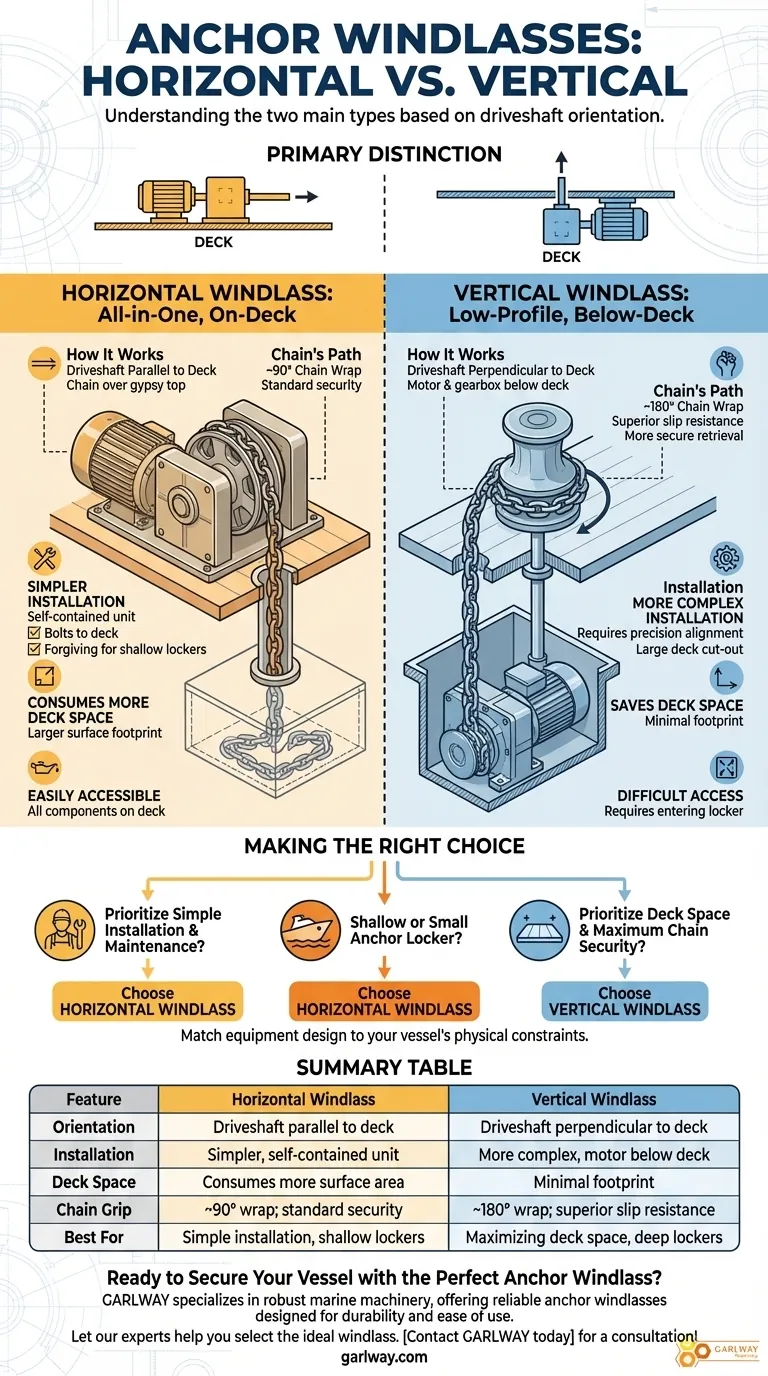
The two primary types of anchor windlasses are horizontal and vertical. This distinction is based on the orientation of the main driveshaft that turns the gypsy—the notched wheel that grips the anchor chain. A horizontal windlass mounts the entire unit on the deck, while a vertical windlass places the motor and gearbox below the deck, creating a lower profile on top.
The choice between a horizontal and vertical windlass is not a matter of simple preference. It is a critical engineering decision dictated by your vessel's available deck space, the size and depth of your chain locker, and the complexity of installation you are willing to undertake.
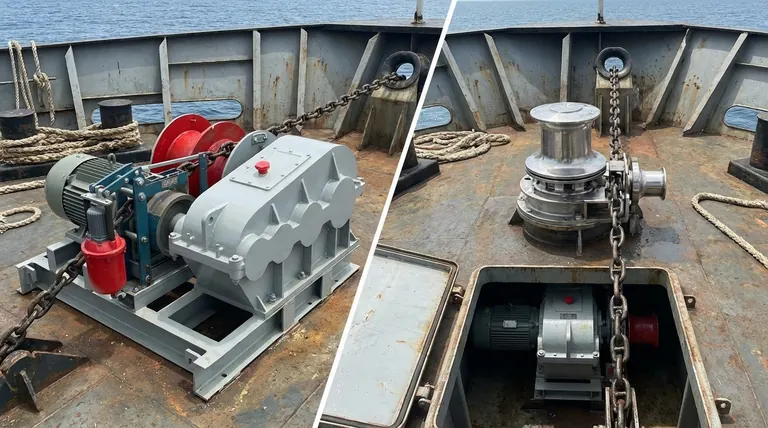
The Horizontal Windlass: All-in-One and On-Deck
A horizontal windlass is a self-contained unit where the motor, gearbox, and gypsy are all housed together and mounted horizontally on the deck.
How It Works
The main shaft is parallel to the boat deck. As the anchor chain is retrieved, it runs over the top of the gypsy.
The Chain's Path
The chain engages with the gypsy over approximately 90 degrees of its surface before making a sharp downward turn into the chain locker through the deck pipe.
Primary Advantages
Because the entire mechanism is above deck, installation is typically simpler, often requiring only a few mounting bolts and one hole for the chain to pass through. This design is also more forgiving for boats with shallow anchor lockers.
The Vertical Windlass: Low-Profile and Below-Deck
A vertical windlass features a driveshaft oriented perpendicular to the deck. This allows the bulk of the machinery to be installed out of sight.
How It Works
Only the gypsy (and often a capstan drum for handling rope) is visible on deck. The motor and gearbox are mounted directly below it inside the anchor locker.
The Chain's Path
The chain wraps around the gypsy for a much greater arc—closer to 180 degrees. This provides significantly more contact and grip, reducing the chance of the chain slipping or "jumping" under load. It then feeds directly down into the locker.
Primary Advantages
This design has a minimal footprint, freeing up valuable deck space. The superior chain wrap offers more secure and controlled anchor retrieval, which is a key safety benefit.
Understanding the Trade-offs
Neither design is inherently superior; they simply solve different problems. The best choice depends entirely on your vessel's architecture.
Installation Complexity
A horizontal windlass is far simpler to install. It is a self-contained unit that bolts to the deck.
A vertical windlass requires more complex installation, with a large hole cut for the driveshaft and motor, precise alignment between the deck unit and the below-deck machinery, and careful wiring in a potentially tight space.
Space Requirements
The horizontal windlass consumes more surface area on the deck but requires very little space below.
The vertical windlass is the opposite. It saves deck space but demands significant vertical clearance inside the chain locker to accommodate the motor and gearbox, as well as to allow gravity to properly flake the chain.
Maintenance and Access
All components of a horizontal windlass are easily accessible on the deck for routine maintenance and service.
Servicing the motor and gearbox of a vertical windlass requires climbing into the anchor locker, which can be a difficult and confined task on many boats.
Making the Right Choice for Your Boat
Your boat's design will guide your decision. Analyze your bow configuration and anchor locker before choosing a windlass type.
- If your primary focus is simple installation and maintenance: The self-contained, on-deck nature of a horizontal windlass is the clear choice.
- If your primary focus is preserving deck space and achieving maximum chain security: A vertical windlass is the better option, provided you have adequate below-deck volume.
- If you have a shallow or small anchor locker: A horizontal windlass is almost always the only practical solution, as it doesn't intrude on that limited space.
Ultimately, selecting the right windlass is about matching the equipment's design to the physical constraints of your vessel.
Summary Table:
| Feature | Horizontal Windlass | Vertical Windlass |
|---|---|---|
| Orientation | Driveshaft parallel to deck | Driveshaft perpendicular to deck |
| Installation | Simpler, self-contained unit on deck | More complex, motor/gearbox below deck |
| Deck Space | Consumes more surface area | Minimal footprint, saves deck space |
| Chain Grip | ~90° wrap; standard security | ~180° wrap; superior slip resistance |
| Best For | Simple installation, shallow lockers | Maximizing deck space, deep lockers |
Ready to Secure Your Vessel with the Perfect Anchor Windlass?
Choosing between a horizontal and vertical windlass is a critical decision for safety and performance. GARLWAY specializes in robust marine and construction machinery, offering reliable anchor windlasses designed for durability and ease of use. Whether you're a commercial operator or a dedicated boat owner, our equipment is engineered to meet your specific needs.
Let our experts help you select the ideal windlass for your boat's design. Contact GARLWAY today for a consultation and ensure your anchoring system is up to the task!
Visual Guide
Related Products
- Electric Hoist Winch Boat Anchor Windlass for Marine Applications
- Heavy Duty Electric Boat Winch Windlass Anchor
- 12000 lb Electric Boat Trailer Winch with Windlass Anchor Warn
- Quick Windlass Portable Winch for Truck and Boat Best Boat Winch
- Warn Winch Windlass Boat Trailer Winch
People Also Ask
- How does an electric anchor winch work? Power, Safety, and Reliable Operation Explained
- What are the advantages of installing an electric anchor winch on a boat? Boost Safety & Ease for Boaters
- What are the operational differences between electric hoists and winches? A Guide to Safe Lifting vs. Pulling
- What are the main benefits of a boat anchor winch? Boost Safety & Efficiency for Your Vessel
- How does a boat anchor winch work? A Guide to Reliable Anchor Handling


