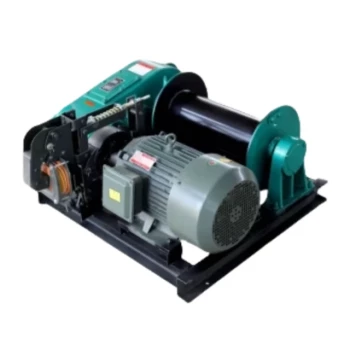
The two primary systems of winding gear used in mining and shaft operations are drum winding and Koepe (or friction) winding. Drum winders operate by spooling the entire length of the winding rope onto a large drum, similar to a massive fishing reel. In contrast, the Koepe system uses a friction-driven wheel to move the rope, which simply passes over the wheel without being stored on it.
The choice between a drum winder, which physically stores the rope, and a Koepe winder, which moves the rope via friction, is a fundamental engineering decision driven primarily by the depth of the mine shaft and the operational payload.
The Core Function of Winding Gear
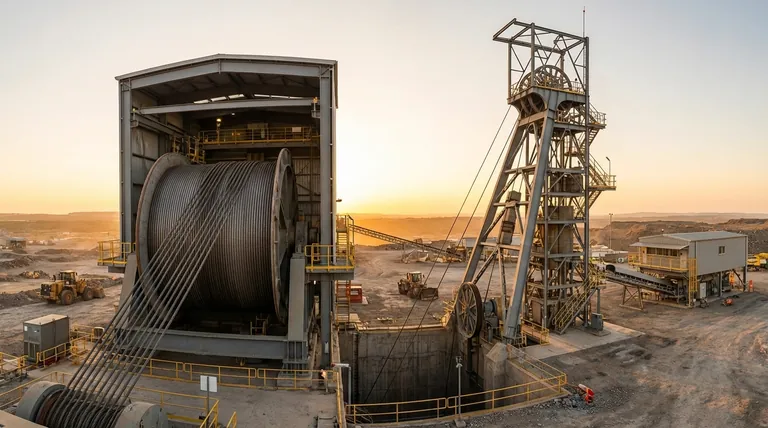
Winding gear, or a hoist, is the essential machinery that moves conveyances like cages (for personnel) or skips (for materials) up and down a vertical mine shaft. Regardless of the system type, several key components are always present.
Key Components
The winding engine or motor provides the power. This power is transmitted through gearing to the rope via either a drum or a Koepe wheel.
The entire system is housed in a winder house on the surface, with the rope running over a sheave wheel at the top of a headframe, the tall steel structure situated directly over the shaft.
System 1: Drum Winding
The drum winder is the more traditional of the two systems. Its principle of operation is direct and mechanically straightforward.
The Principle of Operation
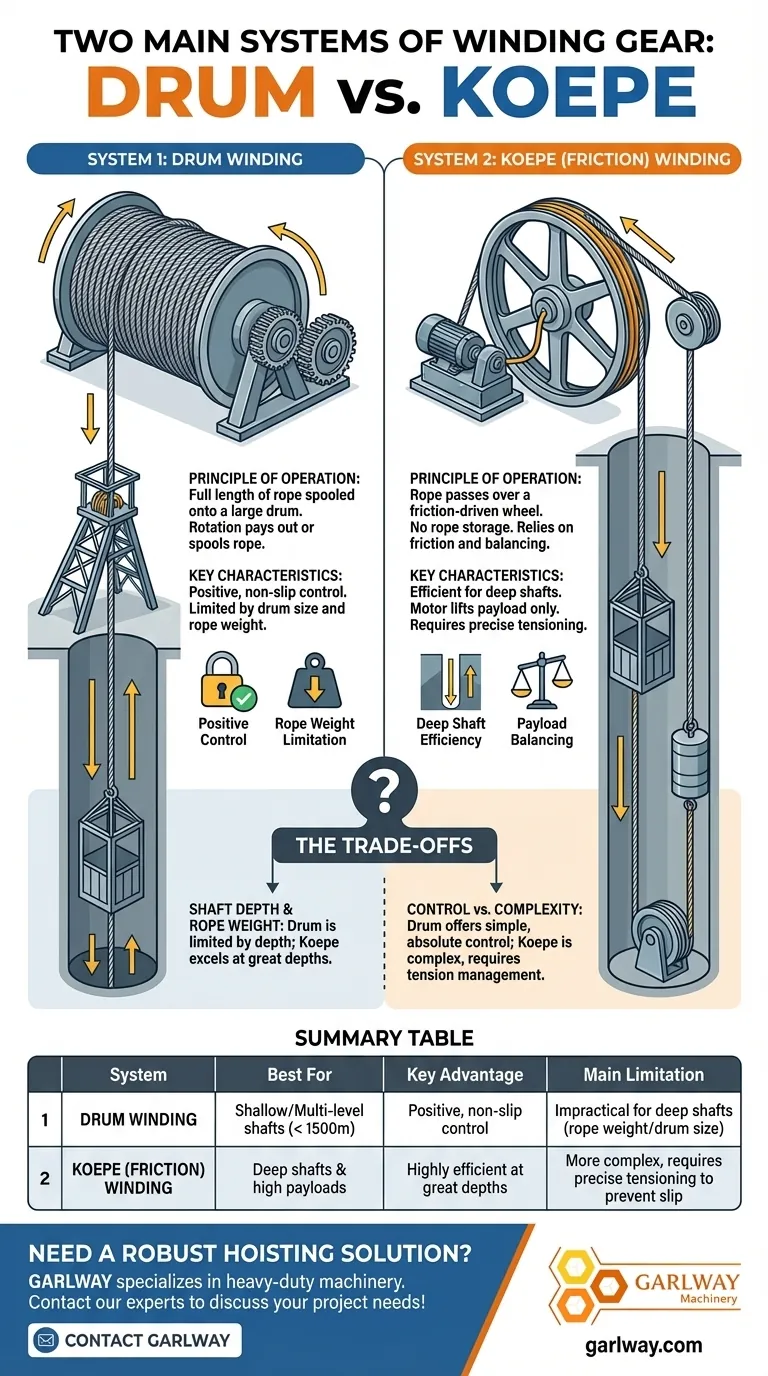
In this system, the full length of the winding rope required to reach the bottom of the shaft is securely attached to and wound around a large cylindrical or bi-cylindroconical drum. As the drum rotates in one direction, it pays out the rope, lowering the cage or skip; rotating in the other direction spools the rope back onto the drum, raising it.
Key Characteristics
This method provides positive, non-slip control over the conveyance's position in the shaft because the rope is physically fixed to the drum. The size of the drum, however, must be large enough to accommodate the entire rope, which can become a significant limitation.
System 2: Koepe (Friction) Winding
Developed to overcome the depth limitations of drum winders, the Koepe system is the standard for modern deep-shaft mining.
The Principle of Operation
The Koepe system does not store the rope. Instead, the rope passes over a single, large-diameter wheel (the Koepe pulley) that has special friction-lining grooves.
The system relies on the friction between the rope and the pulley lining to transmit power. A cage or skip is attached to one end of the rope, and a counterweight (or a second conveyance) is attached to the other, balancing the load and ensuring sufficient tension for the friction drive to work.
Key Characteristics
This design is far more efficient for deep shafts because the motor only has to lift the payload, not the immense weight of the steel rope itself. The weight of the rope on the descending side helps lift the rope on the ascending side.
Understanding the Trade-offs
Choosing between these two systems involves a clear set of engineering trade-offs based on the specific demands of the mine.
Shaft Depth and Rope Weight
Drum winders are limited by depth. As a shaft gets deeper, the rope gets longer and heavier, requiring an impractically large and heavy drum to store it.
Koepe winders excel at great depths. Because the rope weight is balanced, the system is not constrained by the need to store and lift the rope itself, only the payload.
Control vs. Complexity
The drum winder offers absolute position control with no risk of rope slippage, making it a robust and simple choice for shallower, multi-level shafts.
The Koepe system is more complex, requiring precise tensioning, balance ropes, and management of potential rope slip. However, its efficiency and suitability for deep shafts make this complexity necessary and worthwhile.
Making the Right Choice for Your Application
Your operational goal is the determining factor when selecting a winding system.
- If your primary focus is shallower shafts (under ~1500 meters) or multi-level access: A drum winding system offers robust, positive control with simpler mechanical requirements.
- If your primary focus is maximizing depth and payload capacity: The Koepe (friction) winding system is the definitive industry standard, as it overcomes the fundamental limitations of rope weight and drum size.
Ultimately, the correct system is the one that safely and efficiently meets the unique geological and production demands of the shaft.
Summary Table:
| System | Best For | Key Advantage | Main Limitation |
|---|---|---|---|
| Drum Winding | Shallow/Multi-level shafts (< 1500m) | Positive, non-slip control of conveyance | Impractical for very deep shafts due to rope weight/drum size |
| Koepe (Friction) Winding | Deep shafts & high payloads | Highly efficient at great depths; no need to store/lift rope weight | More complex, requires precise tensioning to prevent slip |
Need a robust hoisting solution for your mining or construction project? GARLWAY specializes in heavy-duty machinery, offering reliable winches and concrete equipment for contractors globally. Our engineering expertise can help you select the right system for your depth and payload requirements. Contact our experts today to discuss your project's specific needs!
Visual Guide
Related Products
People Also Ask
- What role does hydraulic fluid play in hydraulic winches? It's the Lifeblood of Your Heavy-Duty Pulling Power
- What vehicles commonly use hydraulic winches? For Industrial Trucks Needing Unmatched Power
- What are the features of hydraulic winches? Unmatched Power and Continuous Duty for Heavy Loads
- What preventive measures can be taken to avoid oil leakage in hydraulic winches? Ensure Long-Term Reliability
- What does 'power out' mean in a hydraulic winch? Achieve Absolute Control When Lowering Heavy Loads